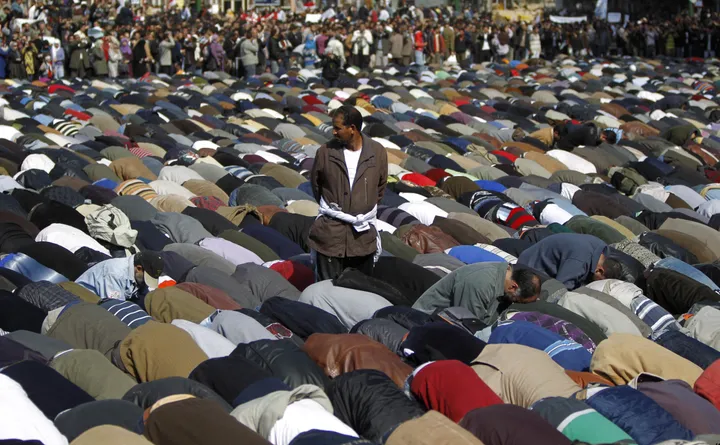
During my visit to Cairo last month, I witnessed an incident that today seems almost prophetic. At one of Cairo's posh coffee shops, I saw a customer screaming at the young man serving him, claiming that the waiter had shown him disrespect. The young worker responded firmly, "I did nothing wrong. You yelled at me." "Do you know who I am?" the customer slammed back. He then went on to demand that the café manager reprimand the worker publicly, by, in the customers' words, "dragging the dog's honor in the dirt."
Anyone familiar with Cairo has seen this scenario too many times: a member of the "protected" upper class elite abuses a member of the working class for a trivial perceived offense. What came next however was new. Instead of cowering into an apology, the young worker looked his accuser in the eye and said, "You're not God. I'm not your subordinate. I'm a person just like you."
Many Western analysts and media outlets are attempting to force categorize Egypt's uprising as either a secular demand for democracy (which we should therefore support) or a religious revolution (which we should fear and try to stop). Neither depiction captures the complexity or the opportunity of this historical moment in Egypt. To truly partner with the Egyptian people, as President Obama recently promised, U.S. policymakers must first develop a far more sophisticated understanding of Egyptian aspirations.
Ordinary Egyptians' growing sense of self worth fuels the current popular anti-government uprising, not any political ideology or charismatic leader. It is a belief that citizens should no longer have to endure the daily humiliation of economic and political stagnation. The protesters represent a wide cross section of Egyptian society who demand justice, as they call for Muslim-Christian solidarity. They wave Egyptian flags, not specific opposition party banners or sectarian symbols.
At the same time, Egyptians' rising religiosity may very well play a role in this development, just as faith often animated our own civil rights struggle. If Tunisia's success story was the match that ignited Egypt's popular uprising, decreased tolerance for injustice -- in some cases born out of a religious awakening -- provided the fuel. Gallup found that Egyptians were the most likely in the region to say moving toward greater democracy would help Muslims progress, and the most likely to agree that attachment to spiritual and moral values would similarly lead to a brighter future. This duality stands strong in the country with the highest percentage of people in the world affirming that religion is an important part of their daily lives. Surveys show that Egyptians prefer democracy over all other forms of government. They also say that religion plays a positive role in politics.
The majority of Egyptians want democracy and see no contradiction between the change they seek and the timeless values to which they surrender. More than 90 percent of Egyptians say they would guarantee freedom of the press if it were up to them to write a constitution for a new country. Moreover, most Egyptians say they favor nothing more than an advisory role for religious leaders in the crafting of legislation. Egyptians choose democracy informed by sacred values, not theocracy with a democratic veneer.
U.S. policy makers would do well to embrace this nuance, which to us as Americans should sound familiar. From abolitionists to the civil rights movement, American leaders have drawn inspiration from their faith in their pursuit of justice. Today, some of the loudest voices in the United States calling for environmental preservation, an end to torture or global poverty eradication are faith leaders. I witnessed this first hand when serving on the White House Faith Based and Neighborhood Partnerships advisory council. Religious and secular leaders and scholars from different backgrounds sat at one table to find solutions to our country's toughest challenges, each drawing on their individual ethical tradition for the common good.
Our country's unique history and passion for social justice makes us natural partners to the Egyptian people in their struggle for a better future. Moreover, there is hunger on both sides for greater cooperation. Gallup surveys found that the majority of both Americans and Egyptians say greater interaction between Muslims and the West is a benefit not a threat, despite Egyptian disapproval of U.S. policies in their region.
The continuing popular protests in the most influential and populated Arab country may represent the future of the Middle East. U.S. policy makers cannot afford to alienate this movement by failing to understand its intricacies. Faith is a part of Egypt, but most Egyptians do not support the rule of clerics. They seek the rule of law.
Follow Dalia Mogahed on Twitter: www.twitter.com/dmogahed
Scott MacLeod: Egypt the Day After
2011 Egyptian protests - Wikipedia, the free encyclopedia
Egypt protests: The flowering of democracy, or the birth of ...
Egyptian protests intensify - Featured Articles From The Los ...
Religion's Role in Egyptian Protests May Grow - NYTimes.com
BBC News - Egypt protests escalate in Cairo, Suez and other cities
Those were indeed prophetic words. We heard them again from others, such as Wael Ghonim. They became almost a battle cry in Tahrir Square.
All revolutions, regardless of when, where, or the ideas expressed, share two words at their foundation - humiliation and dignity. Revolutions acquire intellectual direction, but at the core they are emotional and driven by passion.
As the world get flatter more people the world over are confronted with their daily humiliation - "my God, those people have more than one pair of pants!" - and demand an avenue to respect and dignity. I don't know if that waiter earned the respect of that patron, but he sure earned mine!
Reply button does not work.
If it's just a bunch of guys in long robes making up laws, then it's no different from "man-made" law, rendering yours a trick question.
=====
If you are not interested in defending Sharia law as superior to man-made law, then we don't have a disagreement.
I don't believe Sharia law is valid or that it supersedes civil law, but I am not a Muslim and Muslims are supposed to have a different opinion of Sharia law. I am aware of Muslims who are Koranists. They ignore the interpretations of others and interpret the Koran on their own.
I think it is possible to interpret the Koran in an entirely peaceful way. I have no problem with Muslims who do that.
But Sharia law does not do that.
The Muslims, Christians and Jews I have a problem with are the ones who say their sacred law must supersede civil law.
Supernatural revelation can be a myth or a parable or a rhetorical device but it is not demonstrable truth.
Rubbish. Read what the father of modern Singapore says about Islam. You can not face the truth.
He has created a modern, prosperous, muti religious and multi ethnic country in the world. There is no comparable figure in the entire muslim world. Do some introspection.
"I would say today, we can integrate all religions and races except Islam," he said in "Lee Kuan Yew: Hard Truths to Keep Singapore Going," a new book containing his typically frank views on the city-state and its future.
"I think we were progressing very nicely until the surge of Islam came and if you asked me for my observations, the other communities have easier integration -- friends, intermarriages and so on..." he stated.
"I think the Muslims socially do not cause any trouble, but they are distinct and separate," Lee added, calling on the community to "be less strict on Islamic observances."
http://www.google.com/hostednews/afp/article/ALeqM5hmM9iHjTTGwAC-MZv19__oNqX3zw?docId=CNG.4f8b988b9ebd1a5c9a9eba1574013bc8.b81
"Both Tariq Ramadan and Imam Rauf look very different via that approach, than via the "form opinion based on what anti-Islamists say" approach.
====================
Again we are speaking of writers who are trying for synthesis. They want to prove that traditional Islam and liberal democracy are not incompatible.
To do this, they must retain their bona fides as Muslims. One charge of apostasy and they are done. So they try to walk a line that will avoid that outcome. Without new fiqh, the synthesis is not possible. Either Shari or civil law is supreme. They dance around that and are very good at avoiding the direct confrontation such as Sarkozy posed.
He can say he personally opposes stoning for adultery, but he cannot say Sharia law is wrong on this. So he bows to the supremacy of Sharia law over French civil law. One has to give.
Muslims like Zuhdi Jasser realize this and openly say that Sharia law has to accommodate American law. It is just a matter of time before he is declared apostate. Ramadan and Rauf will avoid this at all cost.
I agree with Ramadan's assessment that Sarkozy was playing politician; playing to his audience.
Please Remember: Men like Tariq Ramadan and Imam Rauf know Islam ... they know it well ... they know it better than you or I ever will.
You're judging both men over the use of a single word ("deplore" in Rauf's case, and "moratorium" in Ramadan's).
What you see as "retaining their bona fides", I see as understanding and working within their own system.
"Condemning" makes for a great sound-bite on TV ... but what does it do to help solve the problem?
Zip. Zero. Nada.
A moratorium on the other hand, is an actual function within Sharia Law ... where Islamic jurists say "there's enough question of Shariah-compliance here, that it bears re-analysis".
This is exactly the approach that could lead to the law being changed.
I see men like Rauf and Ramadan as leading the charge to re-opening the gates of Itijihad, which they have both declared they intend to do.
And the more I learn of them, the more I feel confident that we will not go wrong by letting them do their work, and supporting them as we can.
I am aware of the utopian aspect of Islam. Just as in Communist theory, an Islamic society cannot be judged a failure until all the principles (of Islam or Communism) have been adopted and internalized by that society. Only then does the full effect of the utopian prediction take effect and produce the blissful state of Islam (or dictatorship of the proletariat). Christianity predicts a similar bliss when everyone accepts Christ.
Secular liberal democratic societies have no such dream of perfection. We simply accept the flaws of human nature to be what they are and try to deal with them day to day in the most humane way possible, consistent with keeping the peace and preserving as much individual liberty as possible.
Even in this inadequate thumbnail sketch, the fundamental incompatibility of the Sharia and liberal democratic approach to creating the good society is visible. Sharia is a means to an end, liberal democracy is a process without end.
Is that a fair statement of the differences?
Here's a video of the author discussing Women & Sharia Law that you might find interesting:
http://www.youtube.com/watch?v=WeqmKTd0b6M
"Most of the âreformersâ are usually fighting for either a takeover by the local socialist party or the local Islamist party. The general public will join in the stone throwing and the looting, without necessarily taking sides. Often the socialists and the Islamists will actually cooperate to bring down the dictator. They treat most of the crowd scenes as popular uprisings, which they are but not in the sense that the people will get to decide one way or another. Only that they get a chance to take part in the brief spurt of violence before being ordered to go home"
"The Islamists promise a system based on Allahâs law. Rule by moral clerics instead of greedy officials. Traditional values, benefits for families and teddy bears not named Mohammed for everyone. Itâs a scam of course. The Islamist takeover means another strongman or oligarchy. Except instead of being named General Saddam Hussein, heâll be known as the Ayatollah Khomeini. The differences are minimal. The ruling families will still sock away money in foreign banks. Loyalists will still be appointed to top positions. The bureaucracy will go on abusing and blackmailing the public. The police will still be vicious thugs. And law will be promulgated by Imams or Muftis or Mullahs, but it will still be the law that those at the top want."
http://www.eurasiareview.com/opinion/opinion-opinion/the-fall-of-the-strongmen-01022011/
How hard / maybe impossible for you to be normal with so much of poison inside.
Pakisrtan started as a secular country, assuring equal treatment to minorities, assuring gender equality, secular and modern laws, separation of state and the religion and it was the ideal Jinnah envisioned for his new country in 1947. It has travellled to the current situation with shariaa, stoning for adultery, execution for blasphemy and assasination for demanding change in blasphemy laws. It is the inexorable route for any muslim country and any claim for a different version is fictional. They can not abandon shariaa nor can they accept the notion that all religions are equal.
Am I suggesting a patriarchal society is better? Absolutely not; personally, I think a society without gender bias would be the best. All I'm saying is don't make things up.
Knowing is half the battle.
The separation of religion and state is only a facade to hide this new religion.
Nobody is allowed to question the gods in FED and we still talking about separation of religion and state.
This separation slogan is there only to make sure that Jesus, Mohammad or Mosses could not point out the immorality of this situation with growing number of poor people, vanished middle class and sick and dieing people because of super expensive medicine and health care costs and at the same time big corporation virtually own people and their lives.
There is a reason why religions, specially the ones with a sense of justice, like Islam are on the marsh.
The poor people want an ideology and religion to give them moral rights to revolt.
Not in America. Not yet.
neeeds to include real help for american indians and consciousness of native spirituality
the whitehouse needs to be more conscious of the fact that america's wealth is from the natural resources which american indians had not exploited [as distinct from ethical harvesting, sustainability] and certainly not destroyed of polluted
american indians are history [pardon the implication] but amazonians are still in possession of ancestral lands and need our help
in Congo its so chaotic i've not heard any mention of 200 tribes and 150 languages or cultures [ traditional knowledge]
intelligen tpeople in leadership need to distinquish between the goals of human rights , responsibilites, sensibilties , rule of law and what democracy actually is namely the hope that party warfare results in peace; it does not. any party is easily taken over by special interest; even in america big business is running one party and alarge part of the other
and rule of law in a democracy can result in dictatorial laws
america's constitution does not mention political parties. i do not know what constitutional legitimacy the 2 parties have
there needs to be one constitutional amendment "no cruel OR unusual punishment" and that extented into more specificity no mistreatment of human beings by agents or officials of the state [this wording is preferable to the word minority]
USA needs the Bhutan's institution of Gross domestic happiness index and England's recent legislation requiring measurments of happiness
The people who took the streets were people just like me looking for a better opportunity. They were teenagers and young adults looking for a better future. In fact most of the people were not "poor" or hungry. They were men and women.
They were people who were religious, and people who were not. They were bearded and veiled, and they were clean-shaven and wearing the latest fashions from Paris and New York.
They were Muslims and Christians. They were Egyptians, and their message was one. "Down down with Hosni Mubarak".
There were no religious slogans, there was no political representation. Which is exactly why the protests prevailed. There was no single "head" of protestors or organization that the current regime could silence. They were the Facebook and twitter generation. That's why the regime cut off the whole Internet and cell phone communication...
http://www.wearewideawake.org/index.php?option=com_content&task=view&id=1958&Itemid=241
Surveys show that Egyptians prefer democracy over all other forms of government. They also say that religion plays a positive role in politics.
===============
To Western ears, this sounds unremarkable. Until you get specific:
"In a 2007 University of Maryland poll (PDF), more than 60 percent of the populations in Egypt, Morocco, Pakistan, and Indonesia responded that democracy was a good way to govern their respective countries, while at the same time, an average of 71 percent agreed with requiring "strict application of [sharia] law in every Islamic country."
http://www.cfr.org/publication/8034/islam.html
More than 90 percent of Egyptians say they would guarantee freedom of the press if it were up to them to write a constitution for a new country.
=================
To Western readers, that means what we have in America. To an Islamist, it means severe punishment for anything construed as critical of Islam.
Umdat al-salik: (Shafii Islamic law as of 1991)
o11.0 NON-MUSLIM SUBJECTS OF THE ISLAMIC STATE (AHL AL-DHIMMA)
[âŠ]
o11.10 The agreement is also violated [when the non-Muslim]
(1) Commits adultery with a Muslim woman or marries her;
(2) Conceals spies of hostile forces;
(3) Leads a Muslim away from Islam;
(4) Kills a Muslim;
(5) Or mentions something impermissible about Allah, the Prophet (Allah bless him and give him peace), or Islam.
[...]
Typical Islamist doublespeak, a la Tariq Ramadan.