I attended two early screenings this summer of Davis Guggenheim's big-ticket education documentary, Waiting for Superman, and it touches the education reform zeitgeist. When the film unspools across America over the next weeks, I predict a massive chorus of voices echoing his entreaties for more great teachers, less union influence, and school choice.
The movie masterfully pushes the audience's emotional buttons by following five vulnerable children and their vulnerable parents who are hoping and praying for admission by lottery to privately-run, publicly-funded charter schools. The families' limited options are undeniably unjust. The post-screening Q&A sessions I attended featured Michelle Rhee, Randi Weingarten, and Geoffrey Canada, and all of them opened their comments by saying they cried through the film's final scenes.
In the closing credits, the movie plays hopeful music, and floating text assembles itself on the screen to read: "Great schools come from... you" and repeatedly encourages viewers to sign up for a text message feed.
The overarching message to movie-watchers is: CARE!!! CARE ABOUT SCHOOLS!!!
It's unassailable. So let's take a step past that. Let's assume, as a baseline, that we all care. How does a school system -- not just a few schools, but our entire national public school system -- improve? Caring isn't enough. In fact, a riled-up crowd that's hazy on details will be willing to follow just about anyone who presses home their talking points and waves the rhetorical banner of "reform."
I'm really scared that caring, well-meaning people who want justice for underserved students will follow this reform drumbeat into an irreversible abyss of privatization and high-stakes testing.
Guggenhein's front-page Huffington Post essay titled "Repeat After Me: We Can't Have Great Schools Without Great Teachers" emulates his film in its structure. Guggenheim presents his teacher bona fides by mentioning his first documentary, The First Year, which followed rookie teachers. He opens and closes with a personal, emotionally-charged narrative that informs his above-reproach talking point (Teachers are very, very important). The essay, though, is light on the actual steps we need to take to recruit, develop, and retain a new generation of great teachers.
The closest Guggenheim comes to getting specific is here:
So when the conversation about how to fix our school feels too complicated and overwhelming, just think of one thing: we can't have great schools without great teachers. Repeat after me: We can't have great schools without great teachers.And when you start with that simple truth, the solutions become pretty clear. Let's recruit our best and brightest. Develop the ones we have to become better teachers. Reward the ones who are doing a great job. Recruit and train talented principals. And after trying everything, help find another job for those teachers who aren't cutting it.
This is the most important part of his essay -- the part that might actually influence what happens in American classrooms -- and it's simplistic to the point of uselessness. I know that Guggenheim is a movie director and not necessarily a policy wonk, but by making Waiting For Superman he should assume responsibility for the reforms he's pressing. His recommendations are so vague that many would-be reformers can and are using the same language to promote untested, potentially dangerous initiatives.
Let's take these one at a time:
#1: Let's recruit our best and brightest.
Yes, it would be great if a huge number of our top college graduates became career teachers. Right now, they don't. The profession of teaching doesn't pay well enough and doesn't get enough respect to attract the numbers necessary to draw the power class into social studies class. This school year, reformer darling program Teach For America has 8,200 corps members, which accounts for about 0.2% of the national teacher workforce. The enormous amount of money needed to boost teacher education programs, teacher salaries, and student loan forgiveness is nowhere on the political radar for Democrats or Republicans. It should be, but when our leading advocacy voices simply say "recruit our best and brightest," it commonly leads to token praise for "innovators" like TFA (and often its offspring, the KIPP charter school network) and skirts the crux of the issue.
#2: Reward the ones who are doing a great job.
What is a great job in teaching? You get different answers when you ask students, parents, principals, and the data analysts who make policy. The current tide in education reform is dictated by data worshippers; they say a great job (or poor job) can be reflected in year-to-year high-stakes testing data. This a flawed ideology; there are too many inputs that contribute to a child's one-time bubble test score. This system punishes teachers who work with tougher students and distorts curricula for an out-of-control testing regime -- a wolf in accountability's clothing. Guggenheim's vague statement is red meat for merit-pay advocates who don't understand classroom dynamics and want a market-driven silver bullet-- cash for test scores. (They called it rewarding "achievement.") This is bad for kids.
#3: Recruit and train talented principals.
Amen! But where do the principals come from? Is he talking about importing managers from the private sector? Implementing more career ladders for educators to grow into leadership positions? What does a talented principal look like-- a beloved community leader or a savvy technocrat?
#4: After trying everything, help find another job for those teachers who aren't cutting it.
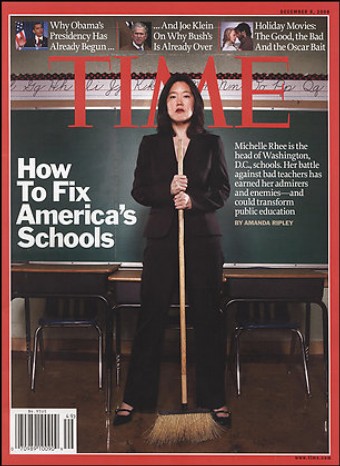
Since when does anyone care about finding another job for departing teachers? Geoffrey Canada said at the screening, "I don't care if you counsel them out, ice cream them out, whatever. Just get them out." The unions need to give a little here on expediting due process for firing bad teachers. But due process is a crucial protection for teachers against hostile or unfair administrators who populate many schools. And what does "trying everything" mean? What kind of supports does Guggenheim propose for struggling teachers? It's too easy to read this as code for: "Eviscerate the unions. They're in the way of cleaning house." (Imagine Michelle Rhee with her broom and scowl on the cover of Time Magazine.)
I don't doubt Guggenheim's earnestness on these issues. But as a teacher in an urban school, I am terrified that the "reformers" who share his talking points are creating school environments so unwelcoming to teachers' individual talents that Guggenheim's dream of great teachers everywhere will never come close to realization.
Would-be great teachers -- the best and brightest -- can be great because they are driven to become experts in their craft, their content, and they are skilled in how to work with other human beings. But they won't enter the profession, and they certainly won't make a career in the classroom unless they are supported and valued in tangible ways. Reformers must think about what that looks like on the ground.
Dan Brown is the author of The Great Expectations School: A Rookie Year in the New Blackboard Jungle. He teaches high school English in Washington, D.C.
Follow Dan Brown on Twitter: www.twitter.com/danbrownteacher
Me too. People need to understand that education is, just like everything else in America, incredibly political. To analyze, dissect, and comprehend from all angles is necessary before getting gung-ho about a movement whose implications are not wholly understood.
then they reward the teachers in the million dollar suburbs? what a joke.
Only someone that has actually worked in the trenches as a teacher knows what we go through in any given school year in a classroom, particularly if one works as a teacher in an inner city classroom.
Thank you for your article, and for saying what many of us feel.
A shame that this article didn't draw the attention that Guggenheims' did. How easy it is to criticize teachers when one is not doing the actual work of educating on a day to day basis.
It's a shame that your well informed, well written article has gotten 22 comments while the vague damaging jingoism of Guggenheim has been commented on by 100s. I wonder
Regardless, keep on writing the good fight, maybe with enough pushing, someday the "progressives" will stop wasting money on initiatives that have already been proven not to work and start listening. I'm not holding my breath.
Children are NOT Blank Minded, Soulless Beings who can be force Fed, or Taught...
A child is a Being with an intelligent mind, who if stimulated to LEARN, can and DO, enjoy LEARNing... They can NOT be taught against their will, but with a desire to educate them self, can be guided... Nature Loads a child with a desire to learn... Much is learned through play... Learning is fun... Learning is an adventure...
By about age 6 to 8, our Factories we call Schools have stifled the great Natural desire to learn...
http://www.amazon.com/Magical-Child-Joseph-Chilton-Pearce/dp/0452267897
I, read Magical Child way back when it first came out... Had to have a Dictionary as he tends to write in "University Speak", but was well worth doing so...
Our Factory approach of Children can be taught is NOT working... To Blame/ Fault, Students/ Teachers/ Principals/ Parents/ Class size, etc, is an assuption School Factories will work... In Fact, they do NOT work... But the argument of how to FIX what does NOT work and who to blame goes on and on!
Bashing teachers is the leatest in America's worship of anti-intellectualism. When we bash teachers without paying attention to all other factors which affects student performance, we are spiralling downward fast.
Chicago teachers union chief minces no words and calls Obama-Duncan's rightwing Education Deform plan and their accomplices like it is : http://www.democracynow.org/2010/9/3/educators_push_back_against_obamas_business
====
"again, Arne Duncan, Michelle Rhee, Joel Klein—I don’t know about Joel Klein—none of these people are superintendents. You have to have, again, credentials for that. These are business folks. Look, the business model took this country to the brink of Armageddon in 2008. And yet, we want to follow a failed business model and imprint that on top of public education? No. And these things are not innovative. What they are is they’re terrorism. They’re "my way or the highway." And they’re still not producing, quote-unquote, "results."
====
"terrorism" "my way or the highway". Ooohhhh,,,, Go Karen.
Very recently, that Versailles elitist Dana Milibank got sensible for once and called Obama as a "bully" who screws up teachers.
I like most of what Arianna says. But why is she on the corporate bandwagon bashing teachers? Is she close to Bill Gates , that monopoly capitalist who pretends to donate to charity while secretly undermining public education in US, unleashing genetic engineering in 3rd world countries etc?
I've read a lot of different ideas and opinions about what's wrong with schools, what's wrong with teachers, what's wrong with education...and the only ones that ever make any sense or are based on any kind of reality are from people who actually work in a classroom.
I don't tell brain surgeons how to make their profession better; I'm still trying to understand why it's okay for every Tim, Jane, and Larry to tell me how I should better mine.
Teachers state the obvious and trustees and politicians baulk.
Teachers are THE least respected profession in this culture that requires a university diploma for entry.
That's why I am at the point that I close the door and teach my way. My scores are fine, but this type of teaching takes some _____.
The result is classes with students who are frustrated and act out. Eventually many pass in a watered down version over the summer. (After having wasted taxpayer money and the time of many hard working students with their disruptive behaviour during the school year.)
A similar , but not quite a severe, situation exists with science standards.
Wonder why math teachers don't stick around?
How would you like a job with a requirement that your case load meet a standard that is not scientifically possible?
Are doctors a failure if their patient's die? Are the lawyers for the defense and prosecution requiered to win all of their cases?
Is the army failing because some recruits can't make it through basic training?
Get REAL and maybe some math teachers will stick around a little longer. The best leave because they have other options and they are intelligent enough to recognise the (well intentioned) idiocy of universal algebra competency.
If the algebra standard is so great, why don't we solve the obesity problem by requireing that, to graduate, all high school graduates run a mile in 6 minutes or less? You think that's unfair? Unrealistic? Not scientifically possible?
Me too.
Given the fact that one in ten kids in public schools don't speak english in their home, I think public schools do pretty well.
The unions don't create scientifically unsupportable standards.
Teachers can and do get dismissed, far more often than people realise.
You should go teach a few classes.
Massachusetts has a strong teacher's union, stronger than many other states, so, one can easily assume they must have a horrific education. Holy cow! #1 in education in the US.
don't let the facts get in the way of your argument. Keep drinking the right wing/corporate anti union efforts.
And, I have seen a number of teachers get fired, many because of the administrations incompetence or bias, so, I'm not sure what makes you think teachers can't get fired. In NYS, teachers are untenured for at least the first 3 years and they can be fired at any moment. I know, I got treated unfairly and picked on in my first 3 years by bad bosses (most teachers left the school) and there was nothing I could do about it because they would have fired me if I fought back and made them follow the law.
So, maybe instead of putting down teachers that you call grossly incompetent, maybe you should set an example of what a competent person looks like by actually researching what you are going to write before writing it. zing.
Instead, we need to create a system where all teachers can flourish and all kids have a fair chance to succeed – by improving classroom conditions, not imposing more of the same: testing, testing, and more testing.
However, some sort of competency system must exist for this profession. Professional standards and required course work is common in most professions.
Despite this, I think the tests are ridiculous and unfair for a number of different reasons. Even the people who make the value added equations openly admit they are approximations at best and that they vary widely for individual teachers from year to year.
Would you be alright with being judged by a method that had a degree of error of 25% even when applied over a 3 year period? And that level of error is from the people who are pushing the equations.
But, as I always say, don't let the facts actually get in the way of your argument.