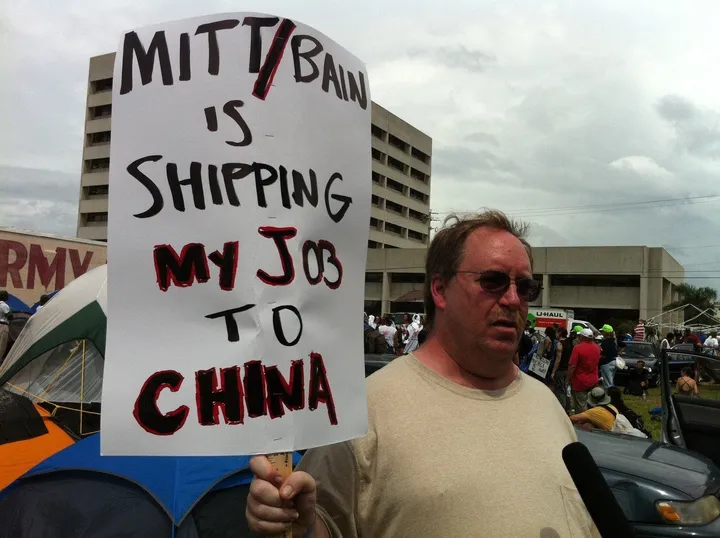
To the extent that there has been any attention paid to public policy issues amid all the mud-slinging in the 2012 presidential campaign, the most frequent subject has been jobs -- and which candidate can create more of them over the next four years.
So far, that debate mostly involves attacking the other guy, rather than advancing any real solution. The Obama campaign has been trying to define Mitt Romney as an effete champion of outsourcing (with some justification) while the Romney camp has dwelled on Barack Obama's failure to reignite the job market (also with some justification, though in some significant part the failure is because of GOP obstruction).
Their descriptions of their own plans are no more edifying. As the incumbent, Obama has to run on his record -- and despite his talk of bold solutions, that means either exaggerating his successes or making a lot of excuses.
Romney, meanwhile, offers little more than a collection of vague allusions to the wholly disproven theory that tax cuts lead to hiring.
The fact is that there is no Democratic jobs plan, if Republicans are able to keep either their control of the House or their ability to paralyze the Senate, or both. And there is no Republican jobs plan at all.
So what's the press to do? There's some value in differentiating between the two positions, which in this case has the added advantage of exemplifying each party's central weakness (in one case a failure of will, in the other a departure from reality).
But read some recent scholarship on the subject, and it turns out there is much more to talk about than that.
Jeff Faux, a progressive economist who founded the Economic Policy Institute in 1986, is the author of the new book, The Servant Economy: Where America's Elite Is Sending the Middle Class. "The mantra, as you know, in today's political debate is jobs, jobs, jobs," he told an audience at EPI recently. "Listen carefully because the subtext is low wages, low wages, low wages."
Faux argues that by the mid-2020s, even with the most optimistic assumptions about economic growth, current trends indicate that the average American's wages will drop about 20 percent. One big factor is that more and more good jobs will go overseas, leaving even America's best and brightest no alternative but to enter the service industry.
"You go into an Apple store and you see the future," Faux said. "The future's not in the technology -- the future of the labor force is all in those smart college-educated people with the T-shirts whose job is to be a retail clerk for Chinese goods."
One impetus for job growth, Faux writes in his book, is that as the super-rich get even richer, they'll need more and more servants:
They will hire people to take care of their large homes and to tutor their children in Chinese, tennis, and sophisticated strategies for getting into the best private schools and universities. They will hire personal assistants to shop, pay their bills, and run their errands. Coaches will come to their homes to instruct them in physical fitness, mental relaxation, and spiritual transcendence. They will need maids, cooks, and gardeners.
Neither party, Faux argues, is addressing the economic realities that make this the most likely future for our country -- because changing course would require massive government intervention. There's a pretty strong consensus among all but the most ideologically conservative economists that the solution would involve considerable public investment in education, infrastructure, and green energy, new policies to promote domestic manufacturing, more activist regulation of the financial industry in particular, and a more progressive tax structure.
But no matter who wins the election, Faux said, the governing elite has pretty much already ruled out that agenda, in favor of light regulation and governmental austerity.
"I think Romney and Ryan are reactionary disasters. But the last four years should have told us something, and that is the power of big money to intimidate the Democrats," he said. "The deal has already been made … Government over the next 10 to 15 years will be starved for revenue."
Still, Faux argues, someone should be making the argument to the public that "Hey, this is a big country. It needs a big government to solve its big problems."
Peter Edelman, a law professor at Georgetown University, writes in his recent book So Rich, So Poor: Why It's So Hard to End Poverty in America that the proliferation of low-wage jobs -- not the lack of jobs -- is the single biggest cause of persistent poverty.
"The first thing needed if we're to get people out of poverty is more jobs that pay decent wages," he argued in a July New York Times op-ed. "We've been drowning in a flood of low-wage jobs for the last 40 years… Half the jobs in the nation pay less than $34,000 a year, according to the Economic Policy Institute. A quarter pay below the poverty line for a family of four, less than $23,000 annually."
And wages in the bottom half "have been stuck since 1973, increasing just 7 percent," he noted.
Robert Pollin, co-director of the Political Economy Research Institute at the University of Massachusetts-Amherst, despairs that the goal of full employment -- with a decent job for everyone who wants one -- doesn't even come up in the political debate these days.
In his new book, Back to Full Employment, Pollin writes that such a goal would be good for the economy, for fighting poverty, fostering social and economic equality -- and is a matter of "basic ethics."
Getting there, however, would require significant investments in clean energy and education, and "substantial levels of government intervention," he writes.
With so much at stake, journalists have good reason to go beyond the empty sound bites and, at the very least, ask people who talk about creating jobs: What sorts of jobs?
But beyond that, it's worth exploring the question of why a much bigger government response to the jobs crisis is so far off the political agenda of the governing class? How did that happen? Who benefits? And who loses? Those are certainly more intriguing things to ponder than whose zinger zinged the most.
Reposted from Nieman Reports, where Froomkin is a contributing editor.
Follow Dan Froomkin on Twitter: www.twitter.com/froomkin
Arianna Huffington: What Is Working: A Bipartisan Search For Solutions To The Jobs Crisis
![]() |
![]() |
|
| Obama | Romney | |
|---|---|---|
| Electoral Votes (270 to win) |
332 | 206 |
| Obama | Romney | |
|---|---|---|
| Total | 65,899,660 | 60,932,152 |
| Percent | 51.1% | 47.2% |
| Democrats* | Republicans | |
|---|---|---|
| Current Senate | 53 | 47 |
| Seats gained or lost | +2 | -2 |
| New Total | 55 | 45 |
| Democrats | Republicans | |
|---|---|---|
| Seats won | 201 | 234 |
So, my guess is that if Romney does decides to stick with any convictions about saving this country, the powers-that-be will off him like they did JFK or that Romney will be doing a lot of high intensity back-peddling to conform to Agenda-21 and having UN forces stationed here while our own troops have been intentionally removed from American soil for when they pull the plug. So, real quick, I guess we'll all find out what kind of backbone Romney has because you can't support the Constitution and the UN, NAFTA, and globalism at the same time.
Pardon me, but the Dems are not folding to "intimidation." They are being purchased.
" The Obama campaign has been trying to define Mitt Romney as an effete champion of outsourcing (with some justification) while the Romney camp has dwelled on Barack Obama's failure to reignite the job market (also with some justification, though in some significant part the failure is because of GOP obstruction). "
"The fact is that there is no Democratic jobs plan, if Republicans are able to keep either their control of the House or their ability to paralyze the Senate, or both. And there is no Republican jobs plan at all."
I guess that's it. President Obama's American Jobs Act, would have helped this country tremendously, and the Republicans knew it - hence the reason for the obstruction.
Had the President been successful, we would be in a much better place. Thank you Mr. President for trying - Republicans, you're not welcome. Really tacky behavior just to win an election. Do you really think you can win points with this? Seriously?
President Obama deserves to have the American Jobs Act pass with flying colors in his next term. Republicans, for shame. Party before American Jobs!!!!
http://www.counterpunch.org/2010/07/26/the-year-america-dissolved/
The Year America Dissolved ╗ Counterpunch: Tells the Facts, Names the Names
"by PAUL CRAIG ROBERTS
It was 2017. Clans were governing America.
The first clans organized around local police forces. The conservatives’ war on crime during the late 20th century and the Bush/Obama war on terror during the first decade of the 21st century had resulted in the police becoming militarized and unaccountable.
As society broke down, the police became warlords. The state police broke apart, and the officers were subsumed into the local forces of their communities. The newly formed tribes expanded to encompass the relatives and friends of the police.
The dollar had collapsed as world reserve currency in 2012 when the worsening economic depression made it clear to Washington’s creditors that the federal budget deficit was too large to be financed except by the printing of money.
With the dollar’s demise, import prices skyrocketed. As Americans were unable to afford foreign-made goods, the transnational corporations that were producing offshore for US markets were bankrupted, further eroding the government’s revenue base..."
We used to pay $69 extra for the dell computers we bought for work so that we could have access to the Austin tech call center. They do not seem to offer that option anymore so maybe the market told them something.
In one of our companies we moved a small line back here and branded the product made in the USA at a total price only about 18% higher than our foreign factory product because we had tons of people saying they would buy it. We have gotten killed on it. We are basically running it and cannot get the premium.
It seems like everyone wants to buy made in the USA until they have to pull out their wallets (and then the alligator arms appear).
Philippine Call Centers Overtake India - BusinessWeek
"For the past decade, Americans dialing customer service have stood a strong chance of being connected to someone in India. Now they're more likely to end up phoning the Philippines. Although the country got a slow start in outsourcing, strong government support, a plentiful supply of English-speaking college grads, and an effort by call center operators to diversify have helped the Philippines overtake India in call center revenues. "It's not that we are trying to take business away from India," says Oscar Sañez, chief executive officer of the Business Processing Association of the Philippines, an industry group. "We're just looking for our own place in the sun."
The Philippines this year will pocket $5.7 billion for call center work from the U.S., Europe, and Australia, vs. the $5.5 billion that India's call centers will take in, according to the Everest Group, an outsourcing advisory firm. Call center operators like the Philippines because English is taught in schools and Filipinos have a cultural affinity for the U.S., which ruled the country from 1898 to 1946..."
Hope the $39 DVD players can keep us fed and warm through the winter.
o computer programmer
http://www.liveleak.com/view?i=4ea_1195705444
LiveLeak.com - "30 Days: Outsourcing" (2006) (Part 1/2)
The "star" is Chris Jobin, a programmer whose job was outsourced to India. He traveled to India and stayed for 30 days as an employee of a call center.
o accountant
o architect
o engineer
o radiologist
o car designer
o legal services:
http://www.manufacturingnews.com/news/10/0126/outsourcing.html
Outsourcing Firms And Foreign Countries Target More American Service Industries, Especially U.S. Law Firms
And don't hand me the platitudes about free market enterprise, which is a euphemism for "Big Business Fleeces the American Workers" -- not to exclude the empty envelopes with nothing inside but rightee propaganda.
Hell, you don't need to be an economist to figure it out, albeit we can expect a few self-proclaimed gurus on the subject to chime in a ding-dong or two.
Oh they’ll proclaim, I'm wrong about all other first-world countries having protectionist tariff-based strategies, as the US used to….Hello. Ding-dong!
The US has become a land where the bulk of the available jobs will be service jobs, but doesnt want to actually pay the people that work these jobs an actual living wage. Our major industries are all gone for the most part and manufacturing is all done in China. This is why the middle class is shrinking.
Its a great place for the people that are the management at these companies, they get huge bonuses regardless of performance and jump from company to company like sports free agents making 100 times their low level employees. Meanwhile, the average employees' wages have stagnated for the last 30 years.
If America is truly going to be a service based society, the stockholders are actually going to have to start sharing the wealth. As we all know that wont happen, which is why Republicans are so anti-union and anti public sector.
The rich can only be rich if they hoard all the money.