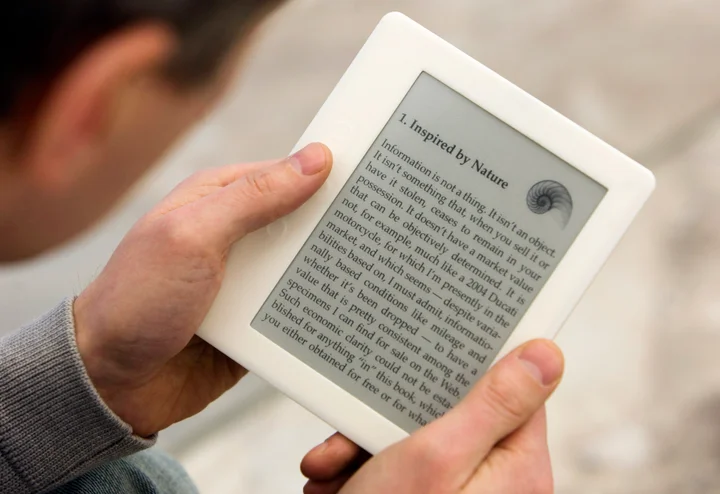
Tomorrow I'll be part of a panel on e-books being organized in Boston by the Association of College and Research Libraries. We're supposed to talk about what we like and don't like about them, and I can do that. But what I really hope to discuss is the place of e-books in a world in which what we used to think of as public space is increasingly being turned over to private, profit-making entities.
Let me explain what I mean with a couple of non-book examples.
In 2003 I bestowed a Boston Phoenix Muzzle Award on Crossgates Mall, in the Albany, N.Y., suburb of Colonie, for calling police and having a man arrested because he was wearing a mildly worded T-shirt in protest of the war in Iraq. The protester -- actually, he was just having a bite to eat in the food court after picking up his purchase from the mall's T-shirt store -- was quickly released.
But there's almost no chance he would have been arrested if he'd been hanging out in the village square rather than a mall. The trouble is that in too many cities and towns, we no longer have a village square except in the form of enclosed spaces owned by profit-seeking corporations. What happened to that protester said a lot more about our privatized idea of community than it does about that one particular incident.
In 2008 the Beverly Citizen, a weekly newspaper on Boston's North Shore owned by GateHouse Media, discovered what can happen when you turn over some of your publishing operations to Google. The Citizen had posted a video of the annual Fourth of July "Horribles" parade, which included an offensive float that featured a giant, water-squirting penis. The float mocked an alleged "pregnancy pact" involving girls at Gloucester High School, a much-hyped story that turned out to be not quite true.
Although the Citizen's judgment in posting the video could be questioned, there was no doubt that the float was newsworthy, as it had been seen by hundreds of people attending the parade. Yet Google-owned YouTube, which GateHouse was using as a video-publishing platform, took it down without any explanation. It would be as though a printing company refused to publish a particular edition of newspaper on the grounds that it didn't like the content. YouTube is an incredibly flexible tool for video journalism. But Google has its own agenda, and hosting content that might offend someone is bad for business.
What's that got to do with e-books? A physical book, once printed, enters a public sphere of a sort, especially if it's purchased by a library. But an e-book remains largely under the control of the corporation that distributed it -- most likely Amazon, Apple or Barnes & Noble.
We all remember those horror stories from a few years ago when some books people had purchased suddenly disappeared from their Kindles because Amazon was involved in a rights dispute. (Ironically, the books included George Orwell's 1984.) In some cases, students lost books they needed for school, along with their notes.
More recently, Apple refused to carry in its iTunes store an e-book by Seth Godin called Stop Stealing Dreams. The reason: Godin included favorable mentions of -- and links to -- other e-books that were available only through Amazon. "We're heading to a world where there are just a handful of influential bookstores... and one by one, the principles of open access are disappearing," Godin wrote.
And I'm not even getting into the U.S. Department of Justice's investigation of alleged price-fixing by Apple and several leading book publishers.
Another concern I have involves the rights of authors. Several years ago Rodale, the publisher of my first book, Little People, reassigned all rights to me after the book had reached the end of its natural life. I published the full text on the Web, which led to my hometown high school's adopting it as its summer read -- which in turn pushed me to create a self-published paperback edition with the help of the Harvard Book Store in Cambridge. Little People has had a pretty nice second life for an out-of-print book. (I wrote about the experience recently for Nieman Reports.)
But now that e-books and e-readers have become ubiquitous, I'm worried that publishers will simply have no incentive to let authors benefit from the full rights to their own work. If a publisher can make a little bit of money by selling a few e-copies each year, then it might just decide to keep those rights to itself. This is long-tail economics for the benefit of corporations, not authors.
And have you ever tried to lend an e-book to someone?
There is a lot to like about e-books. As someone with terrible eyesight, I like being able to adjust the type to my own preference and use my laptop's or iPhone's backlighting rather than depend on iffy room lighting. And my iPhone, unlike whatever book I might be reading, is always with me.
But when unaccountable corporate interests maintain control over what shall take place in the village square, what content shall be deemed suitable for public consumption and what rights the authors and even the purchasers of books shall have, we have put our culture at risk in ways we couldn't have imagined a generation ago.
Thanks to Twitter followers @jcstearns, @JimandMargery and @BostonGuyinNC, who responded quickly to my pleas for help with research.