
This was a piece posted on The Perennial Plate blog earlier this week by camera woman, co-producer and blogger Mirra Fine.
Yesterday, on our way towards Immokalee, Florida to visit with Immigrant Farm laborers, we decided to stop into a Chipotle. We pride ourselves on not eating fast food, and have only stopped at 1-2 along the way (always either Subway or Chipotle, and always vegetarian). But there is something about Chipotle that makes me feel like I'm not eating at a fast food joint. Their decorum of metallic, aztec-ish mosaics on the walls; smell of cilantro rice; and clean metal tables is familiar and comforting so far from home. Their motto is "Food with Integrity" (it's right there when you pull up the website), and they pride themselves on working with small farmers (when they can) and providing good, local, farm-supporting food. And it tastes good. So, we pulled off of interstate 41 without any guilt and stopped in for a quick bite.
I got what I usually get: veggie bowl with lots of rice, topped with a little bit of black beans, cheese, lettuce and their mild salsa chocked full of red tomatoes, onions and herbs. And I usually swing for some guac on the side. Maybe it was the oppressive heat outside that made my shirt stick to my back, or my premonition of a long day of filming ahead, or it could have been because deep down, somehow I knew that this would be my last veggie bowl at Chipotle for a long time...but I cleaned my plate.
And then we drove to Immokalee, Florida -- the state's largest farm worker community. In Immokalee the per capita income is only $9,700/year, half the people in town live below the federal poverty line, and the area has seen many cases of "modern day slavery" (meaning farmers holding people against their will, forcing them to work, beating or killing them if they tried to escape, and knowing that they can have this control over them because the workers don't have any means to save themselves). As Barry Estabrook wrote in his book, Tomatoland: "Any American who has eaten a winter tomato, either purchased at a supermarket or on top of a fast food salad, has eaten a fruit picked by the hand of a slave. That is not an assumption, it is a fact (Douglas Molloy, US Attorney for Florida's Middle District)." "Immokalee," as Estabrook continues. "Is the town that tomatoes built."
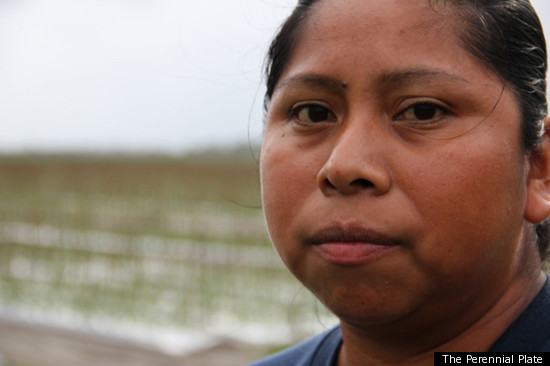
We drove in around 3pm and went to the small, nondescript Coalition of Immokalee Workers (CIW) office building that had been painted the strange off-yellowish color that many buildings in Florida sport. It was like a scene from a Mexican folk movie: a man sitting outside on a fold up chair listening to Mariachi music blaring through the windows while stray chickens roam the streets outside and do their best to stay out of the path of little Mexican or Guatemalan boys racking up their own point system by kicking a ball back and forth. We were there to meet up with our film subject for the day: Lupe, an immigrant from Guatemala who, like the other farm workers, lives in this town during tomato season, and then moves north to find other work in the fields. Lupe's husband has been in Northern Florida since May (the last time she saw him). So for now, she lives with her 8 year old son and another family in a (barely 2 bedroom) labor camp trailer. The trailers are small, poorly made boxes with a tiny shared kitchen (a stove, fridge and sink) -- too small for more than 3 people to be in at one time. The little bedrooms house two mattresses and multiple people who pile in at night. One room was for a mother and her 4 daughters. Lupe, whose daughter lives in Guatemala and whom she hasn't seen in 11 years, sleeps in a room only with her son. The labor camps are dotted throughout the little town of 15,000, and to live in them, the rent is steep: up to $400/week for a trailer. A ridiculous amount for farm workers who make (on a good day) $50.
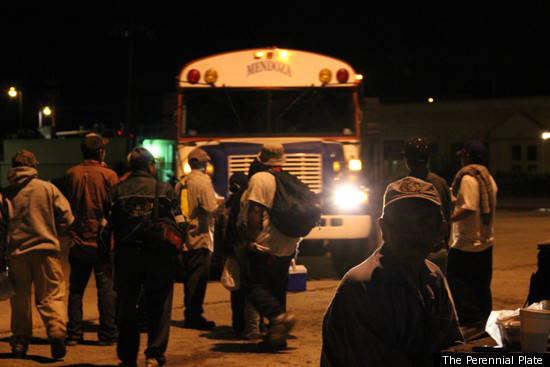
And the good days are for only a couple months out of the year, and even then there is little consistency. Workers line up every morning at 4am in the parking lot of a local "Fiesta" grocery store waiting for buses to pull in looking for labor. Men and women will wait all day if need be. Many go home empty handed, hoping that the next day will be luckier. On rainy days, there will be no work for anyone. Crew leaders (those who round up the laborers and bring them to the farmers) have been known to hold back paychecks, sexually harass the women or limit their access to work. When we asked Lupe why they do this, she answered "because they can."
And that's all before getting to the farm. Once you're there, it doesn't get easier. We weren't permitted on the farms to see the actual work, but Lupe told us how laborers will spend all day in the fields picking tomatoes in the hot, hot heat. Before CIW came along, workers often had no access to water and no breaks. In some ways, things have improved slightly, however each bucket of tomatoes a worker fills (roughly 32-35 lbs) still gets them around only $0.45-$0.50. And they are picking green tomatoes -- as in, tomatoes that are not ripe. If you live in Florida and ever find yourself behind a tomato truck, you probably wouldn't know it as the fruit is completely unrecognizable. The tomatoes are picked green so that they can be gassed with chemicals to turn red and then shipped to other areas of the country. Ever notice how a fresh tomato tastes totally different from those bought in the winter? That's why. Or at least that's one reason.
But back to the workers. The Coalition of Immokalee Workers is doing their best to make conditions better, by "training local, state, and federal law enforcement to investigate, uncover, and prosecute existing slavery operations, in addition to working to eliminate the root causes of the problem: farm workers' structural powerlessness and grinding poverty." (Grist) Beyond helping them to know their rights, CIW also created the Campaign for Fair Food asking the major tomato purchasers in this country (fast food chains, grocery stores) to pay a penny more per pound for tomatoes, and asking farmers to put that penny towards the workers. So a 32lb bucket of tomatoes harvested by a worker would result in $0.80, instead of the current $0.45-$0.50. That would mean a huge increase in wage for that worker.
The Campaign doesn't stop there, CIW also asks the major food purchasers to work with agricultural suppliers that adhere to the CIW first ever Code of Conduct, which looks out for worker rights, and creates market incentives for those suppliers willing to respect their worker's human rights, even if those rights are not guaranteed by the law. And lastly, they ask for 100% transparency for their tomato purchases in Florida. In November 2010, the CIW and the Florida Tomato Growers Exchange signed an agreement to extend the CIW's Fair Food principles - including a strict code of conduct, a cooperative complaint resolution system, a participatory health and safety program, and a worker-to-worker education process - to over 90% of Florida's tomato fields.
Taco Bell has agreed to join the plight for farm workers, as have 9 other major corporations including McDonald's, Subway, Burger King, and Whole Foods. But guess who wont: Chipotle and Trader Joe's.
Yep, the two corporations whom you would assume would be at the forefront of workers rights issues, are distancing themselves. Trader Joe's is a leading retailer of organically certified products -- one of the primary reasons for its reputation as a progressive grocer. And that Chipotle -- the company who promotes the integrity of their food and practices more than anyone -- wont partner with CIW in adopting the Fair Food Principles is especially baffling. The company's whole image is around Food with Integrity and their focus on ensuring the products they use "are grown, made and shipped without exploiting people". From Chipotle's website: "We can talk about all of the procedures and protocols we follow and how important they are - but it all really comes back to the people behind every ingredient we purchase, burrito we make, and customer we serve."
These workers are the people behind their ingredients. Instead Both Trader Joe's and Chipotle have decided to do it their "own way" in an approach that forgoes transparency and farmworker participation. Both have written statements about their uninterest in partnering with CIW. Trader Joe's says that they do not sign agreements that allow third party organizations to dictate what is right for their customers. And though they say they would buy from producers who have agreed to the Fair Food agreements, CIW says that doesn't seem to be entirely true.
So what the hell is going on? These actions seem very at odds with the Trader Joe's and Chipotle image. They both claim to be doing it their own way, but as Eric Schlosser was quoted as saying: "Claiming you support farm-worker rights but refusing to work with CIW is like someone in the '60s saying they support civil rights but they won't work with Martin Luther King, Jr. or the NAACP."
When researching information for this blog post, I found that in 2009 and 2010, tons of articles were written about just this. But nothing has changed. CIW went to protest Trader Joe's in California a couple days ago, and the issue still seems to be going strong. What's it going to take? Maybe if the two chains came down to Immokalee and saw what its like to be on the other end of the tomato, they'd change their minds. It has definitely done a number on me.
To tell Trader Joe's to change their policy toward farm workers, please sign this petition.
For more articles like this as well as videos and recipes, visit www.theperennialplate.com