After almost thirty years President Hosni Mubarak is gone. For the people of Egypt and especially those with the courage to have taken to the streets it is no doubt a day that is impossible to put into words. For the rest of us, a day of awe, celebration and inspiration.
Some however have probably not summoned up too broad a smile today -- the other non-democratic regimes of the Middle East for instance. Interestingly, Israel too belongs on that list of the "not-exactly-thrilled".
Israel has long made much of its claim to being the only democracy in the Middle East, it now seems that the claim was more an aspiration rather than a lamentation. Israel has been clinging dearly to the Mubarak regime, and encouraging others (notably the U.S.) to do likewise.
Despite claims to the contrary, Mubarak's Egypt was far from being a regional linchpin for security and stability, for moderate governance, or even for economic success. The country's harsh security regime produced terrorists and a rallying cry for extremists. Its authoritarianism made a mockery of the tag "moderate," and its economy is today a quarter the size of Turkey's (though both countries have populations of similar size). In fact America's previous role as a guarantor of the Mubarak regime should be considered counterproductive to American interests, certainly once the Cold War was over.
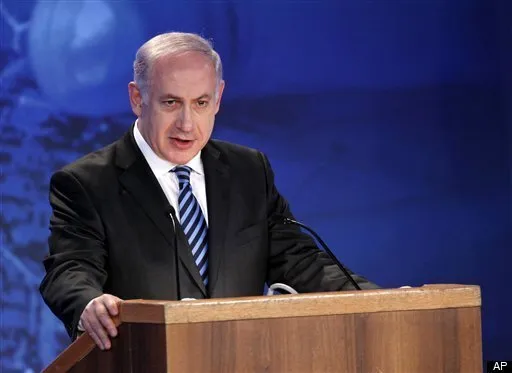
But Mubarak's Egypt was a linchpin for something else -- namely Israel's ability to pursue a hard-line regional policy with near impunity. When Benjamin Netanyahu (or his predecessors) needed to revive his 'man of peace' credentials he could always pop over to Sharm el-Sheikh for a hug-in with his friend Hosni, and when Israel needed the Arab world to turn a blind eye to entrenched occupation and settlements or harsh military adventurism then it would be Hosni running cover and diluting any Arab response. For years that strategy paid off for the now-deposed Egyptian leader -- it made Mubarak relevant, even indispensable for successive U.S. governments desperately trying to balance their indulgence for outlandish Israeli behavior with a desire to retain some semblance of credibility in the Arab world. The latter of course never happened, but the America was too busy listening to the unelected leaders rather than to their publics.
Trying to keep this equation in play is what brings many Israeli officials (and others in the region, the U.S. and beyond) to now push for continued military, as opposed to civilian control.
As of today, the new equation is simple and it is this -- those governing Egypt will henceforth have to be more responsive to the public will.
Some have suggested that Israeli concern is focused on avoiding a revocation of the Egyptian-Israeli peace treaty. It is not. Insisting on Egyptian adherence to the peace treaty with Israel is a legitimate position, has international support, and also accords with both Israeli and Egyptian interests. The treaty has saved lives on both sides, neither of which relishes the prospect of renewed military conflagration. The treaty can be sustained.
Israel's real concerns lie elsewhere.
There were a set of regional policies pursued by the Mubarak regime which lacked popular legitimacy. These included the closure imposed on Gaza, support for the Iraq war and for heightened bellicosity toward Iran, and playing ceremonial chaperone to an Israeli-Palestinian peace process that became farcical and discredited. Arguably these policies were also misguided for Israel. For an Egypt reflecting the popular will they make absolutely no sense and are therefore likely to be discontinued.
Yes, the January 25 democracy protests were about economic conditions, domestic governance issues and freedom, but a part of the democracy deficit in Egypt was also a dignity deficit, and these Israeli designed policies for the region appeared undignified and anti-Arab to the Egyptian public.
When Egypt first made peace with Israel it was criticized at home and in the region for going it alone, for abandoning the Palestinian and broader Arab cause. Had the Israeli-Egyptian peace been followed by a regional peace then this narrative would likely have disappeared, but in the absence of comprehensive peace it was a critique that seemed to be vindicated.
To the 1978 Camp David Accords was attached an annex entitled "A Framework for Peace in the Middle East," which included a commitment to Israeli withdrawal from the Palestinian territories and to negotiating final status within five years. That of course never happened. What did happen is that the 10,000 Israeli settlers living in the West Bank when that accord was signed have become over 300,000 today.
Indeed, whether by design or not, the peace treaty with Egypt ushered in the era of the Israeli "free hand" in the region. Even though it has not delivered real security for Israel and has encouraged an Israeli hubris that can be both dangerous and self-destructive, that era of hegemony is something that Israelis are instinctively uncomfortable about losing.
A popular Israeli refrain is that the peace with Egypt has neutralized any serious Arab military option vis-a-vis Israel. That the same cannot be said in reverse understandably irks the Arab street. Since signing the accord with Egypt, Israel has conducted several large-scale military campaigns against Lebanon and against the Palestinians, launched bombing raids against Syria and Iraq, and conducted high-profile assassinations in Jordan and the UAE -- and that is only a partial list.
This deep regional disequilibrium, one that became more rooted under Mubarak's Egypt, is, understandably, both unpopular and unacceptable to a majority of Arab public opinion.
Maintaining the peace treaty with Egypt has morphed over time and under Mubarak into maintaining a peace process that has ultimately entrenched occupation and settlements and made a mockery of its Arab participants. Post-transition Egypt is unlikely to continue playing this game. And without Mubarak's enthusiastic endorsement, the process itself is likely to further unravel. It is hard to imagine other Arab states leaping into this breach, or the Palestinians accepting 20 more years of peace-process humiliation, or indeed Syria adopting the Egyptian model and signing a stand-alone peace agreement with Israel. Israel's strategic environment is about to change.
Israel's options would appear to be narrowing. Thus far Israeli establishment voices have discussed two options. One has been to dig in, to fear-monger, to convince the West that Israel is its outpost of stability in a sea of hostility, and to hope the military stays in power and democracy is tamed. In the words of Prime Minister Netanyahu, "might" is the answer. The second approach advocates an urgent return to the peace process. Neither will work. The first will exacerbate Israel's predicament, and the second is too little too late.
Israel has a third option, albeit one that is dramatic and out of synch with today's zeitgeist. It would be perhaps Israel's best and last chance for a two-state solution. While it would involve cutting Israel's losses, it would also have the potential of unleashing huge benefits -- economic, security and more, for an Israel accepted as part of the tapestry of a democratic Middle East.
Broadly speaking, this option has three components. First, an Israeli withdrawal to the pre-1967 armistice lines almost without preconditions or exceptions (minor, equitable and agreed-upon land swaps and international security guarantees could fall into the latter category ). Second, Israel should undertake an act of genuine acknowledgment of the dispossession and displacement visited on the Palestinian people, including compensating refugees where appropriate, and thus set in motion the possibility of reconciliation. Third, there needs to be a clear Israeli commitment to full equality for all of its citizens, notably including removal of the structural barriers to full civil rights for the Palestinian Arab minority.
Admittedly, this is a path less traveled and one likely to remain so, and while the alternatives to this path may well include democracy in the region, they could preclude a future for the State of Israel.
While Israeli-Egyptian peace has often been described as a cold peace, it could perhaps be more accurately framed as a pyramid peace -- in which only the very tips of the respective societies met and forged narrow common interests. It is high time to reverse that equation and build a democratic peace between the bases of those pyramids. In truth, the onus is on Israel to make this happen, and one key will be to take a more honest and dignified approach to Israel's Palestinian neighbors and co-citizens and to belatedly implement that regional peace annex from Camp David.
Daniel Levy directs the Middle East Task Force at the New America Foundation and is an editor of the Middle East Channel at foreignpolicy.com.