
Occupy Wall Street (OWS) brought the increased inequality in the U.S. to the headlines, where it deserves to be. Almost a quarter of total U.S. national income now accrues to the richest 1 percent of the population, a figure that was barely above 10 percent 40 years ago. Other countries, most notably the U.K., have also witnessed growing inequality, but none competes with the U.S. in the surge in inequality. Is it unfair and unjust for so few to become so much richer than the rest?
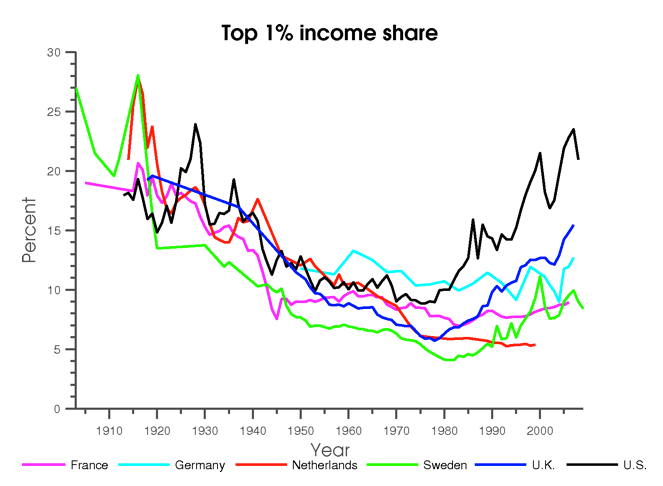
But the real reason to worry about this picture is not the unfairness of it all. Any discussion of inequality should distinguish economic inequality from inequality of opportunity and from political inequality. You may not like economic inequality but others may be indifferent to it. There are huge disagreements about how much redistribution there should be, and we know by now that very high tax rates can choke off economic incentives. The problem is that economic inequality often comes bundled with inequality of opportunity and political inequality.
Prosperity depends on innovation, and we waste our innovative potential if we do not provide a level playing field for all: we don't know where the next Microsoft, Google, or Facebook will come from, and if the person who will make this happen goes to a failing school and cannot get into a good university, the chances that it will become a reality are much diminished. There is a lot to worry about here. Our schools are failing and American youth is less likely to graduate from high school or college today than in the 60s. We are no longer the country of opportunity and upward mobility that we once were -- largely because that upward mobility crucially depended on the expansion of mass schooling.
The real danger to our prosperity lies in political inequality. The U.S. generated so much innovation and economic growth for the last 200 years because, by and large, it rewarded innovation and investment. This did not happen in a vacuum; it was supported by a particular set of political arrangements -- inclusive political institutions -- which prevented an elite or another narrow group from monopolizing political power and using it for their own benefit and at the expense of society. When politics gets thus hijacked, inequality of opportunity follows, for the hijackers will use their power to gain special treatment for their businesses and tilt the playing field in their favor and against their competitors. The best, and in fact the only, bulwark against this is political equality to ensure that those whose rights and interests will be trampled on have a say and can prevent it.
So here is the concern: economic inequality will lead to greater political inequality, and those who are further empowered politically will use this to gain a greater economic advantage by stacking the cards in their favor and increasing economic inequality yet further -- a quintessential vicious circle. And we may be in the midst of it. The U.S. tide has lately not lifted all boats; over the last 40 years, while the richest Americans have seen a sharp increase in their incomes, the income of the median household has hardly budged. Predictably, this has gone hand-in-hand with political inequality. Yale University political scientist Robert Dahl painted a picture of U.S. politics in the 1960s through the lenses of politics in New Haven as a system in which not only the wealthy but even the little man had voice. But that system is in decline. Money matters much more in politics today than it did in the 1960s, and we are currently witnessing its import rising. The wealthy have greater access to politicians and to media, and can communicate their point of view and interests -- often masquerading as "national interest" -- much more effectively than the rest of us. How else can we explain that what is on the political agenda for the last several decades has been cutting taxes on the wealthy while almost no attention is paid to problems afflicting the poor, such as our dysfunctional penal system condemning a huge number of Americans to languish in prisons for minor crimes? How else can we explain, as political scientist Larry Bartels has documented, that U.S. Senators' votes represent the views of their rich constituents but not those of their poor ones?
There is a lot to despair about. But despair would be the wrong reaction. First, we have been here before and we have rebounded. Things were much worse during the Gilded Age, and the wealthy elite more unscrupulous. Yet the robber barons did not prevail. The U.S. political system was also able to tackle the problem of Southern segregation and black disenfranchisement, which if anything looked even more insurmountable. Second, despair would strengthen the tides towards inequality. Americans are proud of their Constitution. But no constitution can enshrine political equality. It needs to be fought for and defended. Whatever we may think of the views, rhetoric, and tactics of OWS, not only does it deserve our respect for putting the question of inequality on the agenda, but also for actually standing up for political equality.
Daron Acemoglu and James A. Robinson are the authors of Why Nations Fail: The Origins of Power, Prosperity, and Poverty, available March 20.
The big discriminator now is between the college and professionally educated (they would call themselves upper middle class) and those who have not completed college, let alone lowered educational levels. The more educated parents have different child rearing strategies and invest much more in their children - and the children build upon this from an early age. While not quite as intensively cultivated as the children of the wealthy, these kids overall are very well prepared for school and later employment.
The same cannot be said overall for the children of less educated parents, who have more unstable families, lower parental investment, and inadequate preparation for education and later employment.
There are real cultural issues driving the differences in prospects.
Automation and tech further concentrate wealth in the 1%, destroying the republic.
"When economic power became concentrated in a few hands, then political power flowed to those possessors and away from the citizens, ultimately resulting in an oligarchy or tyranny." John Adams
The solution is proven: Progressive income taxes including capital gains.
The USA during Ike's time became the greatest economy in history with 93% top income tax rates.
Sweden, Germany and Holland also show us ways for all the citizens to prosper while still maintaining a regulated capitalistic market and still allowing hard work to make you rich.
Tax income and capital gains at 50% over a million and 90% over a billion. Inflation adjust the basis, and allow 10 year income averaging, that should make investors happy.
Now one gets rich on a desert island. Most people would last a day in Somalia, and certainly not become billionaires.
Pay your due or move Somalia.
"The end of democracy and the defeat of the American Revolution will occur when government falls into the hands of lending institutions and moneyed corporations."
— Thomas Jefferson attributed, no proven source.
"I hope we shall . . . crush in [its] birth the aristocracy of our monied corporations." Thomas Jefferson
When are the mediocre medium/low wage earners going to start pulling their weight with new innovations? The majority of the innovation from the last century was from the middle class, but now they are content to draw a wage and go home to the "toys" iphone, ipad, computer, 52" tv that are available. They are the ones who should be the innovators and job creators. Maybe they are the ones who should pay their due or move to somolia.
"The real danger to our prosperity lies in political inequality"
REALITY-CHECK= We don't have any political inequality
The supporters of the GOP show up at the ballot box about 85-90% of the time, and they ALWAYS VOTE REPUBLICAN
The rest of the electorate shows up at the ballot box less than 50% of the time, and the way they vote is all over the map.
Thanks for the reply
Nowhere today do we have an equivalent leader to that of 'Trust Buster' Teddy Roosevelt. What we have are Republicans who pander to the elites and Democrats who pander to the elites each tearing down whichever piece of the constitution they can exploit for their own power, whether the second amendment or the fourth or others. The fight is not between right and left. There are the lucky folks who own gov't and the drive/restrict the passions of the public discourse. Then there are the rest of us.
Money and lives have been sacrificed for at least 2 wars by both parties. FISA and NDAA have stripped the law of the protections of the bill of rights. The tax code has incented offshoring of jobs and the collapse of our infrastructure. Both parties are complicit. We are very close to losing what our Founding Fathers had hoped for our nation.
We need to ignore all of the distractions of such as guns, gays and religion and take back our country. Wish I knew how.
The charade that is being played out there now surely does not feel like democracy.
I also think that rewards for innovation and investments is not the driving force of our Innovation and Economic Growth...I think Civil War and World Wars had a bigger hand on our innovation and economic growth than the reward for innovation and investments....imagine our country without having experienced Wars against ourselves and our competitors...I see us as a third class developed country without them...No Civil War and we would have had to deal with slave revolts and World pressure because we were the last major nation to abolish slavery ( ignore South Africa). No World Wars and no English Treasure to place economy in overdrive...standard of livings would be lower than we experienced in the economic golden years after World War II. Inequality in all its forms is unfair and we need to get people focus on it to get politicians to think out of the box and quit protecting national wealth by protecting the interest of the Rich...
How can the situation improve, without a major set of changes to our Society..?
What could make these changes occur....?
I look to Science Fiction books I read in the past, and it is long since here already..
.Many dystopian Societal set-ups are posed - some seem quite possible... Especially the Personal Monitoring aspects.. And The Utilization of "Fear" to manipulate the Masses, the Economy, and Geopolitical decisions.
Along with the many examples of a Cashless Society, such as "Star Trek The Next Generation" by way of the use of "Credits.."
Think about what might be the reason. Early 1900s was when mass production and increased productivity really kicked in. Trade between countries had barriers, and was relatively open, but with clear distinctions between advanced economies and poor ones. Money was tied to gold (and some actually made of silver)... right up to 1971, the beginning of the upward inequality trend. This marks the beginning of total fiat currency, when Nixon took us off the gold standard, and the acceleration of debt leverage as a source of economic growth.
This was also the first wave of giving up our manufacturing: electronic and cars came from Japan. They were the China of the day. The era of globalization and financialization had begun. GM decided they could make better profits by making loans rather than making cars. Credit cards, for consumers and governments alike, became the norm. All possible because the American dollar, backed by nothing, remained the world's reserve currency. The real surprise isn't that inequality has grown... it's that it hasn't grown even more.
I don't know what history books you read in your government run school but in the real world Franklin Delano Roosevelt ( a Democrat) took us off the gold standard in 1933.
Richard nixon was the president who allowed private citizens to own gold other than jewelry.