

According to Mayor Kevin Johnson, it is becoming increasingly likely that the Sacramento Kings will depart Northern California for Anaheim. The final decision, though, has not been made. So while we wait, it might be a good idea to look at how we have come so close to seeing the Sacramento Kings cease to exist.
The story taking place in Sacramento is quite familiar to those who study sports and economics. As Marc Stein reported at ESPN.com:
The Kings have been trying for nearly a decade to replace outdated Arco Arena (soon to be renamed Power Balance Pavilion) with a new revenue-generating building that would ensure they stay in a market that was once known as the home of one of the NBA's most fervent fan bases.
Why is building a new arena in Sacramento so difficult? The sticking point is who is going to pay for it. When non-sports businesses move into a new market, it is considered reasonable that the business actually build their place of business. But in sports, teams typically expect the public to build their place of business.
As Rob Baade and Victor Matheson (two economists who have written extensively on this subject) recently reported in an academic article, it is not uncommon for the public to pick up much of the cost of stadiums and arenas. To illustrate, these authors report that seven arenas have been built for NBA teams since 2000 at a cost of $1.925 billion. Of this sum, the public contributed 83%, or $1.524 billion (and as Baade and Matheson note, there is very little return on these public investments).
So what the Kings are asking for is not unusual for NBA teams. And the Kings would seem to "need" a new arena. After all, according to ESPN.com, the team currently ranks second to last in home attendance. And when we look at team revenue - as reported by Forbes.com - the Kings in 2009-10 ranked 22nd in the league. If this team is going to compete - so the story goes - the Kings are going to need to find a way to increase team revenue.
Of course, not so long ago the Kings were competitive. The Sacramento Kings reached the NBA playoffs in each season from 1998-99 to 2005-06. In 2001-02, the Kings had the best regular season record in the NBA and took the Los Angeles Lakers to seven games in the 2002 Western Conference Finals.
Not only were the Kings competitive on the court, the team also did quite well at the gate. From 2001-02 to 2005-06, the Kings sold out every single home game at Arco Arena. And when we look at total revenue - again as reported by Forbes.com (via the website of sports economist Rod Fort) - we see that the Kings ranked 9th in the NBA in 2005-06.
Since 2005-06, though, the team's fortunes have declined. The Kings will not be in the playoffs this season, and that will mark the 5th consecutive season Sacramento has not seen playoff basketball.
A few years ago, Stacey Brook, Martin Schmidt, and I published a study of gate revenue in the NBA. This study revealed that gate revenue is primarily driven by wins (as opposed to the number of "stars" a team employs). The role wins play in gate revenue is not surprising. And we can see this story when we look at the recent history of the Kings.
As the following table indicates, the Kings earned $126 million in total revenue in 2005-06. Of this total, $50 million came at the gate. Again, the team's fortunes have declined since that season. And as the team got worse, attendance and gate revenue declined. Non-gate revenue, though, didn't really change. Nor did spending on players change very much. But because gate revenue is not what it was, the profitability of the Kings has declined.
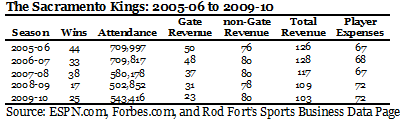
Now there are two solutions to this problem. The Kings could field a better team. Again, just five years ago the Kings were successful on the court and at the gate. And the team's revenue picture - relative to what we see today and the rest of the NBA - looked much better. To illustrate, if the 2009-10 team had the same gate revenue as the Kings saw in 2005-06, the Kings would have earned $130 million in total revenue. And that mark would have ranked 12th in the NBA in 2009-10.
Of course, getting a better team requires making better decisions. And making better decisions can be difficult (although as our research has demonstrated, player evaluation in the NBA is not -- relative to what we see in football and baseball -- that difficult). So the Kings have offered another solution. With a different arena, more revenue can be generated by the fans that still show up to see an unsuccessful team. To implement this second solution the Kings don't need to make better decisions. All they need is a taxpayer subsidy.
Given the choice between these two solutions, the Kings clearly favor the second choice. And this illustrates what we often see from professional sports owners. North American sports leagues often argue that some teams are losing money. Consequently they propose solutions - like taxpayer subsidies from fans and caps on salaries from players - to turn these losers into winners.
All of this suggests, though, that owners of professional sports misunderstand how capitalism is supposed to work. A free market simply gives an organization an opportunity to earn a profit. It does not guarantee that a profit will be made.
More specifically, capitalism rewards winners and punishes losers. And that means society gets more of what we want from the winners and we eliminate the firms that are not providing society what we want. Sports owners, though, want to win even if they make bad decisions.
And fans in Sacramento are doing their best to make this happen. In Sacramento there is an organization called Here We Stay. In an effort to convince the local NBA team to stay, this group is not just lobbying the city council and Mayor to do whatever they can to appease the Kings. This group is also engaging in "a mad dash to sell out the Kings/Thunder game on April 11, 2011."
Again, the Kings are a bad team. There is a reason this team is not selling out. But rather than force the Kings to make better decisions, the Here We Stay group is trying to raise money for the Maloof brothers (the team's owner).
If Here We Stay is successful, the Maloofs will have more money and the city of Sacramento will get to continue to watch bad basketball. If Here We Stay fails, the Maloofs will move to Anaheim; where the residents of that city will get to watch bad basketball.
Of course, people in Anaheim can already see bad basketball. The Los Angeles Clippers have been in LA since 1984. In that time, the Clippers have only made four appearances in the post-season. Despite this poor record, the Clippers - according to Forbes.com - routinely earn a profit. Yes, the Clippers - who have made bad decisions for decades - are actually profitable. And it is those profits the Maloofs are hoping to see, whether or not they ever figure out how to assemble a winning basketball team again.