More

Featuring fresh takes and real-time analysis from HuffPost's signature lineup of contributors
David Borden

David Borden

Posted: July 6, 2010 09:33 PM

UN Drug Policy in the Dark Ages

What's Your Reaction:

Two recently-released reports show that global drug policy is in the dark ages, and that the UN shares the blame for it.
2010-07-01-globalcocagrowingun2010.jpg
One was the UN's own World Drug Report, an annual product of the UN Office on Drugs and Crime (UNODC), analyzing illicit drug use, production, and trafficking. One of the phenomena discussed by UNODC each year, of course, is cultivation of coca, the plant from which cocaine gets derived. Coca is grown in the Andean nations of Bolivia, Colombia and Peru.

The big news -- sort of -- was that Peruvian coca cultivation has surpassed Colombian growing for the first time since 1997. This happened because Peruvian growing has increased the last several years, while Colombian has decreased. UN drug chief Antonio Maria Costa had this to say about the Colombians: "The drug control policies adopted by the Colombian government over the past few years -- combining security and development -- are paying off."

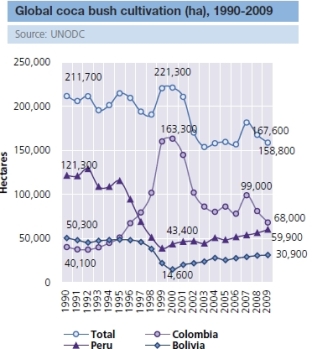
But paying off for exactly whom? For Peruvians in the coca business, among others. Because once again, the main effect of the coca fight has not been to reduce the size of the crop -- total growing only declined by five percent last year, an amount easily accounted for by changes in demand or other fluctuations -- but to shift it from place to place.

The uploaded graph here tells the story. From roughly 1990 to 2000, coca cultivation in Bolivia and Peru dropped dramatically. But Colombian growing increased just as dramatically. Demonstrating that supply will fill demand, when the kind of money is available to be made as the cocaine trade has to offer, total world growing of coca stayed roughly constant despite enormous shifts from country to country. The years 2003 to 2009 in a more gradual way show the same thing in reverse. And even the apparent drop shown from 2000 to 2003 is not what it seems, as 2001 saw the introduction of new, high-yield coca seeds. As the report noted, "[D]espite radical changes within countries, total cocaine output has been fairly stable over the last decade."

Of course it was: Prohibition doesn't work. We'll put the illicit drug trade out of business when we legalize drugs; in the meantime we won't.

The other report was written by colleagues of mine at the International Harm Reduction Association (IHRA). The report, about which my own organization published a feature story in our own newsletter last week, details the continued resort to the death penalty for nonviolent drug offenses -- in some countries, like Iran, a phenomenon on the increase. While it is Asian and Arab countries that are doing this, as IHRA noted and as I have on occasion, at the UN and in western nations we effectively have some of the blood on our hands too, through the funding our governments provide to their law enforcement agencies, and through the intelligence sharing and other cooperation our own agencies have with them. Our money and police power indirectly contribute to sending some number of nonviolent offenders to other countries' executioners.

UNODC had favorable comments to make about the report, telling Britain's Guardian newspaper it raised "legitimate concerns" about how global drug prohibition enforcement "may indirectly result in increased convictions and the possible application of the death penalty," and that UNODC had taken "concrete steps" to include human rights assessments as part of "all drug enforcement activities."

But while those words may have been meant by the people who spoke them, what officials at the UN and in relatively rights-respecting countries around the world have yet to say is that they are going to stop funding governments to track down nonviolent drug offenders if they subsequently might kill them. And the problem is by no means new news. China, for example, has for years marked the UN's International Day Against Drug Abuse and Illicit Trafficking with mass public trials and executions. Yet the UN continues to hold this annual "Day" despite seeing year after year the bloodshed it is prompting by some governments.

I submit that the UNODC's "human rights assessments" are not coming close to getting the job done. And I submit that a program which merely moves production and trafficking of drugs from place to place is not a program that actually helps people. UN drug policy needs to move out from the dark ages, and for that to happen, officials need to start facing not only facts, but the implications for policy that those facts have.


  • Comments
  • 13
  • Pending Comments
  • 0
  • View FAQ
Comments are closed for this entry
View All
Favorites
Recency  | 
Popularity
09:21 AM on 09/04/2010
Another well written piece Mr. David Borden. I had never heard of the UN's International Day Against Drug Abuse, or of it's fatal consequences. I'm happy to be better informed, thanks to you. Your words of wisdom resonate: "Prohibition doesn't work. We'll put the illicit drug trade out of business when we legalize drugs; in the meantime we won't."
HUFFPOST SUPER USER
Balzac
11:56 AM on 07/12/2010
The United League of Nations can go piss in a cup. I don't think the UN matters very much. Especially not with this kind of approach to drugs. What, the UN wants to be our global parents?
10:30 PM on 07/11/2010
"China, for example, has for years marked the UN's International Day Against Drug Abuse and Illicit Trafficking with mass public trials and executions. "

Just as I we were beginning to think that communism is a little better than we paint it.
photo
HUFFPOST SUPER USER
ray christl
HEMP can save us from ourselves.
10:18 PM on 07/11/2010
Dear David; Lively discussion on your article on cannabis culture magizine.com. This site of liberals and college educated comment on the two-headed cow ! Now you know why Obama still has all BUSH-DEA personnel in power.
11:11 AM on 07/15/2010
According to my understanding drug is the most one power to make the millions people die and make the country didnt has crime ,so the gaverment to protect or pervant it as soon as possilble.
12:56 AM on 07/16/2010
Yes, Thida. Drug is powerful, and make millions of people die, but why you claim "Drug didn't make the country has crime?" So drug keeps the country, and the world in peaceful way...no crime? I don't think so... amphetamine, morphine, opium...really make no crime?
01:22 AM on 07/16/2010
Yes, drug is most powerful, and millions of people die of it, yet why you confirmed"Drug makes the country didn't have crime". So you mean drug makes the world in peace, no violence, no crime...How about opium, morphine, amphetamine...?
photo
HUFFPOST SUPER USER
IzzyIdol
01:55 PM on 07/10/2010
As long as there is demand, there will be somone to supply. All this world wide drug paranoia and interdiction does is make drugs more valuable. Drugs equal tax free currency.
photo
HUFFPOST SUPER USER
ray christl
HEMP can save us from ourselves.
01:21 AM on 07/10/2010
To make the 5th comment on this vitally important subject?Thousands of posts about Mel Gibson/LeBron James shows how screwed up Americans have become. Mr.Borden devotes his life to scientific drug reform theory,and all we care about is false values of basketball/celebrity??? Global CIA-Mafia mayhem,and we have zero interest in understanding this sumptuary/sin law slavery.Decadent society of fear and Lindsay Lohan worship.
photo
HUFFPOST SUPER USER
Nicon
04:06 PM on 07/08/2010
David:

Are you keeping an eye on the rapidly changing Medical Marijuana world in Colorado? I hope so.
http://www.chieftain.com/article_9c1d775e-8a50-11df-87f4-001cc4c03286.html
the latest out of pueblo co.
photo
HUFFPOST SUPER USER
ray christl
HEMP can save us from ourselves.
08:09 PM on 07/07/2010
Victorian sumptuary law is now global fascism.The Swat Hell is creates allows almost anyone to be a target.This is its intended purpose,protect the king from democracy/rabble class.It maintains the old paradigm of King--serf positioning.Liberty is a joke with global CIA-Mafia controling the planet,and the poison of this Seth worship are nightmarish.
02:22 AM on 07/07/2010
The war on the coca leaf began with the First Council of Lima in 1552. The Catholic clergy in Peru believed that eradiating coca use (an invention of the devil) would make it easier to civilize the indigenous population. Peruvian Inquisition records demonstrate that coca prohibition was still producing drug trials by the end of the 17th century.
Despite continuous efforts by Vatican sadomoralists as well as foreign and domestic governments to eradicate coca, 458 years later, Peruvians still chew coca. Since Peruvians experience no ill effects from an acclimated habit that probable goes back many millennia, it’s reasonable to expect they will still be chewing coca 500 or 5000 years from now. Drug cartels will always have a viable source for new coca plants.
It’s obvious that throwing inquisitions and trillion-dollar prohibitions at drug consumers is pointless. Doing so is never a reality-based decision, but one based on xenophobias and culture wars. Once the intolerance starts, the situation always turns unmanageable.
10:19 PM on 07/06/2010
Oh, WOW!!!

We either have or have not pushed down the supply of ______ (insert "pot, coke, smack, meth, etc.). We either have or have not pushed up the price of _____. We either have or have not pushed up (or down) the strenght of _____.

Man, this is a hell of a drug war.

Oh, WOW!!!