
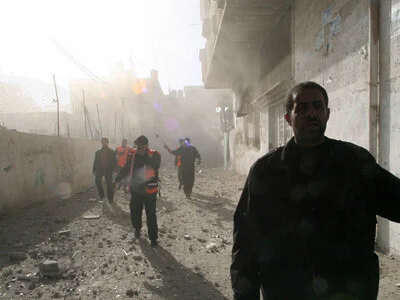
In the days before Israel's overwhelming retaliation, Hamas -- the anti-Israel terrorist sect and democratically elected majority party in Gaza -- harassed the towns bordering Gaza with missile attacks that made ordinary life impossible. It was a matter of chance that not one Israeli was killed by the missiles. Six days ago Israel launched its response: the first stage of a collective punishment which was six months in the making. Round-the-clock attacks by American-built F-16s and Apache helicopters targeted Hamas militants, and also hit the civic institutions of Gaza: a police school, an interior ministry, a president's guest house, a university. AFG Global Edition reported on December 30 that the first three days of the Israeli attacks saw 373 Palestinians killed (including 39 children) and 1720 wounded. Hamas fired into Israel more than 250 rockets and mortar shells. Four persons in Israel were killed and about two dozen wounded.
As American politicians have been careful to say, Hamas provoked the attack. But go back to the blockade of Gaza by air, land, and sea -- trace all the oppressions of the siege that after January 2006 turned this arid strip of land into a prison where fuel and electricity are non-existent and most ambulances do not run -- and cause and consequence become more complex. "Disproportion" hardly suggests the dimensions of the slaughter apparent in the unevenness of the two sets of figures above.
There is a word for the straightforward killing of enemies by a superior force where the victims are sparsely equipped and the odds one-sided. Much of the world is calling Israel's actions in Gaza a massacre. By contrast the American press has been cleansed and euphemized. "3rd Day of Bombings," said the New York Times headline on December 30, "Takes Out Interior Ministry." Takes out. The Times paid an involuntary homage to George W. Bush: "I think it's a good thing for the world that we took out Saddam Hussein." Under that phrase are half a million Iraqis killed and a country destroyed. And for Israel in Gaza?
The U.S. and Israel share many things. A form of government, it is sometimes said; a set of ideals. But much more in the past ten years the U.S. and Israel have shared a fantasy. The fantasy says that the Arabs understand only force. It says we can end terrorism by killing all the terrorists. The neighbors of the terrorists will be overawed. No new terrorists will be created. Finally, when every face on the president's fifty-two card deck is crossed out and the known composition of Hamas is dead, we can "address the social conditions" that foster terrorism. But perhaps there are no such conditions. Do the terrorists not hate for hate's sake?
You can see the shape of the fantasy most distinctly in the writings of those journalistic enablers who move into position as soon as either country starts a war that needs interpreting. "It was Israel at its best," writes Yossi Klein Halevi, a typical war broker, in a New Republic column posted on December 29. "In response to random attacks aimed at civilians, Israel launched precise attacks aimed at terrorists." Halevi does not add that the precise attacks killed almost 400 persons and that one death in every four was civilian.
Another war broker on Gaza has been David Brooks. In a column of January 29, 2006 entitled "The Long Transition," Brooks pointed out that democracy often leads to "bad choices." The people of Gaza, said Brooks, in electing the Hamas government had made a bad choice. This error he attributed to the "traumatic phase" in the gradual maturing of "a romantic, revolutionary people." It was the duty of America and Europe to teach the Palestinians to choose again until they choose right. The task was "to isolate Hamas" and devote our energies to "finding and fostering" an opposition to Hamas. The siege of Gaza, the rejection by Europe and America of the Palestinian Unity Government, and the attempted insurrection in Gaza by Fatah thugs bankrolled by the same powers, might all be said to be pardoned in advance by such a salutary intent.
But a fantasy is no wilder than the methods it answers for; and Israel and the U.S. now hold as common property a whole school of counterinsurgency tactics. The citizen of Baghdad who said of the wall General Petraeus built to separate the good from the bad, "This reminds me of another wall," was only saying what many Arabs must have thought when they reflected on the "surge" in Iraq and its precursor in the West Bank. Israel has most often, these past few years, been the teacher and the United States the pupil. An article by Dexter Filkins in the New York Times on December 7, 2003 reported that the rules of engagement used by the U.S. in Iraq were modeled on the Israeli rules for Gaza and the West Bank. On the other hand, what is happening now in Gaza is plainly modeled on the American "shock and awe" in Iraq; it derives indirect permission from the fact that Americans never regretted that first stage of what we did to Iraq. Also, somewhere in back of the Israeli methods are usually American equipment and an American brand name. Apache helicopters and F-16s for the missiles and the bombs, and a Caterpillar bulldozer to reduce the house to rubble.
There is one art of peace that Israel might have learned from the United States: equal rights and citizenship for all the people of the country. But this, Israel has not learned, and in the nature of its constitution it cannot learn without a radical change of self-definition. The difference ought to be a fact of some interest to the first non-white president-elect of the United States; but the response of Barack Obama to the slaughter in Gaza has been a nerveless silence. "If somebody," he said last summer, "was sending rockets into my house where my two daughters sleep at night, I'm going to do everything in my power to stop that, and I would expect Israelis to do the same thing." He has left it at that, for now, and made no comment on Israel's showing this week of the scale of obliteration that lies in its power.
Obama would not in fact do everything, he would not destroy a city of innocent people. But one may note the resonance of "everything," a word that crept into his usage once before and revealingly, in his AIPAC speech. There, Obama said three times that he would do everything to assist Israel against a threat from a nuclear Iran. When Israel is on the minds and the Israel Lobby script is in the mouths of American politicians, every statement takes on a quality at once categorical and unreal.
We have stopped thinking for long enough. We might start again with a definition. A terrorist is not a function X, the compacted essence of evil. A terrorist is someone who kills and approves the killing of undefended civilians to achieve political ends. Thus the Israeli commander who ordered the attack on the university in Gaza was an agent of state terror. The Hamas soldier who fired the missile that killed an Israeli woman yesterday was an agent of guerrilla terror. But terrorists, too, act from motives. To suppose their only instinct is a fevered hatred of everything we are is to yield to madness. Kill them all becomes the only imaginable policy then. Kill them, or else install a dependency so sweeping and abject that not a man in Gaza mounts a bicycle, not a woman crosses a street, not a child eats a morsel of food but by permission of the Israel Defense Forces. It is hard to see what else the current actions of Israel are looking toward.
The Democratic party grandee Ann Lewis said recently (as quoted in an excellent Salon column by Glenn Greenwald): "The role of the president of the United States is to support the decisions that are made by the people of Israel." The statement is absurd. No country ever gave another country so blind a endorsement. Such a pure identification of interests would amount to the signing away of the conscience of the nation that granted it. We cannot make our fidelity a pawn for another's injustice; and more than conscience forbids it. Prudence also does. Even in the depths of the Second World War the U.S. never said it would support every decision made by the people of Britain, nor did it say in the Cold War that it would do whatever the people of Formosa wanted, or what the people of West Germany wanted. Such a surrender of judgment, even if it were practicable, would be a curse that harms the receiver as much as the giver. To support without question the decisions of any person or any people, is to accept a standard of friendship or fealty above the standard of right and wrong. Do that, and you resign yourself to a world of injustice.
The eighteenth-century moral thinker Joseph Butler once gave us one of those sentences that are so true they earn a separate life for themselves. "Every thing," said Butler, "is what it is, and not another thing." Gaza is not Iraq then. Mumbai is not New York, and the contests against terrorists are not the War on Terror. Butler also asked once in passing: "Why might not whole communities and public bodies be seized with fits of insanity, as well as individuals?" We have seen it happen in our time. This surmise received vivid confirmation from the head of an IDF rocket unit in Lebanon who told the Haaretz reporter Meron Rappaport in a story published on December 9, 2006: "What we did was insane and monstrous, we covered entire towns in cluster bombs."
Israel and the United States have evolved, almost behind our backs, from the countries we read about in histories to militaristic societies widely seen as oppressors by those on the wrong end of our adventures abroad. Israel has the better excuse, driven half mad by threats and wars and the suicide bombings of the Second Intifada; but a series of queasy concessions to the fanatical colonists who are sometimes miscalled "settlers" have deformed its politics from within. The U.S. may now be the country with the stronger hope, and therefore the stronger partner. Anyway one thing is sure. When an allied nation goes out of itself, in the same sense in which a person may be out of himself, the work of a friend is to say no and no again and refuse to give the self-destruction our blessing.