
 Yesterday Google announced that it was rethinking its policy of filtering search results in China, prompted in part over concerns involving human rights activists.
Last week, Sen. Richard Lugar (R-Indiana) penned a piece in Foreign Policy, "Twitter vs. Terror," in which he argued that the U.S. State Department should "enable and encourage social-networking sites in the global fight for freedom."
It seems that in the wake of last year's Iranian elections, a great deal of attention has been focused on the role of unfettered Internet access as something akin to a basic human right. Finland actually made broadband access a legal right in late 2009. However, I'd guess the motivations were more economic than political. Access to affordable broadband is access to the single greatest economic engine humanity has known since industrialization. The twenty-first century story of the haves and have-nots will be framed largely in terms of access to the Internet.
If you've ever seen a map of global Internet traffic you know that large swaths of the world, and America for that matter, remain dark, without access to this great economic and political force. This March, as part of The American Recovery and Reinvestment Act, a National Broadband Plan will be put forth "to accelerate broadband deployment across the United States," with some estimates putting the total cost in excess of $100 billion. Now imagine I told you we could accomplish this goal for less money while also ameliorating the hold of totalitarian governments over their citizens, undercutting the recruiting power of terrorists, promoting global democracy, providing the means for millions to lift themselves out of poverty, and helping to save the Earth from global warming.
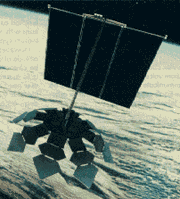
The trick is constructing a truly world-wide web, allowing everyone access to the information they need to build a better life. Unfortunately, the Iranian elections and the Great Firewall of China have demonstrated how sensitive such access is to state control. In the 1990s there were a number of companies with plans for launching a constellation of satellites capable of providing broadband Internet access to nearly every corner of the globe. The price tag was around $9 billion (~$13 billion today), and given advances in electronics, today's cost is probably considerably less. The rational for launching such a project today is laid out quite well in this piece by Robert X. Cringely, but suffice it to say, yesterday's impracticality may be today's sound investment. Totalitarian regimes limit the flow of information because they know that information is corrosive to their control. Terrorism feeds on the poverty and desperation of some while exploiting the misconceptions and insecurities of others. Giving people access to a global store of information counters both poverty and misconceptions. We are starting to see the effect of information access on the economics of the third world. In a common example, up-to-date pricing information communicated over cell phones is allowing farmers the freedom to cut out the middleman and maximize profits. Many developing countries oppose binding reductions in CO2 emissions because they fear it will hamper their economic growth, but with universal access to the Net they can leapfrog at least some of the dirty technologies upon which we have built our success. The benefits are too many to enumerate here. So I'll leave further exploration to the comments section below.
What is clear is that the time for action is ripe. Earlier this week, I was reading about a recent meeting between Secretary of State Clinton and a number of Silicon Valley luminaries, including Google C.E.O. Eric Schmidt and Twitter Founder Jack Dorsey. It was a brainstorming session to discuss the "21st-century statecraft" touted in Lugar's article and one suggestion stuck with me: "finding creative ways to ensure that Internet access is always freely available." I didn't take this to mean free in the sense of no-cost, but rather free in the sense that ones access to the Internet should not be unduly restricted. If there was a global I.S.P. in the sky, it would be rather difficult to restrict access both technically and politically. So why not do it? If we're going to spend the money to wire-up rural America, why not bring the whole world along for the ride and improve American and global security as a byproduct?
I can see at least three major problems, all of them human: (1) totalitarian states get upset; (2) our friends get upset; or (3) the American people get upset.
It's easy to see why totalitarian states would get upset. A free Internet is more than a potential source of competing information. It is a means by which citizens can share their stories with the world, and it is likely that such governments would attempt to block access by their citizens. The closest analog I can think of is the Voice of America which broadcasts across national boarders, often to the chagrin of totalitarian regimes. The legal issues here are a bit cloudy, but even if the satellites' broadcasts were seen as a violation of national sovereignty, it could be hard for a government to make this case to its people, especially as they saw the positive benefits such access visited upon their neighbors. As for our friends, some would surely object to the system as a power grab, an attempt at American hegemony. Perhaps this could be addressed by bringing them on board, say placing the system's governance with an N.G.O. or international consortium. In return for an initial investment, the U.S. would require only that this I.S.P. be operated in accordance with a set of free principles to be laid out beforehand, and the system's operators could pay us back over time. An inescapable consequence of such a truly world-wide web, however, would be increased access to non-American labor. Some jobs would surely be outsourced, but remember leveling the playing field doesn't only help others but ourselves too. We gain access to entirely new markets, and in launching such a system, we help insure that all Americans have access to the tools needed to engage the growing global economy. We also help safeguard the globe against the dangers of terrorism and totalitarian regimes, not to mention the dangers of global warming and poverty. By no means is it a cure-all, but taken together, I think these goals are worth reaching for the stars.