iPhone app iPad app Android phone app Android tablet app More

Featuring fresh takes and real-time analysis from HuffPost's signature lineup of contributors
David Dodge

GET UPDATES FROM David Dodge
 

What Is It Like to Live Next to a 136-Megawatt Wind Farm? Get It Straight From the Horse's Mouth

Posted: 09/25/2012 11:33 am

2012-09-24-HeidiHuffpo1.jpg

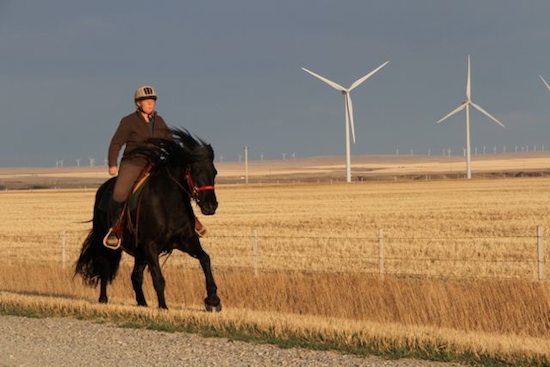
Heidi Eijgel (pronounced eye-gel) is an Alberta horse farmer who lives in the last house at the end of a gravel road surrounded by one of the largest wind farms in Alberta - and she's ok with that.

She moved to the windy prairie of Pincher Creek from the intensely developed Fraser Valley in British Columbia, attracted to the beauty of the fescue prairie landscape and to be close to her husband's family.

Their property is called Windy Coulee Canadian Horses and they raise well-trained and tough riding and driving horses. Only an hour away from rugged Waterton National Park they're built to handle the rough backcountry and Eijgel prides herself on the fact that a 20-mile mountain ride is a cakewalk for her stout, muscular horses.

Heidi trains horses, but she is also passionate about the environment. Her and her husband put a conservation easement on their land to protect the natural fescue prairie and riparian habitats and she can wax lyrical about the health benefits that horses get when eating native grasses.

They even approached a wind energy developer to see if they could have project on their land. Unfortunately, its location ruled it out. Being in a coulee, a deep prairie valley, means the wind is too turbulent for wind energy development. That doesn't mean it isn't windy though, it's enough to knock you over on a windy day.

In 2003, the 70 megawatt Summerview wind farm was built adjacent to Eijgel's property. She has been peacefully co-existing with that wind farm since 2003. In 2010 an additional 66 megawatts of wind energy was installed. We went to Eijgel's horse farm northeast of Pincher Creek to find what that it was like to have a wind farm developed next door.

Your Friendly Neighborhood Industrial Wind Turbine

When the Summerview wind farm was proposed Heidi had some concerns.

"I was worried about a lot of things, the fescue grassland, which is the native grassland around here is one of the most invaluable remnants of nature left. It's unbelievably beautiful and it hosts many birds," said Eijgel.

Concerned about the wildlife impacts Eijgel did her homework. When the time came for a meeting with the developer she was ready.

"The nice thing about it is that the questions were answered right away," said Eijgel. "We met with someone who knew everything about wind farms and they brought up some things that we weren't really aware of."

"I did have a concern about noise and they related the noise that we might expect to hear to be comparable to the refrigerator in the house," said Eijgel.

Since then about a dozen wind large Vestas wind turbines were constructed within 1.5 km of her home, the closest being 700 metres.

By sheer chance at the same time an oil and gas company wanted to drill for sour gas on their property. After multiple meetings she still wasn't happy due to an inadequate plan to deal with her horses in case of an emergency.

"I was stressed and in tears many times talking to that company afraid that I might have to leave my farm because I didn't want to live in an emergency evacuation zone. The wind company was almost a relief to talk to. One meeting at our convenience and it was great."

If an oil and gas company has the mineral rights to a piece of land, property owners are obligated to negotiate with and accommodate the development. It's a far cry from wind energy where developers have to be invited onto the land in order to develop the resource.

Lawnmowers, traffic, blenders and wind turbines

It might seem obvious to say but the wind is a rather loud weather phenomenon. It's no rolling thunder, but when the wind is blowing it's easy to underestimate just how loud the wind it can be.

When the wind is really blowing all Eijgel can hear is the wind in her ears or if she's inside, the wind hitting the house. During low winds she can hear the turbines and she likens them to a train off in the distance. Like the wind though, they've become background noise for the area.

At 500 meters a wind turbine puts out roughly 40 decibels, roughly the same as the compressor on your fridge. The closest turbine to Eijgel is 700 meters away from her home.

The design of their house ended up working to their advantage as well.

"Once the wind farm was here we realized that we had built our house very well. Not that we planned it but with our windows facing east and the wind farm upwind of it we really do not ever hear wind turbines in our house."

The Bats and the Birds

One year after the turbines were installed the company reported an unusual number of dead migratory bats under the wind turbines. TransAlta hired scientists to determine the cause of these bat deaths in 2006. Two researchers from from the University of Calgary determined that it was the sudden changes in air pressure behind the spinning blades that killed the bats.

Eijgel says they'd run into the researchers along the road at night and "they invited us in - you could see little blips of the bats flying."

In 2009 TransAlta conducted a large scale experiment to reduce these bat fatalities.

By not allowing the wind turbines to turn in low winds the researchers were able to reduce bat fatalities by 57 to 60 per cent.

So is Eijgel comforted that the birds and bats are ok?

"I think people need to keep watching and people need to keep monitoring," says Eijgel.

Alberta horse farmer tours Ontario

With nearly a decade of experience living next to a wind Eijgel was invited by Tim Weis of the Pembina Institute to head to Ontario on a speaking tour. .

At a series of three presentations in London, Grand Bend and Chatham-Kent a vociferous group of anti-wind protestors traveled from meeting to meeting to protest, heckle and disrupt the presentations.

A reporter at the Lakeshore Advance wrote: "One (audience member) told QMI Agency he has never been so embarrassed by a group of adults who could not control their tempers. At one point the OPP (Ontario Provincial Police) was called to control the irate crowd.

The reporter continued: "During the chaos, a former educator from Exeter said he attended so he could hear what was being said and if people wanted to behave in this manner they should leave. He said the average person is 'not radical and wants to hear the information.' The loud objections to the meeting did not stop so the man left."

In this environment Eijgel managed to complete her presentations and was still positive about the whole experience.

"Personally this was a pretty amazing experience to be able to share my personal thoughts on one of the most important topics that I can ever share my thoughts on."

Polling has repeatedly found a significant majority of Ontarians and Canadians support reducing our reliance on fossil fuels and creating more jobs in clean energy.

In a Massachusetts study (page 27) on wind and health effects people who were financially benefiting from wind turbines experienced "virtually no annoyance regardless of whether those people could see or hear a turbine." By democratizing and spreading around the financial benefits of wind energy development you end up with far less community opposition.

This is why he highlighted the work of groups like TREC and the Peace Energy Cooperative and continually talk about the individual and community ownership levels of renewable energy in Germany and Denmark.

Gone with the Wind

After her London talk I asked Eijgel why she did it. She said "There's only a few things that I think you really need to stand your ground on and speak out on and for me ... the most important is protecting the natural environment."

As for her support of renewable energy, the horse farmer from Pincher Creek says it well.

"It makes business sense, it makes environmental sense, but really these are air molecules that are flying by here and they are going to fly by whether we use them or not... With a wind farm or a wind turbine, if anything goes wrong with it, it's not going to be an environmental disaster, we're not going to have radiation here for a hundred thousand years in the future. We're not going to die in our sleep if there's a sour gas problem - wind turbines are very safe for us and for our communities"

-30-

For more resources debunking several of the myths propagated by anti-wind forces head to our latest episode and check out the resources and the extras.

Loading Slideshow...
  • Out for a trot

    Heidi Eijgel lives on a horse farm surrounded on three sides by the Summerview wind farm in southern Alberta. Photo David Dodge, Green Energy Futures

  • Luna the horse

    Heidi Eijgel on her horse Luna, a Canadian horse. Canadian horses are known for their stocky, muscular build and their hardiness on the trails.

  • Keep on turning

    Here are several of the 61 giant wind turbines in the 136 megawatt Summerview wind farm northeast of Pincher Creek, Alberta. Photo David Dodge, Green Energy Futures

  • Here are seven of the 61 giant wind turbines in the 136 megawatt Summerview wind farm northeast of Pincher Creek, Alberta. Photo David Dodge, Green Energy Futures

  • Moo

    A seemingly healthy cow grazing amidst the turbines.

  • Summerview Wind Farm

    Summerview wind farm near Pincher Creek, Alberta.


Follow David Dodge on Twitter: www.twitter.com/greenergy_dave

Heidi Eijgel (pronounced eye-gel) is an Alberta horse farmer who lives in the last house at the end of a gravel road surrounded by one of the largest wind farms in Alberta - and she's ok with that. ...
 
 
  • Comments
  • 24
  • Pending Comments
  • 0
  • View FAQ
Comments are closed for this entry
View All
Favorites
Recency  | 
Popularity
This user has chosen to opt out of the Badges program
photo
marklemagne
It's it's if it is it is, it's its if it's not.
10:56 AM on 10/03/2012
How does she feel about the high-tension wires that run the electricity to remote users? If you like wind farms you better like high-tension wires too.

Also, I'm not familiar with Canadian tax law, but in the United States the wind industry has set up some really nice tax loopholes that help investors like JP Morgan Chase and T. Boone Pickens, etc. avoid taxes through write-downs and depreciation. Please don't say that JPMC and other corporate investors are doing this because of their altruistic spirit.

I support intelligent use of wind energy, but -- gasp -- it should be regulated like any other utility so that the primary benefit of wind farms is cleaner energy...not corporate profits.
12:01 PM on 09/26/2012
The wildlife kill still remains a problem that should be further addressed. Also, there is not one single type of turbine. Articles do not advise people of that fact enough (hardly at all).

Different turbines can be appropriate for different areas. For example, perhaps the size of turbines should be decreased as they approach where people are living, and the size can increase as they move away from where people are living. Our decision making suffers way too much from a "black and white" and "one size fits all" mentality.

I've long been wondering with the bat kill problem why the turbines couldn't have an ultrasonic sound generator that sent out some noise to warn off the bats. It could probably be above the range of human hearing, and it wouldn't be necessary to make it that loud to being with. Some university should get funding from the industry to experiment with the concept.
11:09 AM on 09/26/2012
They aren't attractive but I am sure it beats living down-wind from a nuclear energy plant.
HUFFPOST COMMUNITY MODERATOR
JScott
John Galt's last name is McGuffin-Smithee
10:37 AM on 09/26/2012
I've noticed when driving thru the wind farms at San Gorgonio Pass, the newer larger and slower turning (and more efficient) wind turbines are less noisy than the older models.
photo
HUFFPOST SUPER USER
aligatorhardt
Cut on the bias
02:02 AM on 09/26/2012
Well, considering that coal pollution is responsible for 30,000 premature deaths/year (PHysicians for Social Responsibility), mountains are leveled, streams trashed, coal's major push of climate's deadly changes (which will cost trillions), and that cats kill millions of birds/year, Wind Power seems, in comparison, pretty benign.
07:35 AM on 09/28/2012
All the lighting at night in city and sububian settings kill far more birds and disrupt mating and hunting balances that effect many spicies. So before we gripe about a a relitivly small fraction caused by wind turbines maybe we can go win-win and cut the unnecessary lighting and point the remainder where we Need it the most, and eliminate the need to produce power to run all the unneeded lighting.

Just a thought.
09:44 AM on 09/28/2012
I like it!
This user has chosen to opt out of the Badges program
photo
marklemagne
It's it's if it is it is, it's its if it's not.
10:59 AM on 10/03/2012
I think from a cost-benefit analysis point-of-view cats less of a threat to birds than a wind turbine farm.
Genders
Love, Tolerance, Enlightenment
07:38 PM on 09/25/2012
There are rural places for onshore wind. Far from migratory bird paths, of bats habitats. Bit offshore is the best place for wind., near the big coastal cities so no grid problems.

combine that with rooftop and parking lot solar, electric cars and waste char energy and fuels and you have a complete 24/7 system that is 24/7, uses existing peak generators for backup, is forever, clean and safe.

Once we extract the materials needs, we can recycle them forever.

Not so with fossils and nukes, we would have to keep mining forever.

3KW 100lb rooftop solar panels systems produces as much electricity as a full 110 ton coal car, or 70 tons of oil, and the panels can be recycled.

It's obvious.
This user has chosen to opt out of the Badges program
photo
marklemagne
It's it's if it is it is, it's its if it's not.
11:01 AM on 10/03/2012
No grid problems? To support the grid you need to get the electricity to the cities. That means lots and lots of high-tension wires and towers. Not a good thing.
Genders
Love, Tolerance, Enlightenment
05:39 PM on 10/03/2012
BS.  Rooftop solar reduces grid load. 
Cities already have a large grid to connect to.  You run underwater cables to shore.  that's it.
Nukes have to be sited  away from cities for safety  and they do require your high tensions lines.
Besides which is, not like we don't have lots of high tensions lines already.  
learn something.
photo
HUFFPOST SUPER USER
Linus521
In wildness is the salvation of mankind
06:05 PM on 09/25/2012
Heidi said, the most '"mportant thing is protecting the environment". What is protecting the environment, exactly? Is slathering the natural, life giving surface of the Earth with wind and solar protecting anything? How about all the mining done for wind, and solar is mined from a rare Earth mineral? When we kill birds and bats, are we protecting the Earth?

Humankind is alive because of the Earth's natural and wild life giving surface or ecosystems. Any agent that kills ecosystems and their plant and animal biodiversity, like birds and bats, kills the Earth's ability to create and support all life. Plant and animal biodiversity create and sustain all ecosystems, and ecosystems supply humankind with all his life giving and supporting cycles, systems and services.

Destroying ecosystems' plant/tree biodiversity, destroys the Earth's climate cooling water cycle. Skinning ecosystems for wind and solar destroy the habitats/homes, shelter, food, cover and nurseries of all animal biodiversity. Earth's ecosystems and their biodiversity are the eco-nomy of life itself.

If we slather the Earth with wind and solar, we aren't protecting the Earth's ability to give and support all life, including our own existence. Both birds and protect are in the eco-nomy of protecting human existence. All life on Earth is interconnected, like the strands in a great web of life,
photo
HUFFPOST SUPER USER
samearl
What is truth?
01:43 PM on 09/26/2012
I'm curious. Since you are so dead set against wind then are you supportive of fossil fuels or if not what other alternatives do you offer?
photo
HUFFPOST SUPER USER
Linus521
In wildness is the salvation of mankind
03:19 PM on 09/26/2012
I am supportive of oxygen releasing, the atmosphere, the climate cooling water cycle, the sequestration of the greenhouse gases, the natural regulation and moderation of the climate, the viability of a living soil and the very biosphere or a life giving and sustaining planet.

When man skins ecosystems for any reason, he is destroying every and all reasons he is alive, regardless if it is for concrete, asphalt, shopping malls, sprawl and dead fields of wind and solar. And, when man pushes extinct biodiversity, like birds and bats, he is causing a danger to his existence, right up there with thermonuclear war, according to some of the most recognized ecological literates.

You are alive because of wild, natural ecosystems, and ecosystems support all life because of the wealth of their plant and animal biodiversity, all being destroyed in California for alternatives.

We need to shift our current paradigm, seek energy conservation, re-use and reduce, and simplify our lifestyle because concurrently, we are killing the Earth's ability to support human existence, and birds and bats protect mankind from global, human disease epidemics.

Instead of killing the planet, why not incorporate the alternatives where man actually needs it, like on every rooftop or a small windmill for every backyard? When they kill Earth for the alternatives, the energy must be "piped" in, killing more of the Earth.
This user has chosen to opt out of the Badges program
04:50 PM on 09/26/2012
rooftop solar, passive heating/cooling and efficiency upgrades. no dead wilderness; no long, unreliable, power-leaking, SF6-spewing transmission; no blight; no noise; no endless repairs of moving parts; no fires; no dynamite; no huge upswing in disease vectors (because the bats and raptors are dead or avoid the area); and best of all - reduced, not increased power bills and reduced Big Energy dominance over our lives.
05:06 PM on 09/25/2012
According to Ontario's Regulation 359/09, a dozen 1.8 MW wind turbines would probably require a setback of 1.5 kilometers. She has a dozen 1.8 MW wind turbines within 1.5 kilometers of her house with no problems at all.

550 meters is for smaller numbers of smaller wind turbines. A dozen 1.8 MW wind turbines wouldn't qualify.

Good for Ms. Eijgel for exposing herself to the virulent anti-wind lobbyists and telling the truth about what it's like to live with this great vertical crop.
03:44 PM on 09/25/2012
Wonderful for Heidi. She fortunately for her, does not have turbines that are nearly the same size as the ones being built in Ontario. Plus, the closest turbine to her is 700m, while in Ontario, the distance is 550m.

I'm assuming that the Huffington Post, in fairness, will next do an article about a family in Ontario that has had to abandon their home and property, due to the illnesses caused by having these 500-foot monstrosities built so close to them.

I'm anxiously awaiting the article.
photo
HUFFPOST SUPER USER
Paul Stacey
What?
08:29 AM on 09/26/2012
Well, I assume you know who this family is. Even if HP doesn't want to publish the story, there are plenty who will. Then you would have references.