
Sen. Lamar Alexander, R-Tenn., has a "Low-cost Clean Energy Plan" being marketed to people with substandard reading skills. His press release claims his plan to build 100 nuclear power plants will "lower utility bills," though it "should not add to the federal budget since ratepayers will pay for building the plants." In other words, the people in Missouri, Ohio, Michigan and elsewhere who get their electricity from coal-fired power plants should see their utility bills skyrocket. Here's a reality check on Alexander's flimflam.
The Republican plan proposes to double the level of U.S. nuclear energy generation in 20 years. How much would that cost? We currently have about 100,000 megawatts of nuclear generating capacity, and the cost of building a nuclear plant is about $7.5 million per megawatt, according to Moody's. So the cost would be about $750 billion. On a per megawatt basis, a nuclear plant costs five times as much to build and 10 times as much to operate as a natural gas plant. The $750 billion cost excludes the cost of shutting down the CO2 emitting coal-fired plants.
Now bear in mind, outside of a need to reduce carbon emissions, there is no economic basis for building 100,000 megawatts of new baseload generating capacity, especially in the states most reliant on coal power. Almost all the fuel currently used in our power plants, coal and natural gas, is produced domestically. Nuclear power has a lot of issues, but it does not emit CO2, so there is a rational basis for considering nuclear as one of several solutions to climate change.
Alexander proposes that construction costs would be financed with loans from the federal government, since the private sector would not take the credit risk. As Moody's notes, the "cost and complexity of building a new nuclear power plant could weaken the credit metrics of an electric utility and potentially pressure its credit ratings several years into the project." Of course, none of that lets the ratepayers off the hook. Most of what we pay in our utility bills covers the cost of capital infrastructure, not fuel or other operating costs.
Moody's estimates that it takes about 10-15 years to build a nuclear plant. So it would be more than a decade before we would see any real reduction in CO2 emissions from Alexander's plan. During that decade, the damage from greenhouse emissions will only be more disastrous.
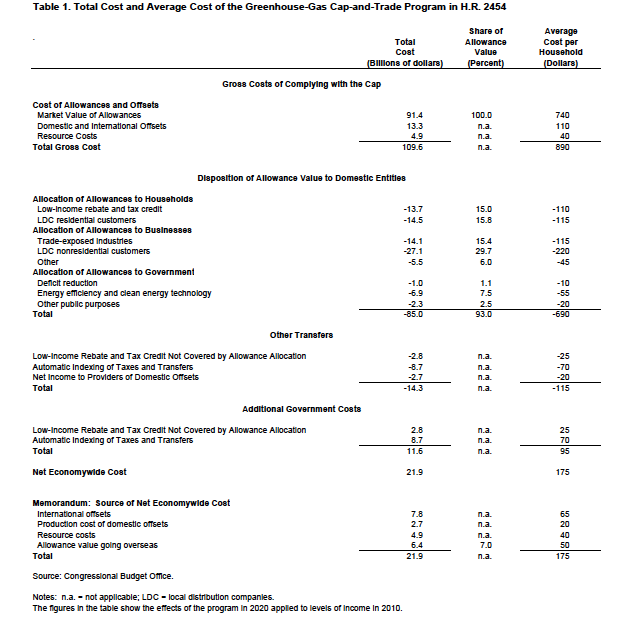
Alexander offers up his plan as an alternative to the current proposed cap and trade legislation, which is designed to begin greenhouse gas reduction right away. He describes the House Bill as a "$100 billion a year national energy tax." Once again, he panders to people who don't know how to read, because the $100 billion refers to the gross cost, not the net cost. The net cost is more like $22 billion a year, or about $175 dollars per average household, according to the Congressional Budget Office. (See CBO calculations below.)
Anything that addresses the issue of climate change involves a tradeoff, and nuclear power may very well be one part of the long-term solution. But this Republican scheme offers nothing to reduce greenhouse emissions in the short run. Alexander's claim that it imposes less of a financial burden on utility ratepayers than the current House Bill is close to fraudulent.
Addendum, July 15, 2009: Salon's Andrew Leonard reports on, "The ridiculously high cost of nuclear power."
Without any doubt it will be as environmentally as production friendly direction.
Trees will work as huge pumps to evaporate water-using energy of sun. Water vapors as lightest than most others gases will go up to clouds levels, where latent heat capacity of producing droplet of water will easily escapes to space. This is natural source of cooling the Earth surfaces. More clouds will reflect to space more sun energy and additionally cool the Earth.
North America is only one huge land from France to Japan. Cooling air with help of forests in places where we growing corn or grass for ethanol production all around USA, Canada and Mexico will mild climate in North America. It will reduce power of weather disaster and more important reduce movement of air from south to north-main reason of melting ice in Greenland.
On the other hand, if we use the wood and crops for food, clothing and shelter we can still use to energy when We would otherwise spend money to dump it.
Waste BioFuels and energy makes sense.
Growing fuel and energy does not.
rooftop solar energy is much cheaper than bio electricity, at this time. And it is much more efficient, since the sun conveniently optically distributes the energy for free.
In small power plant which use as electricity as heat we use 3-4 times energy sources compare with huge power plant, where we loosing 80% of energy in vain.
In this case 300,000,000 acres of forest enough to cover all projected energy needs for US, where right now we have 600,000,000 acres of forest.
Forest could provide not only energy, but also food, it will increase not decrease production of food in any country.
Growing trees will take a lot of GHG from air and will allow to use any others source of energy.
Take a little visit over to Pripyat in Russia and see how clean that city is. It is very untidy since it's entire population of 14,000 people had to drop everything and run for their lives when Chernobyl went down. I wonder how many of those hastily built 100 nuclear reactors would go China Syndrome?
IS that so hard to understand?
At least when pilot sees wind turbines he's not going to think about of trying to do some cool acrobats through wind turbines blades. Multi-ton blade vs aircraft = massive fly swatter.
Next let's agree that big nuclear power plants are so 40 years ago! It doesn't make any financial sense to build these big facilities any more. They cost too much, they take forever to build, the government has a hard time regulating these facilities, and no one wants them in their backyard. They are 'make work' projects that the politicians can control.
Now private industry, realizing that there is a need for clean economical energy, is developing small nuclear power plants that can service 20,000 residents at a time. The units are the size of a hot tub, and if nuclear is the answer for certain areas of the country, this might be the way to go.
http://www.hyperionpowergeneration.com/about_tech.html
They have already acknowledged down here in FLA that for the cost of a nuclear power plant, the power company could provide the solar equipmment for all Florida homeowners to generate their own hot water by using the power of the sun.
One last point, who ever wrote this article is extremely bias, Huffpost should have at least one article that argues the merits of nuclear power. There are many well know environmentalist that see the potential of nuclear to help reduce our emission, like James Lovelock who created the GAIA principle:
http://www.youtube.com/watch?v=OOaDY13bI84&feature=channel_page
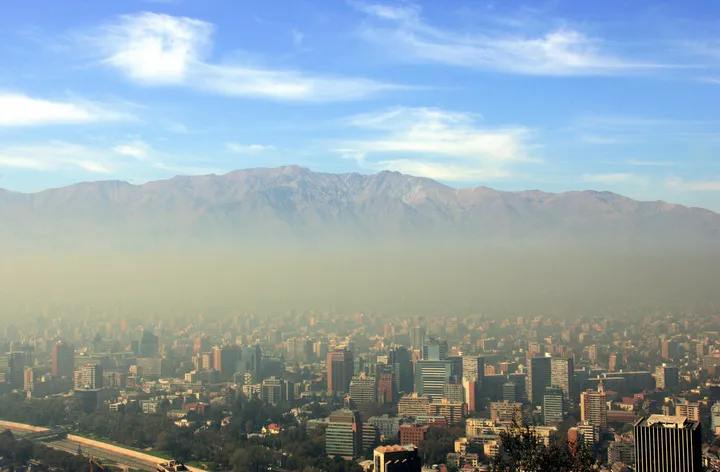
But what really gets me is the scare tactics of the anti-nuclear people. Just look at the picture for this article it's city cover in green smug. What? why dont they have a picture of a city that's truly power by nuclear power like Paris, but I guess that wont still fear into people.
Regardless...nuclear power may not emit CO2 but the bottom line is STILL...THERE IS NO SAFE DISPOSAL OF NUCLEAR WASTE. And that is only the most toxic...long lasting substance in the world.
There are no containers in existance that outlives the half-life of nuke waste.
2$ per peak watt, 3 cents per KWH.
750B$ will buy 375 GW peak solar, which on appropriate roofs, will supply about an average of 100 GW average. And it will supply that power when we need it most!
See my profile for details and links.
You are misleading yourself and public opinion about solar panels.
They are expensive, need batteries and always need energy from usual grid.
Receiving energy from solar cells and usual greed make this direction at least twice expensive.
Of cource we could use it in places, where they are economically profitable, but please reevaluate your agenda.
The nuclear problem is that construction will take decades and we don't have the time. Solar and wind can be brought online much faster, much cheaper and no waste.
Nuclear is more susceptible to earthquakes as far as density of damage goes. And is not nearly as portable as solar and wind.
http://en.wikipedia.org/wiki/File:Us_pv_annual_may2004.jpg
You apparently want to believe that humans are a plague on the planet, and technology is always bad, that we should return to wood burning and horses. Your way requires 5 billion people die.
I listed where you can buy the solar panels for less than 2$ per watt. No matter what you WISH to believe, that works out to 3 cents per KWH over 30 years.
Since it's Grid connected, as I have said 100 times, it needs NO BATTERIES.
They don't take energy from the gird, the SUPPLY energy to the grid when it is needed most.
Why don't you post your ideas to your profile, as I have done, with links, calculations and proof.
Otherwise, your are just wasting time.
Additionally, the EPA plans to enforce hardrock mining cleanup efforts beginning in 2011. This act will replace the Superfund cleanup operations that have occurred at abandoned uranium mines. This means that future mining operations will add that cleanup bill to their cost of operations in the future. Costly and dirty - nuclear is as dirty as coal if you consider the similarities with mining and even further with waste.
There have been significant advances in uranium mining that have drastically reduced the environmental impact.
http://www.world-nuclear.org/info/inf27.html
Arguing that we should not pursue nuclear because the enrichment plant is powered by coal generation is somewhat a chicken & egg argument (should we not produce photovoltaic cells because the production facilities are powered by oil?). I am not aware of any technical reason that the enrichment plant runs from a coal source, I think it is just a coincidence of its location.
"Nuclear is not as dirty as coal" - You're right - radiation poisoning is not as dirty as coal, but it is much deadlier. In situ mining is mining - the only difference is that the problems have been pushed underground.
If you think that the enrichment plant in the U.S. is the only plant powered by coal, then you don't know your nuclear power processes. Do you even know how many enrichment plants are in the world, where they're located and what they use to enrich uranium? Do you even know the history of the Paducah plant? The lawsuits? The pollution? Learn, baby, learn.
why would we invest 5 billion into construction costs alone for a nuclear plant, when we can spend that on renewables such as wind and solar.
with nuclear we have construction cost, operating cost, waste disposal cost, and cost of decommissioning.
with wind and solar, we have construction costs and limited maintenance cost. couple this to fuel cell power for night-time and low-wind time we have the perfect solution.
it's not rocket science. the Europeans and the Chinese are already doing it. Spain gets 20% of its electric needs via wind.
only in America could this be even debated when sound research and investigation by other governments have offered a solution.
wind + solar + hydroelectric + fuel cell. why are do we continue to pollute the air that we breathe and the land we live on? only in America!!!
Then there is the problem of yellowcake. It does not grow on trees. It is in limited supply.