David Fiderer

David Fiderer

Posted: March 9, 2009 04:01 PM

The Simple Arithmetic of the Mortgage Crisis Debunks Right Wing Media Narratives

digg Share this on Facebook Huffpost - stumble reddit del.ico.us RSS

Five months ago, when the world trembled at the specter of a global financial meltdown, Rep. Darrell Issa of California ran on to Hardball to deliver a "f____-you" to his constituents. They live in San Diego and Riverside County, Ground Zero in the foreclosure crisis.

Explaining why he worked to defeat the bipartisan bailout deal intended to stabilize the mortgage markets, Issa, who had previously voted against laws to curtail predatory lending, blamed the Treasury Secretary. "You know, in fairness to Hank Paulson, I don't know him well, but I know enough he's not a banker, he's comparatively a day trader," said Issa. "We need him to get bankers to say how you stabilize long-term assets and stop treating it like it's Goldman Sachs." Issa's poison darts foreshadowed the current rhetoric of Newt Gingrich, who rails against the "Bush-Obama continuity in economic policy."

Why do fabulists like Issa can get traction in the media? One reason is that many talking heads still lack a command of the basic data. So much coverage of the financial crisis remains fragmentary, vague and anecdotal. For businessmen, the narrative is always framed by the numbers, the bottom line. There's no way around it. If we want to grasp how we got in this mess we need to look at some numbers.

Here are the salient numbers, simplified in a user-friendly format, that get to the heart of the matter.

They explain the year-old diagnosis rendered by a Presidential Task Force headed by Hank Paulson:

"The turmoil in financial markets clearly was triggered by a dramatic weakening of underwriting standards for US subprime mortgages, beginning in late 2004 and extending into early 2007."[Italics in original text.]

Why would subprime mortgages unravel the entire system? First of all...

Home mortgage debt is HUGE.

The residential mortgage market dwarfs the market for Treasuries. By the end of 2000, home mortgage debt in the United States was about $4.8 trillion, or about 1.4 times the Federal debt owed to the public. By the end of 2007, home mortgage debt had doubled, to $10.5 trillion, or 2.1 times the national debt. Since then, Federal debt has jumped up, to $5.8 trillion at September 30, 2008, whereas home mortgage debt has remained flat.

Home Mortgage Debt [$ trillions as of Dec. 31]
2000 $4.8
2003 $6.9
2007 $10.5
Source: Federal Reserve

Of course, this comparison understates the relative debt burden on homeowners, who, unlike the U.S. government, can neither roll over their debt indefinitely, nor print money.

Debt of the Federal Government [$ trillions as of Dec. 31]
2000 $3.4
2003 $4.6
2007 $5.1
9/30/08 $5.8

[The foregoing debt reflects amounts owed to the public. Most of the government debt racked up during the Bush years, excluded from the numbers above, was "borrowed" from the Social Security surplus.]

Home mortgage debt is central to the solvency of the financial system and, perhaps, to the U.S. government. Over eight years, the one category that grew as rapidly as home mortgages was the size of debt owed by financial entities. The two categories are related.

Debt Owed by Financial Entities [$ trillions as of Dec. 31]
2000 $7.4
2003 $10.9
2007 $16.2
Source: Federal Reserve

If you fear that some of that $10.5 trillion in home mortgage debt might be eventually converted into obligations of the U.S. government, you're ahead of the game. Almost half of the domestic financial sector debt is already owed by Government Sponsored Entities, or GSEs - Fannie Mae, Freddie Mac, Ginnie Mae - either through mortgage securities that they guarantee, or through corporate bonds that have an implicit (perhaps soon to be explicit) government guarantee.

Debt Obligations of Government Sponsored Entities [$ trillions as of Dec. 31]
2000 $4.3
2003 $5.9
2007 $7.4

Another big factor in the debt markets is other asset-backed securities, which totaled about $4.5 trillion at the end of 2007. Of that amount, $2.1 trillion represents securities backed by home mortgages. These mortgage securities, known as private label securities, are fundamentally different from those underwritten by the GSEs, which imposed standardized quality controls over the entire mortgage lending process. Private label securities were neither standardized, nor were they subject to prudent credit controls, which is why they have incurred 60% of all mortgage defaults, and why they are difficult to value or trade.

Private-Label Residential Mortgage Securities [$ trillions as of Dec. 31]
2000 $0.5
2003 $0.6
2007 $2.1
Source: Federal Reserve

Of course, the Federal government also guarantees bank deposits (bank liabilities) which do not show up in the Federal Reserve numbers shown above. The safety of those deposits is also dependent on the recovery of mortgage loans directly or indirectly held by financial institutions. There's a simple rule of thumb to remember about the banks' ability to lend. For every dollar reduction in bank equity, a bank's lending capability is reduced by at least ten dollars. So if banks lose a trillion dollars from defaulting mortgage loans, their ability to lend is reduced by $10 trillion.

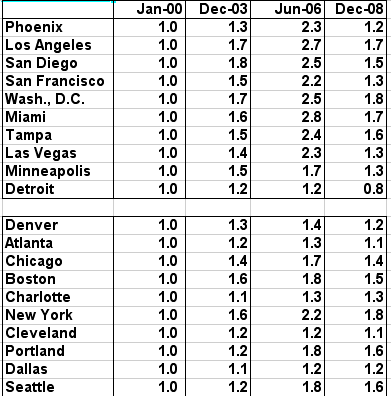
Home mortgage debt increased with the real estate bubble. While the connection would seem obvious, it's worth noting that the bubble was concentrated in some markets - especially in California and Florida - and not others. There was never much of a post-millennium bubble in Texas or Colorado, for instance. The Case-Schiller Housing Index is a user-friendly tool for tracking what happened over the past 20 years. It uses a January 2000 benchmark price of 100.00, further simplified here as 1.0.

With 1.0 as the January 2000 starting point, we can compare benchmark prices as of December 2003, before mortgage underwriting standards were weakened. Then we can see how, in the top 10 of the 20 markets listed below, the bubble inflated prices by June 2006.

Case-Schiller Housing Index
2009-03-09-Picture3.png

In just over 30 months, near the peak in the bubble around June 2006, home prices had risen in Miami and Phoenix by about 75%. By December 2008, index prices, the most recent available, had essentially returned to the same levels seen at year-end 2003.

If you're someone like Rick Santelli, who lives in the Chicago area where the bubble was fairly contained, you may be inclined to think that the problem is limited to a small number of reckless individual borrowers. Those with a firmer grasp of the financial markets know otherwise.

The real estate bubble affects everyone. Most home purchases were made by people with good credit who took out standard prime loans after paying 20% down. The real estate bubble affects those people and the entire financial system, not just people who took out mortgages they could not afford. Using the Case-Schiller Index as a benchmark, anyone who took out a mortgage with 20% down during 2005 though 2007 in the top ten markets listed above now has negative-equity. His home is worth less than his mortgage. Distressed homeowners in those markets may ask the question, "Should I hand over the keys and walk away?"

And many people financed more than 80% of the appraised value. Many people, especially in California, financed up to 100% of their home's purchase price with 2nd lien financing. Those subordinate loans probably have a value that's close to zero. In late 2004 a different type of subordinate financing of residential mortgages took off, in the form of collateralized debt obligations, or CDOs. The current market value for a lot of those CDOs is also approaching zero.

Another form of 2nd lien financing was home equity lines of credit, which, as Alex Blumberg reported on This American Life, some homeowners used "because people needed them to continue making their original mortgage payments." [Every American should listen to "The Giant Pool of Money."]

According to Economy.com, about 10% of homeowners have zero or negative equity.

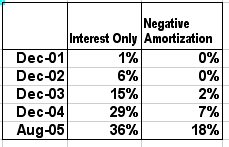
The real estate bubble inflated where exotic mortgages were popular. At the height of the real estate bubble in the summer of 2006, the FDIC did a study which examined the impact of new exotic mortgage products, which began to take off in 2004. While the subprime mortgage business had been around for a while, innovative features - such as interest-only or negative amortization - only came into common use in late 2004.

Subprime Mortgages With
The following Features
2009-03-09-Picture4.png


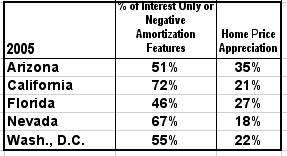
The FDIC study found a correlation between the popularity of interest-only or negative amortization features in non-prime mortgages and the price appreciation in local real estate markets.
2009-03-09-Picture5.png

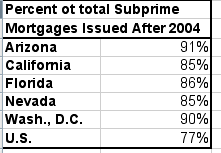
Subprime mortgages took off after 2004. Subprime mortgages had been around for a long time. But their popularity took off in late 2004. Most subprime mortgages were issued after 2004, according to a survey by the New York Federal Reserve.
2009-03-09-Picture6.png

Subprime mortgages were not used primarily for new home purchases.
One of the familiar media narratives is that subprime loans were used as part of a government policy to make home ownership affordable to low-income people. But in fact most subprime loans were used to refinance existing mortgages, and not for new home purchases. And most of those refinancings were also used by home owners to take out more cash from their home equity. The cash-out may have been used to pay down credit card debt.
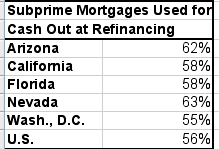
2009-03-09-Picture7.png

Many people who would have qualified for a traditional prime mortgage took out a subprime mortgage instead, based on the recommendation of mortgage brokers, who earned bigger upfront fees from the subprime product.

A big percentage of subprime mortgages had inadequate documentation. It's easy to engage in mortgage fraud if you don't need to prove your income or your net worth. And the proliferation of "no income, no asset" mortgage loans did just that. It was an invitation to fraud. This product was most popular in California and Florida.
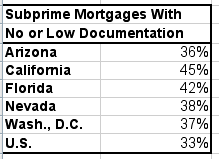
2009-03-09-Picture9.png

Most subprime mortgages had adjustable rates. Most subprime mortgages had low introductory interest rates that reset after a few years. Often, when the rates were reset, homeowners discovered they were no longer able to afford the monthly payments.

Subprime Mortgages With
Adjustable Interest Rates

Arizona 73%
California 69%
Florida 65%
Nevada 68%
Wash., D.C. 68%
U.S. 61%

The foregoing numbers put Hank Paulson's diagnosis in a proper context. They also debunk a variety of right-wing media narratives. Specifically, according to the numbers:

1. The mortgage problem has reached a magnitude that dwarfs the amounts of money spent elsewhere in the government sector. Dismissing the bailout as a "big government program" misses the point, given the amounts at stake in terms of global financial stability.

2. The mortgage problem extends far beyond subprime borrowers. Many prime borrowers now have negative equity in their homes.

3. The subprime problem reached a critical mass between 2003 and 2006, when the Republicans controlled the White House and Congress and did nothing. If you suggest that both parties are comparably deserving of blame, you are ignoring the salient data. [The well is also poisoned by the Swiftboating of prominent Democrats, such as Barney Frank and Chris Dodd, who fought hard to address the issue in the face of Republican footdragging.]

4. The rise in subprime lending from 2003 onward was not driven by government policies designed to make home ownership more affordable to low-income Americans or to stop redlining by banks. It was driven by innovative mortgage products, such as interest-only or negative amortization loans, and by the rise in the market for private label mortgage securities. Most subprime mortgages were not used for new home purchases.

The Bottom Line: Job 1 for every mortgage lender is the preservation of the value of the real estate collateral. Like it or not, this is now Job 1 for the federal government. In the context of what is at stake, Obama's $275 billion plan for arresting the downward spiral of foreclosures seems fairly modest. But clearly, the job is too important and too pressing to be disrupted by cranks like Darrell Issa, who recently joined Barney Frank's House Committee on Financial Services.

Five months ago, when the world trembled at the specter of a global financial meltdown, Rep. Darrell Issa of California ran on to Hardball to deliver a "f____-you" to his constituents. They live in Sa...
 
Comments
166
Pending Comments
0
iPhone App Promo

Want to reply to a comment? Hint: Click "Reply" at the bottom of the comment; after being approved your comment will appear directly underneath the comment you replied to

View Comments:
Page: 1 2 3 4 Next › Last » (4 pages total)

If this economic crisis stems from over levered bets on the performance of mortgages doesn't make sense for the government to fix those mortgages and leverage its efforts and resources to in the end stabilize the financial sector? The billions of dollars going to big to payoff failing bets would be much better spent "fixing the game" and writing down the mortgages to sustainable contracts now. While it might offend some it would magnify the government's efforts. If a bunch of bookies screwed up and blew the spread wouldn't they be better off spending a million dollars to fix the game rather than some how trying to figure out how they could fix all the bets?

    Favorite    Flag as abusive Posted 10:58 AM on 03/13/2009
- dnpvd51 I'm a Fan of dnpvd51 3 fans permalink

People that rent do not exist?

And the media is crying a river over homeowners and there is nothing liberal, progressive or left wing about defending homeowner's property values.

High housing costs hurt people.

    Favorite    Flag as abusive Posted 02:15 PM on 03/11/2009
- boophus I'm a Fan of boophus 10 fans permalink

I hear this from renters that sounds like they love that homeowners are suffering because they think it will mean cheaper housing for themselves when it really means we will all be dragged down. A people that work together can build something but depending on tearing down others to advance yourself is defeatist in the long term except perhaps in some sociopathic sense.

I think that what has been sadly lacking for decades is the building of smaller houses that would be affordable.

I have watched this mammouth 3000 to 4000 sf monsters being bought by couples who then have to maintain and heat(cool) them and pay huge taxes. There is no reason that they shouldn't be building 600 sf to 1000 sf houses that would be affordable to many shut out of the past housing market.

As soon as this market recovers we are planning to sell our empty nest 1400 sf house and build an 800 to 1000 sf cottage. Less resources to build (though we plan to make it as energy efficient as possible) and maintain AND a smaller energy bill to heat and cool.

I once lived in a 240 sf travel trailer and had plenty of room except it was a travel trailer which implies pretty chintzy construction. It moved in the wind and when the dogs ran down the center.

    Favorite    Flag as abusive Posted 01:36 PM on 03/13/2009

boophus means well but is naive & a bit silly, he must not value his quality of life like a healthy person should. The wood had ZERO to do with the problem & I don't like this mentality where the common man who wants a higher standard of living is somehow the problem.

For example, my home is over 3K sq ft. but there were also small houses in this development that were 1/2 the size of mine. And the price for mine was maybe 15% higher, paltry compared to the size difference between the homes. The point is the housing inflation had nothing to do with the price of wood!!! A house in the middle of nowhere might cost 80K, same house in New York costs a million!

The housing bubble wasn't created by wood prices, it was a banking system flooding the economy with money so that 22 yr old investors could by 10 houses as investments to get rich.

30 years ago a home in a great location might cost $30K, today over $500K. Wages did not go up approx 1400%; we had a financial system created bubble that had nothing to do with real demand, real fundamentals or the price of resources. My folks & grandparents lived in a time where life was simpler and a home was a home and if you wanted to enjoy life without getting squeezed for the basics to survive you could live like that; one person working, etc.

    Favorite    Flag as abusive Posted 07:59 PM on 04/04/2009

pt 2

We were all culturally infected with the Wall Street mentality that made our homes become a status symbol of one's ability to get rich overnight instead of an expression of ones creativity and lifestyle. A lifestyle that we will now all be able to afford should we want that option in our lives. As far as I'm concerned housing can drop another 50% because that's the only way the average person will ever get value for the bailout money. Right now it's all about the banking system, not the people. Inflation hurts us all, deflation makes our depressed wages & cash worth more.

So now after the shock of losing almost 50% of the value of my home I now see the light; housing should be cheap because any man who works a decent average job should, and will, be able to buy a home without mortgaging away his future to be a slave to the financial system. And he can buy a big house if he wants because life is meant to be enjoyed...

    Favorite    Flag as abusive Posted 08:00 PM on 04/04/2009

If the numbers from Case Shiller are to be believed, we are at 2003 levels on house prices now. How low is too low? I guess if you have 20% unemployment, the level has to go lower still. I hope we have turned the corner.

    Favorite    Flag as abusive Posted 04:14 PM on 03/10/2009
- jsgaetano I'm a Fan of jsgaetano 185 fans permalink
photo

That's the thing about Goopers- they never let reality get in the way of their talking points.

    Favorite    Flag as abusive Posted 03:47 PM on 03/10/2009
- caterpol I'm a Fan of caterpol 58 fans permalink


In terms of gov't intervention, what I don't get, is WHY anyone would want to prop up home values---at least in bubble areas, like here in So Cal. Home values SHOULD be allowed to revert to pre-bubble norms, ie back in line with the fudamentals of income, rent vs. ownership ratios... (And So Cal ratios were high compared to most of the nation BEFORE the real estate bubble).

In non-bubble areas (the majority), I get it. What's required there is infrastructure; living-wage jobs and affordable health care, as it's not the price of real estate that's the problem.

In any event, the only folks, IMHO, that gov't (us tax payers) should be GIVING to are those folks who took out a standard prime loan, those who got hoodwinked, those who lost their livlihood, those who had a health care crisis, those whose pensions were obliterate­d----innoc­ents who got caught in the crossfire. I have zero sympathy for the banks, flippers, the get-rich quickers, or those home "owners" who used their house like an ATM machine. The latter group gambled and lost.

So scary as it sounds to many, I think the best of the bad solutions is to socialize the banks in the short run. If we're going to be forced to "loan" our future incomes to scoundrels, then we deserve some collateral and first dibs on any future income. Otherwise, we're agreeing to be "legally" robbed twice.

    Favorite    Flag as abusive Posted 03:37 PM on 03/10/2009
- Keith52 I'm a Fan of Keith52 35 fans permalink
photo

I think if you listen to Obama's speech announcing this plan he was very clear about who would be helped and who would not be helped.

The only group that will be helped that I don't agree should be helped are people who are "under water" but can still pay their mortgage. I don't understand that.

http://www.youtube.com/watch?v=RJZr9GrkY44

    Favorite    Flag as abusive Posted 05:54 PM on 03/10/2009

Right now, rates are at their lowest they have been in over 30 years. If you currently have a loan of a rate of 6% or higher, you seriously need to look at refinancing. However, the banks don't have any programs if you owe more or close to the total value of your home - you are out of luck. So if you are currently paying your mortgage on time, have the income, have decent credit, but due to the economic downturn, your value of your home has decreased, you are basically screwed and can't take advantage of the current low rates. Obama's program makes this work for them. They can get the current market rates and modify/refinance, which doesn't hurt anybody....but it can help them save money or with the extra cash flow, spend money, which will help the economy.

    Favorite    Flag as abusive Posted 11:32 PM on 03/10/2009
- Keith52 I'm a Fan of Keith52 35 fans permalink
    Favorite    Flag as abusive Posted 05:55 PM on 03/10/2009

The Bush Administration created the Ponzi scheme in the mortgage market to enrich the insiders and to give the appearance of a growing economy at the same time they allowed vulture capitalists to plunder the pension funds of the companies they were liquidating. To protect themselves companies implemented Golden Parachutes to make buyouts more expensive. Mergers and acquisitions followed the same path. Whole industries were outsourced eliminating middle class jobs and concentrating ever more wealth into the hands of a few.
Changes to the bankruptcy code enabled the securitization of mortgages since the homeowner had no recourse except to hand over the keys. As long as home prices went up lenders couldn't lose. And credit flowed in making everyone feel richer even as they lost their livelihoods. Until they ran out of warm bodies. And the speculative bubble burst.
Millions lost their pensions, their livelihood, and their life savings. Where did the money go? Sweden?
The consumer has been wiped out and the talking heads can only bewail the lack of a quick fix to the same financial institutions who gamed the system.

    Favorite    Flag as abusive Posted 01:30 PM on 03/10/2009
- nikto I'm a Fan of nikto 18 fans permalink
photo

This post adds to the Mount Everest of incontrovertible evidence
showing beyond a doubt that
CONSERVATIVES RUINED AMERICA'S ECONOMY,
AND FOUGHT SAVAGELY AGAINST ANYONE WHO
QUESTIONED THEM WHILE THEY WERE DOING IT.

Tar & feathers, anyone?

    Favorite    Flag as abusive Posted 01:24 PM on 03/10/2009
- econ1 I'm a Fan of econ1 5 fans permalink

Unfortunately conservatives couldn't have ruined the economy because there were (and are) so few of them in office. Bush clearly wasn't a conservative as he increased government at nearly every opportunity. Congress wasn't conservative as it pushed for more lending to unqualified borrowers. The bankers weren't conservative as they allowed their leverage to rise from 5 or 6 to 30. Borrowers weren't conservative as they saved nothing and borrowed beyond what they could afford. And we are hardly conservative now as government spending is going up every day.

Our children though will have to be conservative because all of this debt is going to be on their backs.

    Favorite    Flag as abusive Posted 01:51 PM on 03/10/2009
- nikto I'm a Fan of nikto 18 fans permalink
photo

You are one dishonest MFer, econ1.

Sorry, but you come off as a typical disingenuous Conservative.

    Favorite    Flag as abusive Posted 03:02 PM on 03/10/2009
- jsgaetano I'm a Fan of jsgaetano 185 fans permalink
photo

It's funny how conservatives are now trying to throw their entire agenda for the last eight years under the bus.

Bush was the conservative's Golden Boy, he could do no wrong. ALL the Conservatives triumphantly chanted "Deficits Don't Matter" in 1999/2000... and nobody louder than the "fiscal conservatives".

Now that their entire viewpoint has been revealed as the unrealistic and fraudulent joke it always was... they want to paint the Bush Administration as somehow "not conservative"... despite the FACT that GWB was the MOST conservative president EVER- there wasn't a single thing done in the last eight years which wasn't straight policy from a conservative think-tank.

That's the amazing thing about conservative "thought"- it can never fail, it can only BE failed. Must be nice to be infallible, with all the answers in the world handed down to you by St. Reagan.

    Favorite    Flag as abusive Posted 04:00 PM on 03/10/2009
- caterpol I'm a Fan of caterpol 58 fans permalink

The above poster, more accurately, should have said Republicans.

As for the term conservative, Republicans claim that title in two ways. Fiscal conservative, and/or social conservative. "Modern" Republicans deliver on the latter, are a far cry from the former, although they brag about being both in order to get elected.

What bothers me about your response is that you don't differentiate any better than the post you replied to. I can only guess that your definition of a fiscal conservative is a Libertarian.

    Favorite    Flag as abusive Posted 04:07 PM on 03/10/2009

True "Conservatives" vs Faux conservatives? Give me a break. You can't wail for 8 years that your leadership is on the right path, and then when things don't work out say it was all their fault. YOU SUPPORTED THEM!!!!!

Grow up and take some responsibility. We will forgive you if you admit that a) you were wrong and b) the one true conservative ideology can only work where there are no living breathing humans.

    Favorite    Flag as abusive Posted 04:18 PM on 03/10/2009
- CSE I'm a Fan of CSE 8 fans permalink
photo

When you state, "Most of the government debt racked up during the Bush years, excluded from the numbers above, was "borrowed" from the Social Security surplus." - you failed to source this statement and provide any accounting of such.

It would seem this is part of conclusion 3. where you seem to infer one party is more responsible than another without quantifying that conclusion in any relative terms.

You also failed to note that the savings and loan crisis that began in the late 1980's and ended up costing taxpayers $126 billion net. The reasons for the savings and loan crisis are the same as for the current crisis, excepting the type creativity of the loans. Given this, can you demonstrate how the Clinton administration curtailed lending practices and/or regulated mortgage backed securities in direct response to the savings and loan crisis?

The U.S. economy has been 80% service sector for over a decade. The dominant sub-sector has been financial firms. No creation of wealth, just moving it around on paper while pinching the carry. This is also what your numbers demonstrate.

You only perpetuate the right-wing versus left-wing smoke and mirrors that is divisive and unproductive - evidenced up front in your title. It is an American problem. And I didn't see you offer any real solutions. If you're not part of the solution - are you part of the problem?

    Favorite    Flag as abusive Posted 12:44 PM on 03/10/2009
- jsgaetano I'm a Fan of jsgaetano 185 fans permalink
photo

When Clinton left office, there was a multi-billion dollar Social Security surplus. Now, there isn't.

That seems to pretty much reveal the money "borrowed" from SS, doesn't it? Fiscal Conservatives took America from a record surplus to a world record, unprecedented level of debt.

Had the "Fiscal Conservatives" just stayed the course Clinton set, the USA would have been out of debt by 2012.

Sounds like the best case ever made for why conservatives should never, ever, ever be allowed into a position of power ever again.

    Favorite    Flag as abusive Posted 04:03 PM on 03/10/2009
- CSE I'm a Fan of CSE 8 fans permalink
photo

Without a source documenting the surplus - or documenting the statement the author made, nothing seems pretty much revealed. Clinton had budget surpluses of various reported net amounts in specific budget years. There was no record American surplus in general terms.

A date where the US debt would have been satisfied is a projection - as is conjecture over staying the course.

The article is about numbers. The numbers must have sources. Some do. Some do not.

It doesn't matter about red/blue or conservati­ve/liberal or republican­/democrat. They are words being used to keep people busy chasing their tails.

It is about those who usurp privilege and those who pay for it. It has no color, no moniker, no logo or no slogans we can sing. Too many like the smell of the herd and take the herdsman with it.

    Favorite    Flag as abusive Posted 05:47 PM on 03/10/2009
- armstp I'm a Fan of armstp 11 fans permalink

David,

Great post!!!

I would like you to write another post on the national debt.

Is there any way you could look at all the new spending that is coming down the pipe and put it into context. My understanding is that we may get to 60% federal debt to GDP. Historically high for the U.S., but not outrageous when you look at it compared to other countries. Also, obviously we will eventually pay this down over time.

I think you can defang the main "spending and deficit" arguement of the right-wing and Republicans. My thought is that although more debt is not great, we can probably afford it, especially when you factor in the economic benefits of shortening the recession, and we will eventually pay it down again.

Deficits are not great, but there is no harm in running them once in a while to smooth out the economic volatility.

    Favorite    Flag as abusive Posted 12:32 PM on 03/10/2009
- j-stl I'm a Fan of j-stl 5 fans permalink

The best source for you question is President Obama's budget:

http://www.whitehouse.gov/omb/assets/fy2010_new_era/A_New_Era_of_Responsibility2.pdf

(pages 132 and 134 are what you are looking for.)

Some highlights...

In 2008, the debt was 70% of GDP.
By 2016, the debt will be 98.7%.
In 2019 - it will cross 100%.

By looking at the numbers - it isn't obvious that we will pay this down. For example, in 2016, the debt will grow by $992 biliion, but the GDP will only grow by $864 billion. From 2008 to 2016, the debt doubles, increasing just over 100% to $20.018 trillion ($10.032 trillion increase) and GDP only increases $6 trillion.

Simply put, unless we cut spending, we will not be able to pay the debt down.

    Favorite    Flag as abusive Posted 02:54 PM on 03/10/2009
- marxmarv I'm a Fan of marxmarv 24 fans permalink
photo

According to some, public debts aren't there to be paid down. Just as with personal debt, public debt is considered desirable to create an investment in and obligation to society.

Not that I personally or publicly believe in either one.

    Favorite    Flag as abusive Posted 05:46 PM on 03/10/2009

Cut spending and further increase taxes - both will be necessary after the economy has begun to recover. The common notion that our children will pay for our sins is only half correct. We will all pay for them.

The important thing is to tax and to cut where it won't hurt jobs. I don't see how that can be done other than to tax those who have disgressionary income that is not invested in the economy (e.g., raise taxes on speculation and close off-shoring loopholes) and to control spending on high-cost unproductive items such as military research.

    Favorite    Flag as abusive Posted 06:08 PM on 03/10/2009
- boophus I'm a Fan of boophus 10 fans permalink

Disingenuous since you weren't all that concerned when it was tax cuts for the richest, tax cuts for the investor class and oh yeah that great love of the republicans : Military spending. Reps never saw a chance to kill or invade that they could pass up if it offered those same top 2% a profit.

We can bring down the national debt by closing some of the 700 military installations around the world. By eliminating some of the out of control and wasteful military spending. By dropping our position as worlds policemen. We spend MORE then all the rest of the world on the military. The situation reminds me of what happened in Oakland years ago. The football fans wanted a new stadium at tax payers expense. But to build that stadium school budgets were stripped.

And another area which grew HUGEly under Republicans was the dept of homeland security which is in the business apparently of circumventing the constitution to spy on its own citizens and to use its powers to jail people as terrorists if they vocally disagree with some republican jerk.

We already jail a larger percentage of our citizens than any other country at a huge expense. Save money by at the least legalizing marijuana and tax the earnings. Its use is no worse than alcohol or prescription drug abuse (for crying out loud my mom had a zippie bag of prescriptions). Also there are other uses for hemp that could be economically advantageous.

    Favorite    Flag as abusive Posted 01:51 PM on 03/13/2009
- Ironquill I'm a Fan of Ironquill 14 fans permalink

Well done, I'm saving the information. I'd like to refer specifically to the references to "private label mortgage securities" and I assume that Bair's recent references to "private investors" in partnership with government will be targeting these particular securities.

Yesterday Buffet appeared on CNN. His remarks, as always, were well rehearsed ahead of time and in his own self interest. He in effect said, keep mark to market, but ease up on the regulatory interpretation. Thus he will buy at market even while my taxpayer loan insures him to the downside. AT the same time gradual improvement, helped by regulatory easing in accounting, insures him doubling his money, in the least.

So let's call Buffet the private investor referenced to by Sheila Bair.

I guess as a max contributor to O's campaign I can ask a question.

WHERE THE HE LL DO I COME IN?

Ms Bair, do you get that this "private investor" comment reeks with insider-ism, and that "waiting for my rewards as a taxpayer" is an insult?

And do your overseerers get that Geithner's insider and privileged status is anathma to the average voter?

This "private investor/g­overnment" purchase of mortgages securities stinks. It ties into a neat package of the insiders win again and makes me slouch toward Eric Cantor. Now there's a guy who is in tune with the animosity we all feel toward financial insiders and policy wonks.

    Favorite    Flag as abusive Posted 12:11 PM on 03/10/2009
- Ironquill I'm a Fan of Ironquill 14 fans permalink

Not that it matters, but CNBC, not CNN.

    Favorite    Flag as abusive Posted 12:20 PM on 03/10/2009
- marxmarv I'm a Fan of marxmarv 24 fans permalink
photo

It does matter, actually. The overall message a publication sends is exactly what its advertisers want it to send. How would advising people to stay out of the market sell CNBC viewers' eyeballs to brokerages? CNN is a bit more diversified in to whom it sells your eyeballs. A more general message of buying stuff being a sound decision prevails there.

    Favorite    Flag as abusive Posted 06:09 PM on 03/10/2009

If you focus on bitterness and mean spirited viewpoints, feeling only resentment, you will fail, j-stl. That you recognize that movement toward Eric Cantor is slouching is your internal wisdom speaking to you. Resentment focus gets resentment based results. Thus the GOP is withering as their leaders look to resentment as their "in" with their base. Don't fall into this trap.

    Favorite    Flag as abusive Posted 04:25 PM on 03/10/2009
- Synoia I'm a Fan of Synoia 6 fans permalink

"Job 1 for every mortgage lender is the preservation of the value of the real estate collateral. "

Nonsense.

Job 1 for any loan person is to ensure the borrower has the means to repay the loan. Anything else is fraud and breach of fiducary reposnibility to the borrower, the bank and any investor or bond holder.

    Favorite    Flag as abusive Posted 12:02 PM on 03/10/2009
- Pippen I'm a Fan of Pippen 20 fans permalink

no, David is right. If the bank writes a loan to a borrower who fails his mortgage, the bank wins. Provided one key caveate : THE COLLATERAL REAL ESTATE has value !! The bank doesn't care if you default they care if they make money. And if you default, they make MORE money ! Again the real estate must have value.

The banking institutions contributed by deregulation to create their own quicksand.

    Favorite    Flag as abusive Posted 01:36 PM on 03/10/2009

And many people financed more than 80% of the appraised value -- EXACTLY! To buy boats, vacation homes, cars, pay off debts they accumulated overspending --- NO BAILOUT!

    Favorite    Flag as abusive Posted 11:39 AM on 03/10/2009
- Badfickle I'm a Fan of Badfickle 110 fans permalink

If I'm not mistaken (and please correct me if I'm wrong) but Obama's plan would not apply to cash out refinancing but only to primary mortgages.

    Favorite    Flag as abusive Posted 12:32 PM on 03/10/2009
- RMJ50 I'm a Fan of RMJ50 5 fans permalink

Thank you, David, pretty good work for a banker. This is one of the few articles I have found worth reading, which makes one wonder if most writers on the HP are overpaid and underqualified, just like the CEOs of the banks.

I will cut the article and save it for future reference. Thanks again.

    Favorite    Flag as abusive Posted 11:01 AM on 03/10/2009
- it is me I'm a Fan of it is me 10 fans permalink

As someone who has worked with mortgage data for many years and has seen this whole situation unfold, I must say that this was the perfect simplified description of this problem. Thank you for making it so easy to those not fully entrenched in it!

    Favorite    Flag as abusive Posted 10:55 AM on 03/10/2009
- trisha08 I'm a Fan of trisha08 64 fans permalink

Excellent. Thanks for this effort.

But, when have actual facts been a part of the right wing media narratives? It's much easier for them to make up stories. The audience buys in without checking the facts. Then they parrot phrases such as "socialism", etc. Sigh.

    Favorite    Flag as abusive Posted 10:35 AM on 03/10/2009
Page: 1 2 3 4 Next › Last » (4 pages total)
Comments are closed for this entry

 You must be logged in to comment. Log in  or connect with 

Connect