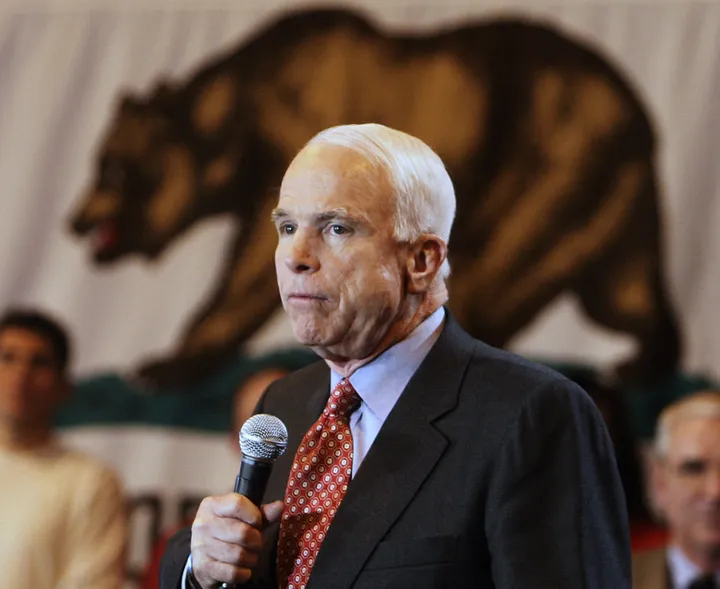
Why McCain's "Drill Here, Drill Now" Proposal Fails the Supply/Demand Reality Check

digg Share this on Facebook Huffpost - stumble reddit del.ico.us RSS

Posted June 26, 2008 | 04:17 PM (EST)


There were two reasons why the Truth-O-Meter at CQ Politics gave a "FALSE" rating to John McCain's "drill here, drill now" proposal for reducing oil prices: supply and demand. The impact on supply, achieved years after oil companies greenlighted any new development projects, would be at most "a couple of hundred thousand barrels a day" or about the same amount that Saudi Arabia promised to add in the next few months. That's well below 1% of today's global production. The impact on satisfying new demand, driven primarily by economic growth in Asia, would be nothing more than a rounding error. McCain's rhetoric on global oil, like the mainstream media narrative, seems stuck in the mid-1980s, when the U.S. produced as much oil as Iran, Iraq, Kuwait and Saudi Arabia combined.

Things were far simpler in 1986, when Saudi Arabia racheted up its oil production to 5.2 million barrels a day, up from 3.6 million daily barrels in 1985. Oil nosedived from $28 a barrel in 1985 to $15 a barrel a year later. But those days, when our good friends the Saudis could easily turn on the spigot to change the supply/demand balance, are long gone. To understand oil prices today, you need look beyond the U.S. and the Persian Gulf, to places where the U.S. has limited influence, places like Nigeria and China and Mexico.

And until we start dealing with the basics of global supply and demand, our political dialogue will be clouded with more empty rhetoric.

Global Oil Supply: A Quick Overview

Back in the 1980s, when three broadcast networks dominated the news business and three Detroit companies dominated automobiles, the majority of the world's oil production came from three major sources, the Soviet Union, the U.S. and the Middle East. But the U.S. oil production has experienced a long steady decline, one comparable to the declines experienced by the networks and the auto companies. After Communism collapsed, so did oil production in the former Soviet states, although things turned around beginning in 2000. Up until a few years ago, most of the growth in global oil production came from the Middle East.


Oil Production

[millions of barrels a day]
1985
Soviet Union 12.0
USA 10.6
Middle East 10.6
Worldwide 57.5

Story continues below
advertisement

1989
Former Soviet Union 11.6
USA 8.9
Middle East 17.5
Worldwide 65.5

1994
Former Soviet Union 7.4
USA 8.4
Middle East 20.1
Worldwide 67.1

2000
Former Soviet Union 8.0
USA 7.7
Middle East 23.5
Worldwide 74.9

2004
Former Soviet Union 11.4
USA 7.2
Middle East 24.8
Worldwide 80.3

2007
Former Soviet Union 12.8
USA 6.9
Middle East 25.2
Worldwide 81.5

Saudi Arabia's announcement that it may increase its daily production by 200,000 to 500,000 barrels was greeted with great fanfare in the press, but as the Financial Times rightfully pointed out, those gains could be wiped out by political violence in Nigeria. According to the BP Statistical Review of World Energy June 2008, the source of all numbers used herein, Saudi production in 2007 declined by 440,000 barrels a day when compared with 2006. Also in 2007, Saudi consumption of oil increased by 148,000 barrels a day from a year earlier, the biggest increase of any country other than China and India. In other words, we cannot count on the Saudis to provide any solutions to global shortages.

Here are some basics known to everyone in the oil industry.

Largest Oil Producers in 2007

[millions of barrels a day]
1. Saudi Arabia 10.4
2, Russia 10.0
3. US 6.9
4. Iran 4.4
5. China 3.7
6. Mexico 3.5
7. Canada 3.3
8. UAE 2.9
9. Kuwait 2.6
10. Venezuela 2.6
Worldwide 81.5

Countries which Experienced
the Biggest Declines in Oil Production

[Change from 2004 to 2007, millions of barrels a day]
1. Norway 0.63
2. UK 0.39
3. US 0.35
4. Mexico 0.35
5. Venezuela 0.29
6. Saudi Arabia 0.23
7. Indonesia 0.16
8. Nigeria 0.15
9. Syria 0.10
10. Vietnam 0.09
Total 2.73

Many of the world's top oil producers have experienced declining or stagnant production.
On a combined basis, the U.S., Mexico, Venezuela, and Saudi Arabia produced 1.2 million fewer barrels on a daily basis in 2007 than in 2004. The reasons:

Natural declines: North Sea oil production (Norway and the UK) has been falling off precipitously. As is true everywhere, the oil in the ground is finite and it comes out at a much faster rate in the early years of a well's productive life. No one anticipates that this natural decline will be reversed. The same applies to Indonesia and, many believe, Saudi Arabia.

Lack of investment and mismanagement: The national oil companies of Mexico and Venezuela have their investment budgets set by the government. Because of a lack of investment and poor management, those countries have been unable to exploit there domestic reserves efficiently. Petroleos de Mexico is forbidden by law to enter into joint ventures with large private oil companies that could share access to the latest most sophisticated technologies. About 10 years ago, Petroleos de Venezuela had independent management and was considered one of the best run oil companies in the world. But Chavez replaced management with his cronies, and the company's operations have deteriorated.

Political instability: Rest assured, Exxon desperately wishes that our government. could exert more influence in Nigeria, the single country where it produces more oil than anywhere outside the United States. Nigeria is case study in what can go wrong when a country fails to use its mineral wealth to promote a greater social good.

And of course, there are a number of other countries that have not begun to attain their potential in terms of oil production because of a combination of local mismanagement and political instability, i.e. Iraq, Iran, Sudan and elsewhere.

Where is oil production ascendant?

Countries which Experienced
the Biggest Gains in Oil Production

[Change from 2004 to 2007, millions of barrels a day]
1. Angola 0.75
2. Russia 0.69
3. Azerbaijan 0.55
4. Brazil 0.29
5. China 0.26
6. UAE 0.26
7. Libya 0.22
8. Canada 0.22
9. Qatar 0.21
10. Kazakhstan 0.19
Total 3.65

As you can see, countries that make up the former Soviet Union (Russia, Azerbaijan, Kazakhstan) produced about 1.4 million barrels a day more in 2007 than they did in 2004. This represents a shift of strategic power back to Russia. Putin exerts a stranglehold over Russia's mineral resources and he will not hesitate to use them as a political and strategic weapon. And Russia exerts a lot more influence over its oil producing neighbors than we do.

(An aside: The price of oil was a central cause of the fall of Communism, the breakup of the Soviet Union, Yeltsin's failure and the ascendance of Putin. It's remarkable how many books and articles on Russia are written by authors who fail to grasp this basic point.)

Can the U.S. restore its production to 1980s levels the way Russia has? Not likely. U.S. reserves have been efficiently exploited with the best equipment and technology for many years. Until recently, Russia's oil and gas has been underdeveloped because of lack of investment, backward technology and poor operating practices.

Bottom Line on Supply: More than ever, the world is susceptible to supply shocks because of political circumstances over which the U.S. has no control and very limited influence.

Global Oil Demand: A Quick Overview

In 2007, the United States consumed as much oil as the next five largest consuming nations combined. Put another way, 304 million people living in America consumed as much oil as 2.8 billion living in China, Japan, India, Russia, and Germany.

Largest Oil Consumers in 2007
[millions of barrels a day]
1. US 20.7
2. China 7.9
3. Japan 5.1
4. India 2.7
5. Russia 2.7
6. Germany 2.4
7. South Korea 2.3
8. Canada 2.0
9. Brazil 2.2
10. Saudi Arabia 2.2
Total 50.1

The chart below explains the commonly accepted view of the global economy: China and India are the economic engines that have driven both global economic growth and the run-up in all commodity prices. In other words, if we asked China to consume less, we would be shooting ourselves in the foot economically. Not that China, which consumes on a per capita basis a tiny fraction of the oil we do, believes that we have standing to criticize others. China and India have been very willing to do business with countries considered pariahs by the U.S., countries like Iran, Sudan and Venezuela.

Countries which Experienced
the Biggest Increases in Oil Consumption

[Change from 2004 to 2007, millions of barrels a day]
1. China 1.08
2. Saudi Arabia 0.35
3. Brazil 0.19
4. India 0.18
5. Singapore 0.17
6. Mexico 0.11
7. Chile 0.11
8. UAE 0.10
9. Russia 0.08
10. Poland 0.07
Total 2.44

One trend that we have overlooked: The developed world is taking steps to reduce its consumption of oil. In Germany, where they love cars and love to drive fast on the autobahn, consumption has declined by 9% over a three year period. Since per capita consumption of oil is about 1.3 gallons a day in Germany, compared to 2.9 gallons a day in the U.S., and because the depreciation of the dollar is reasonably correlated to price increases in oil, we are becoming less economically competitive than other developed nations like Germany.

Countries which Experienced
the Biggest Declines in Oil Consumption

[Change from 2004 to 2007, millions of barrels a day]
1. Germany 0.24
2. Japan 0.23
3. Italy 0.13
4. UK 0.07
5. Indonesia 0.07
6. France 0.06
7. Philippines 0.04
8. Turkey 0.02
9. Portugal 0.02
9. Switzerland 0.02
Total 0.88

What about speculators? This topic warrants another piece for a full analysis, but most of the evidence suggests to me that this hypothesis is overblown. Players like Enron were able to manipulate the price of electricity and natural gas because they figured out how to create and exploit distribution bottlenecks in comparatively small regional markets. It is much harder to have a similarly large impact on the global oil market.

The Bottom Line on Demand: In terms of energy security, and in terms of altering the supply/demand balance, our biggest bang for the buck will come from reducing domestic consumption through new technologies. We hesitate at our economic peril.

There were two reasons why the Truth-O-Meter at CQ Politics gave a "FALSE" rating to John McCain's "drill here, drill now" proposal for reducing oil prices: supply and demand. The impact on supply, ac...
 
Comments
34
Pending Comments
0
iPhone App Promo

Want to reply to a comment? Hint: Click "Reply" at the bottom of the comment; after being approved your comment will appear directly underneath the comment you replied to

View Comments:
Page: 1 2 Next › Last » (2 pages total)

Oil would be about 70$ per barrel without speculation via McCain's Enron Loophole.

Oil is a dead end approaching fast, in any case.

It's time to switch to solar wind and electric cars.

1T$ less then 10 years

http://www.huffingtonpost.com/users/profile/research

    Favorite    Flag as abusive Posted 08:35 PM on 06/28/2008

Show me a supply shortage?

    Favorite    Flag as abusive Posted 03:23 PM on 06/28/2008
photo

Let's speak the truth here. The problem isn't about supply and demand. It's the speculators, pure and simple. They have been ramping up the price of oil with no end in sight and the conrols need to be put back on. I think the true price of a barrel of oil would be half of today's price if the break's were put on these people.

    Favorite    Flag as abusive Posted 07:14 PM on 06/27/2008

Speculators don't actually take delivery of their oil contracts. Oil refiners do. What would you do with 1,000 barrels of oil in Cushing, OK? That's what one oil contract in the US provides for on contract expiration date. Too bad much of the world's oil supply comes from areas that are not very politically stable, but that's the way it is. It is no longer 1971 and the Texas Railroad Commission no longer sets the price of oil. Get used to it. Back in the early 1960's, the rich folks of Marin County, CA (Senator Boxer's home base) voted not to participate in the Bay Area Rapid Transit System. Today, they have no rapid transit, while I can walk to the local train station in about 10 minutes. They can get into San Francisco via the Golden Gate Toll Bridge ($5 toll) + gas + parking, or use their expensive and infrequent bus system. They are are also the first to complain about offshore drilling or drilling on ANWR or building a new oil refinery. None have been built in California for over 30 years. I have no sympathy for Senator Boxer or her rich neighbors in Marin County.

    Favorite    Flag as abusive Posted 10:34 PM on 06/27/2008
photo

It's still the Speculators the Enron Loophole that doubled prices in one year..no rich hip people from San Francisco the crooks are in Texas and Wall St..!

Texas has a $10.7 Billion dollar surplus thanks to it's ripping off America..this year alone..!

It's the Texans and it's crooked criminal business practices..

    Favorite    Flag as abusive Posted 11:25 PM on 06/27/2008

Let's try to take the money out of oil. We can make our hybrid autos 'plug in's' costing much less to drive. In another year, we should be able to go 100 miles by converting hybrid to electric with battery in our garage and inexpensive to drive. Let's get clean, cheap energy. No drilling for oil. Save the enviornment. Stop making speculators and oil company execs even more wealthy.

    Favorite    Flag as abusive Posted 11:39 PM on 06/27/2008

Well,l congress makes you believe they are looking into this mess with the speculators! This is an election year and they will stick it to the Republicans so don't expect anything done immediately. They will ride this out. Then in order to control the real flow of oil, supply and demand, take our West Texas Intermediate Oil off the ICE and we can track it and therefore, fix
this high price of oil. But that would be too easy. As I said, nothing will be done until the end of the
election cycle. Do not write emails to congress, they send you a form letter. But if you call, now they have to answer that and they hate it.

    Favorite    Flag as abusive Posted 11:58 AM on 06/28/2008

Blah, blah, blah. Oil, oil, oil.

Forget about it. In 2010 Five automobile companies, two of them American (Ford, and General Motors) are slated to introduce plug-in electric cars to the U.S. market. They will travel approx. 150 miles on one charge - plenty for commuters. The electric bill cost will amount to approx. 3 cents per mile, at current electrical prices. That's $4.50 for 150 miles. What MPG are you getting now in your Jetta, or your Volvo? 25 MPG? That would be pretty good. Figure $5.00 for a gallon of gas (coming soon, to a gas station near you!), and you're currently paying $30 to travel 150 miles.

Which is better? $4.50, or $30? Hmmmm?

And: because of the peculiar nature of electrical power generation, most of the added electricity will be used during off-peak hours, so the electrical grid won't have to be upgraded until 80 million plug-in cars are on the road. That's a bunch. And, it dovetails nicely with our all-American reluctance to upgrade our infrastructure. At least for a while.

The new plug-ins will start selling at around $25,000. So, be nice to the nice lady at your credit union.

The "smart" money on Wall Street thinks that once it is generally perceived that we are seguing to a plug-in society, there will be a huge rally on Wall Street. So, get ready to bet the farm. But not the condo. Hold onto that.

    Favorite    Flag as abusive Posted 04:00 PM on 06/27/2008

Wow , this was a dynamite article. I learned so much.The most important thing that I gleaned was we have got to reduce our dependency on foreign oil. We must get off this merry go round of more and more consumption sooner rather than later. We can learn from other nations that have reduced their dependence. We had better follow their lead before it's too late. As long as prices stay low we will never be forced to develop alternatives. I guess that may be the silver lining.

    Favorite    Flag as abusive Posted 01:46 PM on 06/27/2008

A few other points on why the drill, drill, drill strategy of McCain is a fallacy.

1 - The worldwide shortage of steel has slowed the construction of additional offshore rigs adding upward of 18 months to the existing construction time.

2 - The industry wide shortage in trained and experienced rig personnel.

3 - The lack of necessary geologic reports, 3D, Satellite, etc.

4 - And the most important, just because you can drill, it doesn't mean oil is there.

I write this as one of the evil oil guys. I own a couple of land based drilling companies.

    Favorite    Flag as abusive Posted 01:31 PM on 06/27/2008
photo

Excellent post, sheds light, not just heat. I hope to see more like this in future HUFFPO editions. For those who want to dig a little on their own, what are your data sources?

World production runs to roughly 81.5, the top ten consumers use 50.1, does that really imply a hefty difference between total world supply and demand or are the minor players soaking up close to 30?
Total world use is a key stat, can you provide an estimate?

With financial markets in turmoil, most lenders are risk averse, nobody is quite sure what paper currency is worth and returns on investment are low. From an investment perspective, why pump oil from the ground and invest it when it will make a better return simply sitting where it is. Nations that need cash flow like Saudi Arabia and Iran may continue to produce, but what about corporations and nations who can afford to stay put? This seems to me a powerful disincentive to increase production or to bring marginal wells on-line. I'm not sure I'm ready to believe the speculation hypothesis is overblown.

    Favorite    Flag as abusive Posted 01:12 PM on 06/27/2008

OMG
this is the best article on oil i've ever seen on huffpo
and he actually talks about depletion

    Favorite    Flag as abusive Posted 11:16 AM on 06/27/2008

One point, one question.

Existing leases are more throughly explored, closer to existing infrastructure, and can be developed quickly compared to frontier areas like the OCS (10-30 years). Consumers are paying a high enough that they don't care about profits or profit margins. Business as usual as profit maximizers is over for the time being in the domestic oil sector.

What would be the price of oil if the dollar strengthened 50% over the next 5 years?

    Favorite    Flag as abusive Posted 11:11 AM on 06/27/2008

In November, Elizabeth Kolbert reported in The New Yorker (http://www.newyorker.com/reporting/2007/11/12/071112fa_fact_kolbert):

"Since 2002, Shell, ConocoPhillips, Chevron, and Imperial Oil (which is primarily owned by ExxonMobil) have all received approval to construct major projects in the tar sands [from British Columbia to Alberta]. Over the next five years, investment in the Fort McMurray area is expected to amount to over $75 billion. Thanks to what"s happening in the tar sands"output now tops ... 1 million barrels a day"Canada has become America"s No. 1 source of imported oil. By 2010, tar sands yield is expected to double, and by 2015 to triple."

And further: "There are several reasons that oil companies are rushing to develop the tar sands. If the price of oil remains above $90, then these and other unconventional forms of fuel can be developed at a profit."

Presumably we will all be happy if oil prices settle somewhere around $100/bbl.

Don't forget how much the banks are making these days from VISA/MC/DISCOVER/AMEX swipes at the pumps: they take from 2 to 4 points off the top (i.e., you charge $100, the gas station gets $97, the bank gets $3). 'WIndfall' doesn't begin to describe their increase in revenues (while their expenses per transaction remain fixed). Don't forget how badly the banks need so much more money these days to keep them from failing.

    Favorite    Flag as abusive Posted 09:36 AM on 06/27/2008

Just for chuckles, when GW was running for President, 1st term, he said the reason oil was approaching $20.00 a barrell was because Bill Clinton did not know how to deal with OPEC and if elected he would change that, guess he did.

    Favorite    Flag as abusive Posted 08:09 AM on 06/27/2008


Just because they don't drill doesn't mean supply is not there!
No incentive to invest when they get plenty of bucks per barrel
hoarding which is a much cheaper.

As for price: Absurd. Last surge in price came when Turkey attacked Northern Iraq, but Andarko said oil should $60 Because they know the oil is 500 miles from there.

It's about old oil men cockers now in hedge funds deceiving Gen-exers (Products of Reagan's cut to education).

99% of Hedging that drove oil prices done by people who cannot take take delivery of oil.

Using their tax cuts to pass the same barrel between each othe at increasingly higher prices.

The hoarding is not only 55MILLION acre leases companies are NOT DRILLING
Bit Morgan Stanely IS THE LARGEST HOADER OF OIL IN NEW ENGLAND.

II's more Republican Delinquents on Steroids. like proior to Reagan same excuses and games.
.
Evey time Cheeney threatened Iran, or Iran threatens us prices benefit Texas and Iran.

They passed the Enron Loophole in 2001 allowing Enron to cheat California at 1000% now using the same garbage on Subprime and oil futures.

They've driven oil using Price Targets as if Oil is a Stock, broadcasting it on CNBC

Meanwhile just like Reagan lost us the Memory chip and not invest in innovation as CHEENEY TOPs OFF STRATEGIC OIL RESERVES slowly 100,000 Barrels at a time. Criminal.

    Favorite    Flag as abusive Posted 12:13 AM on 06/27/2008

It is only our modern society that has decided to burn oil in combustion engines--why not another way? Aren't we more inventive than that? Technology needs to be used in ways that make our lives better, and instead all of the innovations have been funnelled through gas production and creation of more and more inefficient vehicles. My 1984 car gets better mileage than many 2008 models--how does that even make any sense given the massive technological revolution that has happened in this country over the last 25 years? And all this talk about "reducing carbon emissions by 2050" is ludicrous. We better be way beyond oil and fossil fuels before 2050--the North Pole is about to become open sea for the first time since our version of history started--this year.
And let's not even think about what purpose the oil actually serves within the planetary body or what the consequences are of draining it all out.

    Favorite    Flag as abusive Posted 11:55 PM on 06/26/2008

At some point [if not already], the middle eastern oil producers are going to realise that every time they sell a barrel of oil to the US, someone at the Pentagon pumps it in to an aircraft carrier or a stealth bomber and uses it to kill the families of the guys who work on the oil rigs that pumped it out of the ground in the first place!

Not a difficult equation.

btw. Military oil usage is a 'secret' and therefore doesn't get counted when everyone's trying to work out where all the oil goes. Groovy, eh?

    Favorite    Flag as abusive Posted 10:40 PM on 06/26/2008

Military oil consumption is by no means a secret. It is shy of 400,000 barrels a day an accounts for about 1.6% of the nation's oil use. There was a whole blog on the issue a week ago and I pointed out that F-150s alone, of which there must be some 7 million or so on US roads, account for four times the oil consumption of the military.

And I don't even want to comment on the rest of your post.

    Favorite    Flag as abusive Posted 11:41 PM on 06/26/2008

At some point (if not already) American consumers are going to realize that the cost of filling the tank of a civilian HumVee diverts enough profits to Saudi Arabia, Iran, and the other countries who sponsor terrorism to make one bomb to blow up a military HumVee and the soldiers inside.
The more gas you use, the more money you give terrorists.

    Favorite    Flag as abusive Posted 07:15 AM on 06/27/2008

The new study put out by the US Energy Information Administration, finds that OffShore drilling would have no significant long term impact. Quote: "Any impact on average wellhead prices (of oil, now through 2030,) is expected to be insignificant."
http://theoildrum.com/node/4174

A separate EIA study finds that Alaska National Wildlife Reserve drilling would reduce the price of oil by only 2 to 4 cents per gallon by 2024.
http://climateprogress.org/2008/06/04/opening-anwr-cuts-gas-prices-two-cents-in-2025

These minor price reductions could be wiped out by global oil markets next week, much less decades from now.

    Favorite    Flag as abusive Posted 08:01 PM on 06/26/2008
Page: 1 2 Next › Last » (2 pages total)
Comments are closed for this entry

You must be logged in to reply to this comment. Log in  or  Connect