

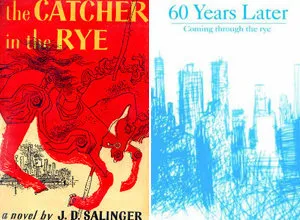
The only book my mother ever forbade me to read was J. D. Salinger's best-seller, The Catcher in the Rye. She gave no reason for banning it. I'm not even certain she ever really read it. My guess is she heard from friends it was "dirty."
Her dictum was particularly strange in light of the books I was reading at the time -- in 1951 or 1952 I wasn't yet a teenager -- about which she had no similar negative reaction. I had graduated from Howard Garis's Buddy Boy series and was gleefully plowing through best-selling historical romances like Zoé Oldenbourg's The Cornerstone and Annemarie Selinko's Desirée.
Yet, in the midst of this, Mom nixed The Catcher in the Rye! But never mind, I sneaked it into the house and read it anyway. And still I couldn't figure out on what grounds it had been grounded. Nor was I sure some years later when my prep-school housemaster, an English teacher, read it to us seniors over a series of nights. The only thing that occurred to me then is that the word "turd" is included. Mr. Pynchon did blush when he read the (offending?) sentence.
I bring this up now because of the literary furor-in-a-teapot over 60 Years Later: Coming Through the Rye by a 33-year-old Swede calling himself J. D. California. Actually named Fredrik Colting, the audacious author describes his -- um -- appropriation as "An Unauthorized Fictional Examination of the Relationship Between J. D. Salinger and his Most Famous Character." That character is, needless to say, Holden Caulfield.
Since I have a special place in my avid-reader's heart for Holden Caulfield -- referred to in Colting's tome as Mr. C. -- I feel obligated to speak up on Salinger's behalf and on behalf of those who think he's overreacting to this odd homage.
My dander has been especially gotten up by an article in this past Sunday's New York Times Week in Review where Jennifer Schuessler reports with what I can only call raging schadenfreude that young readers today "just don't like Holden as much as they used to. What once seemed like courageous truth-telling now strikes many of them as 'weird,' 'whiny' and 'immature.'"
Schuessler's implication is that contemporary adolescents aren't at all "weird," "whiny" and "immature." I'm willing to concede many aren't, but I'm equally certain that some of them are -- and therefore aren't necessarily the best judge of lasting literary value. I speak as someone who's taught literature to youngsters. I particularly recall one 17-year-old reader who said to me when asked why she hadn't finished Jane Austen's Pride and Prejudice, "Why should I read a book by a feminist dyke?"
The only lesson to be cleaned here is that though human nature doesn't change, tastes do. When The Catcher in the Rye was published in 1951, Salinger pinioned the zeitgeist with an accuracy that enticed thousands, if not millions. But nowadays the dialogue and attitudes he ascribes to Holden don't predominate.
Today's teenagers don't employ Holden's "phony"-"lousy" lexicon. Their catchwords run to "awesome" and "like." This only means that 50 years from now, a Schuessler counterpart will be dissing today's bestsellers (Schuessler plugs the Harry Potter books) in the manner that The Catcher in the Rye is rated toast now. Isn't it easy to jettison something by ignoring the context in which it was composed?
Conversely, there's Salinger's current defense of the Holden Caulfield he imagined and evidently never -- for every legitimate novelist's reasons -- thought to follow past his book's final page. It's pertinent, however, to remember this is the Salinger who stopped biographer Ian Hamilton's verbatim quoting for In Search of J. D. Salinger from the books and shorts stories. That volume was only released after Hamilton paraphrased everything he'd included according to copyright law's "fair use" provision.
Remember, too, that this is the Salinger who had Holden Caulfield say his only wish was to be a catcher in the rye -- to be a man who saved children from recklessly falling over the edge of a cliff they hadn't seen. This is the Salinger whose work can be read as a paean to the young and an unconscious repudiation of aging. That's right. Studied from a certain perspective, Salinger -- who's avoided being seen in public for several decades -- considers the only true sin to be growing old. It's not surprising he doesn't like the idea of a 76-year-old Holden Caulfield paraded before the reading public.
Salinger might be better off taking the view of James M. Cain, the author of The Postman Always Rings Twice, Mildred Pierce and several other hot 1940s chart items. Cain, asked once how he felt about what Hollywood had done to his books, said, "Hollywood hasn't done anything to my books. There they all are, up on the shelf."
The Catcher in the Rye will be up on the shelf and intact long after J. D. California's 60 Years Later -- which has already been published in England but is temporarily under a restraining order here -- has had its day.