Introduction
In "postmodern science studies" or "postmodern philosophy of science," scholars critique science and mathematics from a high-level meta-perspective. Two of these writers, Karl Popper and Thomas Kuhn, in the view of many scientists, have significant merit and are worth taking seriously, although both published their most influential books 50 years ago.
Karl Popper
Popper (1902-1994) declared in The Logic of Scientific Discovery [Popper 1959, pg. 40-41], "It must be possible for an empirical scientific system to be refuted by experience." Popper's ideas on falsifiability remain highly influential in scientific research to the present day. For example, various prominent scientists have recently questioned whether it is prudent to continue pursuing string theory, given practitioners have not been able to derive testable consequences after 25 years of effort [Smolin 2006, pg. 352].
Popper's ideas have limitations, some pointed out by Popper himself. In modern-day science, major theories are seldom falsified by a single experiment. There are always questions regarding experimental design, measurement procedures, data analysis and error statistics. Multiple follow-on studies are necessary to conclusively decide the hypothesis one way or the other. The recent "faster than light" neutrino measurements at CERN provides an illuminating case study.
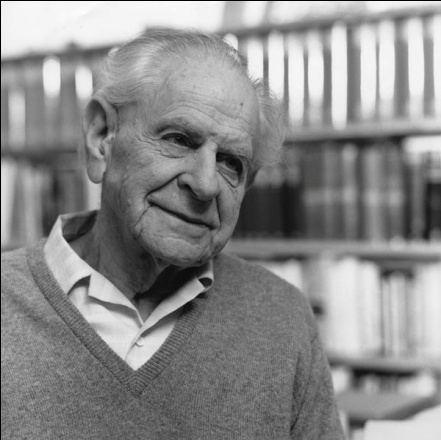
Moreover in most cases, modern "falsified" theories continue to be extremely accurate within appropriate domains. Even today, over 100 years after Newton's mechanics and Maxwell's electromagnetic equations were "falsified" and supplanted by new physics, they remain the basis of almost all practical engineering and scientific computations, giving results practically indistinguishable from modern theories.
Thomas Kuhn
Another hugely influential postmodernist author is Thomas Kuhn (1922-1996). His seminal 1962 The Structure of Scientific Revolutions analyzed numerous historical cases of scientific advancements, and argued compellingly that periods of normal science were interrupted by key paradigm shifts in which old ideas were abandoned [Kuhn 1970]. He likened shifts to "religious experiences" which do not come easily.
Kuhn was a trained scientist with a 1949 Harvard physics Ph.D., and was able to bring significant technical insight to his analyses of historical scientific revolutions. Sadly, the term "paradigm shift" is vastly over-used, and Kuhn's writings, much as Popper's, have been badly misused by a host of eager amateurs thinking they can smash the reigning orthodoxies of modern science.
In a newly published posthumous fiftieth-anniversary interview of Kuhn by Scientific American writer John Horgan, Kuhn was deeply upset he had become a patron saint to such would-be scientific revolutionaries: "I get a lot of letters saying, 'I've just read your book, and it's transformed my life. I'm trying to start a revolution. Please help me,' and accompanied by a book-length manuscript." [Horgan 2012].
More recent postmodern writings
More recent post-modern science studies have over-zealously extended the scope of their critiques, declaring that much of modern science, like literary and historical analysis, is "socially constructed," dependent on the social and political environment of the researchers, with no claim to fundamental truth [Koertge 1998, pg. 258].
Scientists counter that these scholars have distorted a few historical controversies, and have parlayed these to a global condemnation of the scientific enterprise [Gross 1998]. What's more the postmodern science literature abounds with: (a) serious confusion on technical issues; (b) politically charged rhetoric; (c) lengthy discussions of mathematical or scientific principles of which the author has only hazy familiarity; (d) applications of highly sophisticated concepts from mathematics or physics where they don't apply; (e) text peppered with sophisticated technical terms or mathematical formulas and vacuous technical passages [Sokal 1998, pg 4-5; SkepticalTeacher].
The Sokal hoax
Tension between scientific and postmodernist communities came to a head in 1996, when Alan Sokal, a physicist at New York University, wrote a parody postmodern science article, "Transgressing the Boundaries: Toward a Transformative Hermeneutics of Quantum Gravity," and submitted it to Social Text, a prominent postmodern studies field journal [Sokal 1996a].
The article was filled with pages of erudite-sounding nonsense, political rhetoric, irrelevant references to arcane science, and approving quotations from leading postmodern science scholars. In spite of its clear flaws, the article was not only accepted, but appeared in a special issue devoted to defending the legitimacy of postmodern science studies against its detractors.

Sokal had resorted to the hoax to highlight his concern that postmodern science has rejected the Enlightenment which identified with science and rationalism and rejected such obscurantism.
"Theorizing about 'the social construction of reality' won't help us find an effective treatment for AIDS or devise strategies for preventing global warming. Nor can we combat false ideas in history, sociology, economics, and politics if we reject the notions of truth and falsity." [Lingua 2000, pg. 52].
In the same issue as Sokal, a prominent postmodernist (seriously) wrote:
Once it is acknowledged that the West does not have a monopoly on all the good scientific ideas in the world, ... then can we begin to talk about different ways of doing science, ways that downgrade methodology, experiment, and manufacturing in favor of local environments, cultural values, and principles of social justice. [ Ross 1996, pg. 3-4].
Imagine if this extreme cultural relativism were widely adopted in modern science and society. A few years ago the Mexican government encouraged potters, for their safety, to use lead-free glazes, but the local potters were convinced that this was a foreign conspiracy. Unfortunately, as Michael Sullivan has noted, "lead does not care who believes what." [Sullivan 1996]. South Africa's experience with AIDS also shows how destructive of human life ill-educated views of "imperialist scientific plots" can be.
So where are we 50 years on?
The consensus of scientists is that post Kuhn and Popper, "postmodern science studies" have not advanced scientific research (or much else), and even their own writings have often been misappropriated. As biologist Paul Gross wrote [Gross 1996, pg. 50]:
"The dictum that everything that people do is 'cultural' ... licenses the idea that every cultural critic can meaningfully analyze even the most intricate accomplishments of art and science. ... It is distinctly weird to listen to pronouncements on the nature of mathematics from the lips of someone who cannot tell you what a complex number is!"
Similarly, Canadian-American physicist Lawrence Krauss wrote that "philosophical speculations about physics and the nature of science are not particularly useful, and have had little or no impact upon progress in my field" [Krauss2012 ].
One broad criticism is that post-modernist scholars work almost entirely from outside the realm of real scientific research. Unlike predecessors such as Kuhn and Popper, most do not have substantial scientific training and/or credentials; do not address state-of-the-art scientific theories or methods in significant technical depth; and do not participate with scientific research teams in performing peer-reviewed scientific research.
Their approach is best exemplified by a comment made by a leading postmodern writer in the introduction to one of his works: "This book is dedicated to all of the science teachers I never had. It could only have been written without them." [Ross 1991].
However, such writers cannot possibly hope to have tangible impact in the scientific enterprise, since real scientific work is all about the details -- experimental design, careful execution, analysis of results. And when leading figures in this community openly express their contempt for day-to-day scientific work, they are not building bridges that will lead to productive collaborations with real scientists in the future.
Maybe one day the tide will turn, opening the way for a more respectful dialogue between science and philosophy. As physicist Carlos Rovelli recently wrote, "I believe [we] can teach one another enormously." Philosopher Tim Maudlin expressed similar views in his 2007 book The Metaphysics within Physics. In any event, the modern scientific method taking its full form after the Enlightenment has been astonishingly successful, as anyone who has ever been treated for a major once incurable disease can attest. While no knowledge may be certain, modern science comes remarkably close.