
Americans currently "enjoy" the cheapest animal protein in history. Such a monumental achievement could only have been attained through the industrialized mega-production of meat, milk and eggs -- which now cost about $1.56 on average for a large white dozen in the nation's supermarkets.
At just 13 cents apiece, even the poorest American can afford a two-egg omelet in the morning: It will set them back by less than four-percent of the Federal hourly minimum wage
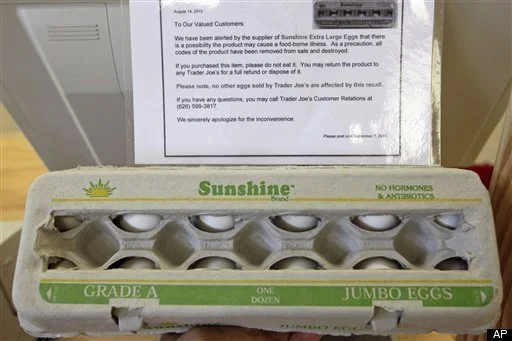
But now Americans are finally coming to terms with the true cost of their wondrous 26-cent breakfasts: a gargantuan recall of mass-produced eggs -- 380 million of them -- contaminated with deadly salmonella bacteria. Hundreds of people have reportedly been sickened, and the true number could be higher.
The laying hens in question were raised (held prisoner is a more apt term) in Iowa, in a massive concentrated animal feeding operation (CAFO), better known as a factory farm. In the typical egg-laying CAFO, hens are crammed into battery cages and given room to move in an area that's roughly equivalent to a piece of typing paper.
Cages are stacked one on top of the other, sometimes 10 or more high, inside large confinements that never see the light of day. Fresh air is pumped into one end, and air fouled with bacteria, viruses, mold, dust, antibiotics, litter and dander spits out the other.
Residents of Florida, Arizona and California have already approved ballot measures that will ban battery cages for hens, and the government of Ohio recently completed major negotiations that will also stop the sickening practice there, as well.
The exact source of the salmonella bacteria now making headlines is not known, though some media reports suggest it may have been in the birds' feed. MSNBC also reported today that the hens' ovaries had been infected with salmonella, which in turn infected the eggs, and then the bargain-hungry shoppers -- and hotel and restaurant guests -- who ate the contaminated food.
Salmonella is largely a problem for factory-farmed eggs. Laying hens raised in organic or sustainable conditions are allowed to peck around outdoors for grubs and high-quality feed provided by farmers who are as concerned about animal health and the safety of the food they sell as they are about keeping their costs -- and prices -- to a minimum. These eggs are less likely to carry disease, and to me at least, they taste a whole lot better.
Even the FDA recognizes the risk from factory eggs. Last month, the agency issued a rule requiring mandatory "flock-based salmonella-control programs,' that include routine microbiologic testing -- for producers with more than 50,000 hens.
Since I began working on my book, Animal Factory, I started buying organic, humanely produced eggs in my supermarket. Yes they cost a lot more: $4.99 a dozen, or about 42 cents apiece. But an 84-cent omelet still seems like a good value to me, especially when I know that the animals were raised like animals are supposed to be raised, and that I'm supporting sustainable farming practices, and not CAFOs, with my limited consumer dollars. (Then again, I don't have a large family to feed, so it's admittedly easier for me).
What good is a 13-cent egg if it's going to get you hospitalized? And why isn't the federal government doing more to encourage and even subsidize the production of humanely-raised and less pathogenic eggs?
Instead, we are told we will have to learn to live with it. The FDA says to cook all eggs thoroughly, but I like my yolks runny and my omelets soft, thank you very much. And the FDA is also recommending that food service providers offer only pasteurized eggs and "egg products" (scrambled eggs in a box) at their establishments.
Of course, The Great American Egg Recall is terrific news for one sector of the staggering economy: egg pasteurizers.
But seriously: Have we really come to the point where we must disinfect our eggs before we consume them? Wouldn't it be better to focus on producing affordable eggs that won't kill you in the first place?