
Last week, I attended my first Consumer Electronics Show, the massive exhibition of all things technology in Las Vegas. Not unlike Sin City itself, it's something everyone should see once, just for the jaw-dropping sensory overload. With 140,000 attendees walking 35 football fields of show floor, it's no surprise that a booth showing state-of-the-art recliners looked like a podiatric casualty ward.
For someone whose particular interest is children and media, it was easy to get lost in the redwood forest of iPad cases, tablets and 3D TVs, and miss the saplings of innovation meant just for young people.
Fortunately, the Kids@Play conference within CES offers a coherent platform for these devices and their followers. 2011 panels covered virtual worlds, interactive learning and -- the session I moderated -- the rise of motion-based devices and content.
Hardware and software that key off of children's activity are important for two big reasons.
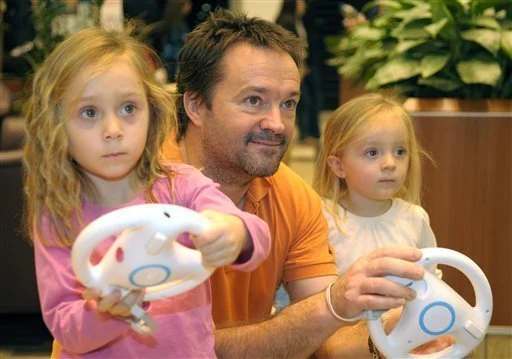
First, with growing attention to childhood obesity, it's encouraging to see screens that aren't "lean back" or "lean forward"; they're "jump up and dance around." This movement (pun fully intended) may have begun with the Nintendo Wii, but new devices -- like Microsoft's Kinect for the Xbox 360 and gesture-recognition technology from Omek Interactive -- liberate kids from controllers and wires, engaging the entire body and upping the intensity.
The first time I tried Kinect, I swayed tentatively to control my whitewater raft. Quickly, I learned that the game would respond only to energetic side-to-side springing. New York Times technology columnist David Pogue wrote that you can't play Kinect sitting down, and that soon "we'll be hearing doctors say, 'I think your kids really need to play more video games.'"
High-tech gear isn't critical to action-based games. Kids@Play also featured HOPSports, a fitness program that uses widely-available technology and low-tech sports gear. Its DVDs of skill-based exercise regimens, presented by athletes and celebrities, are growing by leaps and bounds (again, intended) worldwide, because they scale from small groups to entire schools and mimic globally-popular sports.
The other, broader, significance of motion-based gaming is that it pares away layers of interface that can distance kids from their play. Instead, it substitutes direct modes, encouragement and rewards for kids to take action.
Consider the progression from keyboard and mouse to multi-touch screen. For young children, the former presents an unnatural hand-eye coordination that distracts from their immersion in play. Touch screen devices allow on-the-mark tap and slide exploration that even toddlers can intuit and accomplish their objectives. Kids@Play even featured one special touch tablet engineered for babies.
Some applications of the touch screen, like typing or playing a piano, take practice to master without haptic feedback. Still, their direct, instantaneous response rewards, and so encourages, exploration and persistence.
The Wii, again, introduced natural motion to video sports game, a radical advance from the keyboard and mouse or pad, button and joystick generation of controllers. Motion-based games literally add depth to the action; at Kids@Play, the co-creator of Sony's Playstation Move showed how its dual, wireless control sticks could be used, in an animated setting or augmented reality, to reach around objects and pull them from behind, or to create things and manipulate them in three dimensions, with remarkable precision. Kinect does away with the controller entirely, and the instant form feedback some games provide facilitates iterative adaptation and learning.
It's easy to envision educational uses of devices that depend on active movement and complex manipulation. Already, game developers are looking at gesture-recognition technologies and touch-screen tablets as vehicles for immersive storytelling, hands-on experimentation, and open-ended exploration.
Video games will never replace real-world play in children's discovery and learning; however, by adding active engagement, intuitive interfaces and personalized correction and reinforcement to game play, we change radically the nature of debate over children and screen time. Parents may find themselves not only allowing, but joining their kids in front of the "move tube."