More

Featuring fresh takes and real-time analysis from HuffPost's signature lineup of contributors
David Kusek

GET UPDATES FROM David Kusek

Musicians May Be Owed Billions in Unpaid Digital Music Royalties

Posted: 04/08/11 02:01 AM ET

If you are a recording artist or a manager and have been distributing music on iTunes under a deal with one of the big record labels, pay attention.

F.B.T. Productions in Detroit, the producers who helped Eminem achieve his success are paving the way via a lawsuit against Universal Music and others, to larger payouts for digital music sales via iTunes and other digital services both past and future. This effort could unleash literally billions of dollars in unpaid royalties for recording artists.

How much money is at stake here?

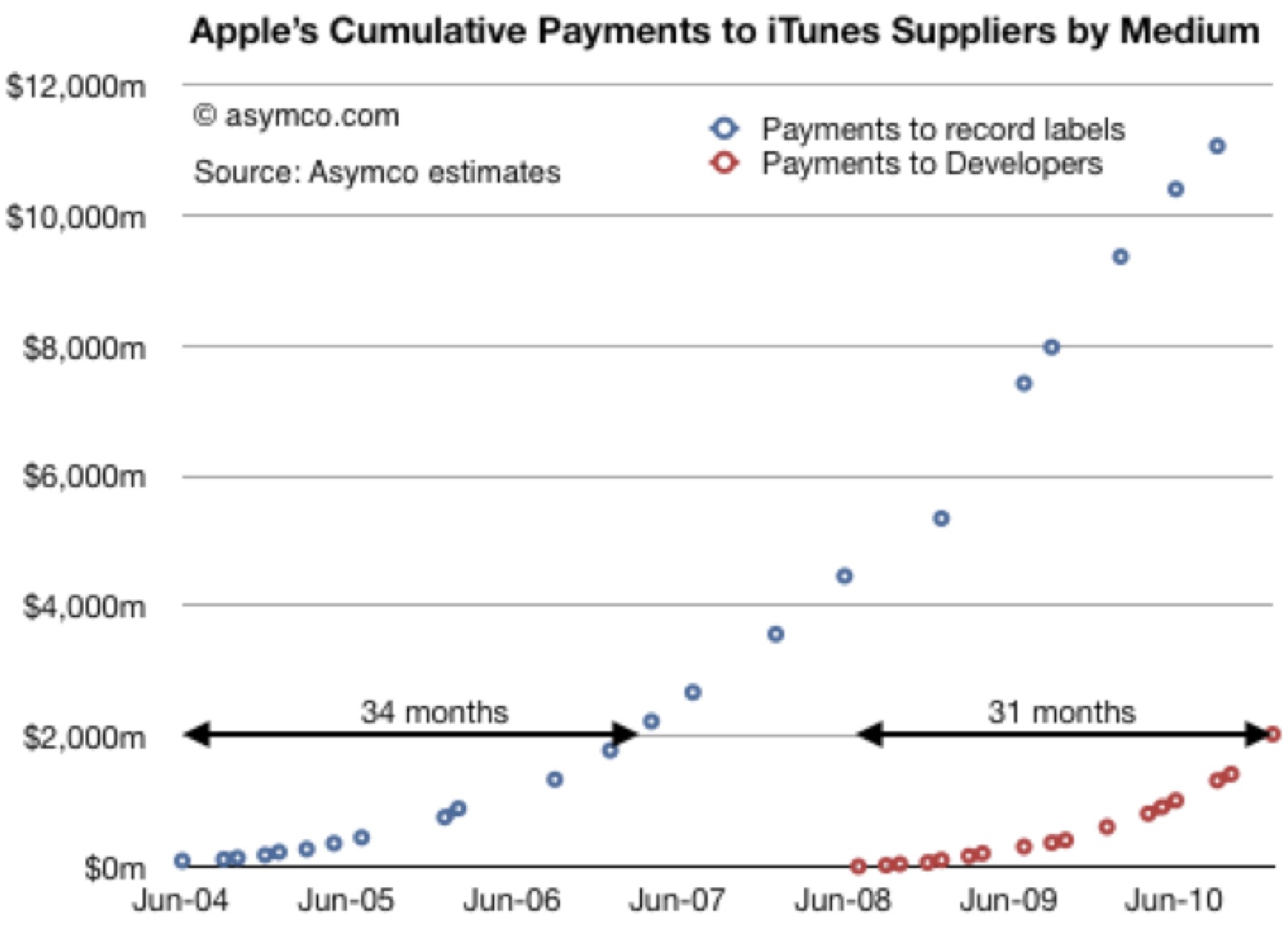
This chart from Asymco, shows the accumulated payments made to suppliers of content to the iTunes store over time. You can see that the total amounts paid to the record labels can be approximated at $12 billion dollars since the launch of iTunes through the first quarter of 2011.
2011-04-07-iTunesGross.jpg

Source: Asymco


That would imply that the gross amounts collected by Apple are in the neighborhood of $17 billion dollars for iTunes music downloads.
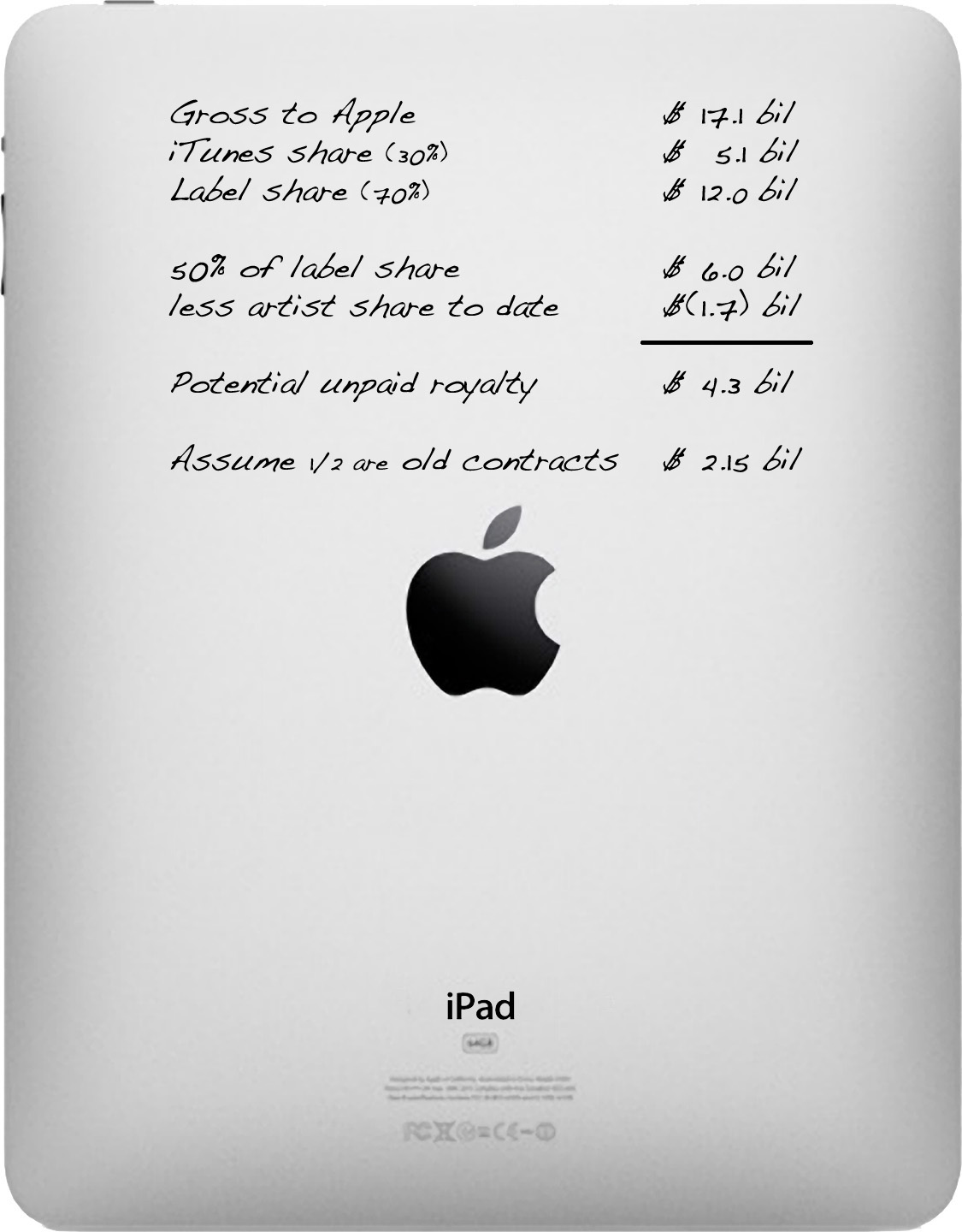
So I did a little back 'o the ole iPad calculation and here's what I came up with.

2011-04-07-BackoPad.jpg

I want to be realistic about the potential to collect and so will assume that half the music distributed on iTunes is from catalog sales of artists with older label contracts, and the other half is from music distributed from sales of newer artists. SoundScan numbers from last year show 648.5 million downloads of "catalog" singles in the US, meaning songs more than 18 months old, compared with 523 million for current tracks, so this seems like a very safe assumption.

Using this quick and dirty math, the potential unpaid royalties to artists from just iTunes sales would be around $2.15 billion. Admittedly some of this money has already been paid to music publishers, so the number may be overstated somewhat, and could benefit from a finer accounting. But then again, catalog downloads from iTunes could be closer to 80% which would make the unpaid royalty number higher. So the amount is significant. Really significant. Are you with me?

The lawsuit boils down to a distinction between selling "copies" of physical products such as CDs or vinyl recordings versus selling a "license" to reproduce the digital song data. Record labels actually ship physical product (principally CDs) to record stores; but in the case of iTunes it gets a license to replicate and distribute digital files. When the record labels sell "copies" of music, the artist typically receives a 10-15% royalty, but when the labels "license" the music to another entity, most artists typically receives a 50% royalty.

The complaint filed by F.B.T states "Defendants have failed to comply with the terms of the March 9, 1998 agreement and the 2003 Agreement by failing to account and pay royalties equal to fifty percent (50%) of Defendants' net receipts from the digital uses of the Eminem Masters by the Music Download Providers and Mastertone Providers. Defendants apply an incorrect formula for calculating royalties with respect to those royalties to be paid to Plaintiffs which results in the payment of approximately twelve percent (12%) of receipts instead of the fifty percent (50%) required by the terms of the agreements."

Universal Music Group, Aftermath Records and Interscope Records appealed against a ruling in the Ninth Circuit Court in December that said they should pay 50% of royalties on digital sales. The defendants took their appeal all the way to the Supreme Court.

However, the US Supreme Court just last week rejected Universal Music's appeal in the case letting the Ninth Circuit Court of Appeals decision stand that digital music (under this particular agreement) should be treated as a license subject to a 50% royalty payment.

Now to be fair, not all label agreements are the same, and if you signed a label deal in the last 10 years or so, you have probably been excluded from the impact of this decision by contract. Label attorneys have indicated that newer artists are unlikely to be affected by the decision because more recent recording contracts include digital distribution in the definition of "sales" for artist's royalty calculation purposes. But if you signed prior to the early 2000's, you may be looking at a significant payday.

That apparently is the thinking by the estate of Rick James, which just filed a class action suit in April against Universal Music, opening the door for a massive settlement involving potentially thousands of artists. The filing can be found here. This is certainly not the last suit that we will see on this issue.

--------

For years I have been arguing that iTunes digital music distribution was a license of music, not a sale. When Steve Jobs and his team negotiated the original iTunes deal with the major labels, the economics gave iTunes roughly 30% of each download, like a distributor/ retailer of CDs would receive and the remaining 70% would flow to the labels and presumably be split as with a traditional CD sale.

But what was rarely questioned at the time, was the way the 70% label share would be split. The labels assumed that these downloads were "sales" of copies of the songs and that artists would receive their royalties based on traditional accounting practices.

Indeed in the early days of payments from iTunes, labels often continued to deduct fees for "packaging" and "breakage" and "co-op" often when there were no actual costs being incurred. Hardly anyone questioned whether iTunes downloads were "licenses" versus "sales" - which would have swung the payments heavily in favor of the artists.

Steve Jobs himself referred to his deal with the labels as a "license" in his rare and open "Thoughts on Music" letter posted February 6, 2007. Interestingly, this letter has disappeared from and is no longer available on the apple.com web site but you can still find excerpts via Google. Hypebot reported that "Although he (Jobs) consistently referred to Apple 'licensing' music from 'the big four music companies', when deposed in this case he claimed not to know whether his company's relationship with Universal was, in fact, a license."

--------

This potential $2.15 billion represents approximately 12.5% of the gross revenue collected to date by Apple, and that 12.5% figure could apply to all the other digital distributors including Amazon, Napster, and others. With Apple's iTunes music revenue running around $300 million per month, that is another $37.5 million per month up for grabs at the present rates from Apple alone.

This ruling has the potential to forever transform the very nature and structure of the recorded music business. Certainly all of the cloud-based systems like Amazon Cloud Player and those being contemplated by Google, Apple and others will be commissioned under licenses, especially when you consider that multiple instances of files will be available on a PC, mobile device or streaming. The very idea of copies just does not make any more sense in the digital age.

This is a significant development for artists and the creative community. Artists and managers joined together could make it happen and see this incredible change of fortune through. This ruling will help transform the music industry for the better and redistribute the money in a way that is more sustainable. Certainly it will continue to be a painful transition, but finally there is some light at the end of the tunnel for creative people looking to sustain a career as a musician. And an indication of a better music business model for independent artists.

What do you all think of this?

Read more from the New York Times here.

The Supreme Court Case info is shown here:

Posted by Dave Kusek, CEO Berkleemusic

My Blog


Follow David Kusek on Twitter: www.twitter.com/davekusek

If you are a recording artist or a manager and have been distributing music on iTunes under a deal with one of the big record labels, pay attention. F.B.T. Productions in Detroit, the producers who h...
 
 
  • Comments
  • 121
  • Pending Comments
  • 0
  • View FAQ
Comments are closed for this entry
View All
Favorites
Recency  | 
Popularity
Page: 1 2 3  Next ›  Last »  (3 total)
01:37 AM on 04/10/2011
Like I care if mm gets more money. Hope the recording company wins.
03:14 PM on 04/09/2011
I think they charge to much for this service!!!!!!!!!!!!!!!!!!
HUFFPOST SUPER USER
mamarama
11:26 AM on 04/09/2011
Here's the legal deal: this case is due to a very bad contract drafting error made by UMG attorneys. Under the Records Sold provision of the UMG agreement, which, in the agreement's final iteration stated that Records Sold included digital downloads (for escalation purposes), there was additional language: "notwithstanding the foregoing, F.B.T. is to receive 50% of Aftermath's net receipts "on masters licensed by us ... to others for their manufacture and sale of records or FOR ANY OTHER USES." This language, among the several iterations of FBT's agreement, was never removed. The court said, in deciding in FBT's favor, that "The parties' use of the word "notwithstanding" plainly indicates that even if a transaction arguably falls within the scope of the Records Sold provision, F.B.T. is to receive a 50% royalty if Aftermath licenses an Eminem master to a third party for "any" use." So, the court ruled that the contract was not ambiguous - iTunes "used" the masters; therefore = License! Even tho' Mr. Kusek's sources say otherwise, I know so many recording artist agreements that have this same kind of language that mistakenly conflate "records sold in normal retail channels" with "licenses", even if those "records sold" definition includes digital sales, i.e., the contracts could be ambiguous because labels assumed iTunes was NRC. If so, even bigger paydays may be coming for artists!
Tara Hunkoff
I could have been Sheila Noyeau
03:14 AM on 04/09/2011
"Super Freak" alone would kick Rick James's estate into financial overdrive.

George Clinton - still alive and well - would do OK too. Here's hoping it happens!
photo
HUFFPOST SUPER USER
HoldenLitgo
08:16 PM on 04/08/2011
When my car was stolen and the thief went to trial and was convicted, part of his sentence was to provide financial restitution. I saw him smirk when he heard the judge read that. And I never saw a penny. Crooks don't follow the rules, that's what makes them crooks.
07:36 PM on 04/08/2011
This could mean that Rebecca Black of Friday fame could be even richer! yay!
HUFFPOST SUPER USER
euromarkusx
Political Party: Lobster
06:49 PM on 04/08/2011
The irony is, the record companies sued users in the name of their Artists, then turn around and keep their money.
ThePeacemakers
Concerned Citizen
06:02 PM on 04/08/2011
This is where the new distribution model starts to look like the old one.

The big major labels will get paid first. They own about 100 years worth of recordings and are a major supplier.

The small labels and TRULY independent labels and artist will be last in line and have to fight harder.
photo
HUFFPOST SUPER USER
AG creative
Ba Gawk!
04:52 PM on 04/08/2011
Now with Amazon's cloud music service, music is worth even less. I'm pretty sure any second itunes is going to release a tiered subscription service.
HUFFPOST SUPER USER
calilife4me
04:10 PM on 04/08/2011
Ha! Good luck trying to collect!
This user has chosen to opt out of the Badges program
photo
Fattonecat
whoops !!
03:20 PM on 04/08/2011
My band sold thousands of CDs out of the trunk of a car ala Dick Dale, Johnny Cash....etc at Blues festivals, private parties, and every other dive that would hire us. We had a lot of fun, made good money and didn't put up with a lot of promoters BS. They paid and we played, otherwise we just moved on. Screw the record companies and their ilk !
photo
HUFFPOST SUPER USER
AG creative
Ba Gawk!
04:52 PM on 04/08/2011
Awesome! If you have 1,000 die hard fans you have an audience to consistently sell your work to.
This user has chosen to opt out of the Badges program
photo
Fattonecat
whoops !!
05:47 PM on 04/08/2011
You're exactly correct. We had a great core fan base and we worked hard to keep em. To this day I run into people I've never met but know me from the band and tell me they still play our music. It's REAL COOL feeling !! 174
This user has chosen to opt out of the Badges program
photo
Fattonecat
whoops !!
05:49 PM on 04/08/2011
BTW Google "Dick Dale interview", that's Dick Dale the surf guitarist. He talks on this subject in an impromptu interview that's very enlightening.
photo
jg401
Reagansux
03:04 PM on 04/08/2011
Record companies. Talk about a group of people who produce absolutely nothing. If it wasn't for the artists, they wouldn't exist. They're just a bunch of corporate leeches. Too bad no one in the business has figured out a way to bypass these criminals. (Maybe they could use the internet as the main source of distribution.) Not only would the existing companies be put out of business, but artists would receive more revenue and consumers could see lower prices. Someone, please figure out a way to get rid of these blood sucking middlemen.
HUFFPOST SUPER USER
Ferrante Photo
Pres.Obama is my neighbor in Chicago
02:54 PM on 04/08/2011
Knowing the labels their probably still taking a dollar off for packaging and a dollar off for breakage if it's an entire album that's bought. When CDs were first introduced they had the artists agree to be paid base of the price of record while they charged several dollars more for CDs " because it was a new and untested configuration and expensive to make ". The problem was the continued to give the artist the reduced royalty after the CD became mainstream and costed less to make than a cassette or record. With digital distribution, why is a record company necessary. Hire a marketing company, raido/video promoter or use YouTube and go to a film school to make your videos.
This user has chosen to opt out of the Badges program
photo
Fattonecat
whoops !!
03:57 PM on 04/08/2011
Exactly !! Google ... Dick Dale interview. It's excellent. We did exactly what you are talking about except we were completely self produced and promoted. We EARNED our following and it paid. We made great money and had a blast. Our rule was always money up front and you'll get your show. Some promoters didn't like it but most respected us and hired us back. The record companies are for the "gotta be a star at all cost" crowd.
HUFFPOST SUPER USER
LLeGrande
An Increasingly Disgusted Liberal Democrat.
02:46 PM on 04/08/2011
I learned about how crooked the record-companies were in the 1960s regarding paying royalties to the performers. And I do mean CROOKED.

Our accounting firm was engaged by Ray Charles to audit a record-company to determine the royalties due Mr. Charles compared to the royalties actually paid.

What did we learn? The record-companies have multiple levels of secrecy about how many records were pressed, where they were, where they went, how they were sold, who they were sold to, etc. etc.

While this audit could never uncover the entire truth about what was contractually owed to Mr. Charles, we did factually determine that Mr. Charles was due around $4-million from the record company, which they had no intention of paying until 'impaled' with the truth of the matter.

Of course, this is the same industry organization - RIAA - which has no problem not paying their performers, but goes after those who get content without paying for it.

Talk about hypocrisy by a bunch of crooks.
ThePeacemakers
Concerned Citizen
06:12 PM on 04/08/2011
"...we did factually determine that Mr. Charles was due around $4-million from the record company, which they had no intention of paying until 'impaled' with the truth of the matter."

I'm surprised a large number of "returns" from retailers didn't suddenly appear.

Gaming returns and holding reserves against returns was one of their favorite accounting tricks (hence, their hesitancy to adopt to digital delivery).....
photo
HUFFPOST SUPER USER
Dnietz
Tired of censorship? Reddit
02:45 PM on 04/08/2011
So, the labels have been ripping off the artists........

............  I think we knew this already.

It is actually because of digital web stores like iTunes that these statistics and analysis will be easier to put together. Now it will be a little harder for labels to hide how badly they are ripping people off (at least with song sales).