
A specter is haunting America--the specter of debt.
Birthed in the dying years of the Cold War, the American polity lost its way. Public policy, as encapsulated in the federal budget, was always about making hard choices among competing priorities and constituencies. The notion that resources were limited was a critical discipline, and the ability to navigate the process of allocating resources was the stuff of which Congressional leaders were made. Throwing arrows is easy. Building a budget in a democracy is hard stuff.
Traditionally, Democrats were the party that believed in spending more--and taxing more, while Republicans once were the grownups of the American political system, sternly cautioning against the political urges toward deficit spending and international adventurism.
But the world changed over the last quarter century. Faced with the realities of survival in a competitive world economy--and the exigencies of political fundraising--Democrats brought corporate America inside their tent and muted their hostility to the private sector. For their part, since George H.W. Bush uttered the words Voodoo Economics in his failed efforts to derail the Reagan Revolution, the unholy alliance of tax-cutting Republicans and big-spending Republicans marked the death knell of that party's claim to the moral high ground in matters of fiscal propriety, while neo-conservatives brought to the GOP an evangelical fervor to change the world that was once a Democratic credo.
The numbers are stark. Over the past 25 years, Democrats and Republicans alike forswore their allegiance to the central responsibility of elected legislators to make choices, balance priorities and pass budgets with integrity. Perhaps they were not to blame, after all East Asian countries led by China continued to fund our deficits by buying our bonds and offered cheap money as an alternative to the more painful options of cutting spending or raising revenues. These foreign purchases of our debt were not an act of faith in the almighty dollar as much as a simple expedient of the export-driven model of economic development that has become the norm across the world.
Over the past quarter century, China, the Asian Tigers of South Korea, Hong Kong, Taiwan and Singapore, and more recent converts such as Vietnam, pursued a successful economic development strategy built on selling manufactured goods into the U.S. consumer market. As these countries took in massive amounts of dollars, they faced two options: They could recycle those dollars back into the U.S. or watch the value of the dollar decline and their own currencies rise. There really was no choice, as the export-driven development model that was lifting the Asian nations out of poverty required that their currencies not rise in value relative to the dollar, so that their low-cost goods remained attractive in the U.S. market. Accordingly, U.S. Treasury securities became the preferred investment for Asian trade-surplus dollars, and our financial markets become flush with that kept long-term interest rates low.
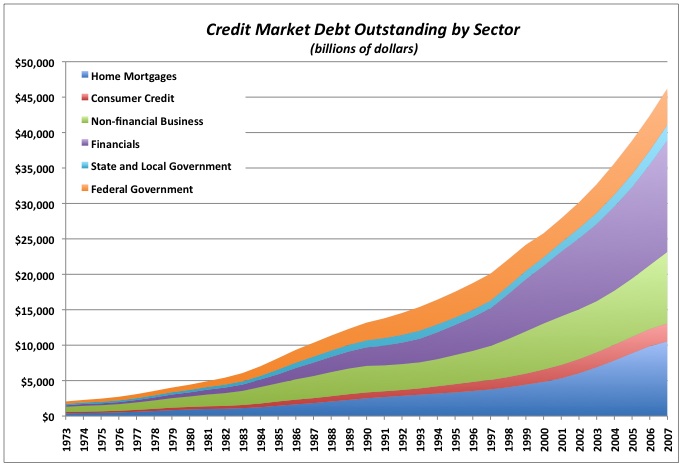
What was lost in the orgy of low cost debt that ultimately engendered the securitization boom in credit card and home equity lending--and enabled growing deficit spending at the federal level--was that the American economy, like the American household, was living on a chimera of growth that belied the underlying damage that was being done to our economy.
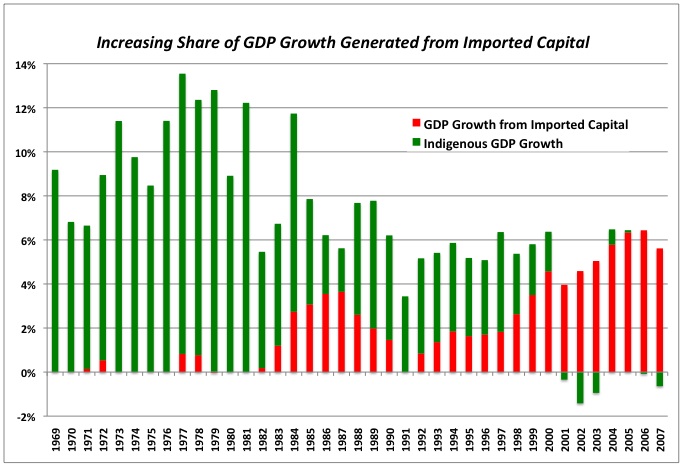
As the table here illustrates, over the past 25 years, our economic growth has increasingly been driven by imported capital. In the same way that the average American household saw no real income growth during the past decade, but increased their spending through borrowing, so too the national GDP was flat, but for the growth realized through externally borrowed dollars.
Today, we are faced with stark choices. But if the health care debate is any measure, it is evident that our political establishment has lost much of its capacity for honest debate and real decision-making. Twenty-five years of free money and no discipline has made a mockery of the federal budget process, as we now are accustomed to avoiding choices and accepting the false notion that there are obligations that are non-negotiable.
For two decades now, we have become accustomed to justifying any manner of spending, from education to tax cuts, as an investment in our future. This rationale is a direct outgrowth of the availability of low-cost capital that has itself undermined the ability to weigh and make choices. This has undermined as well the notion of a national consensus on foreign policy, as we now go to war with little regard for the financial cost. With no fiscal consequences and no universal service, war has become a sideshow of American political life.
Today, the generation-old paradigm may well be shifting. It is with no small amount of irony that even as our Republican and Democratic representatives have lost anything but a rhetorical commitment to the traditions of responsible budget policy, it is the Chinese Communist Party--the largest holder of our debt and the most at risk for the consequences of a devalued dollar--that is becoming insistent that we pay attention to our cascading fiscal mess.
Surely, as the source of the free capital to which we have become addicted, the Chinese have little more standing to scold us than the crack dealer who declares to the destitute customer that it is time to stop. The true dividend to the Chinese is not the return on their investments, but rather the economic growth that has lifted the livelihood of hundreds of millions of Chinese out of poverty over the past two decades--paid for graciously by the American factory workers whose livelihoods were lost.
But ironies aside, we have to listen. A new economic model could be beneficial to us--over the longer-term. Increased domestic savings and a declining dollar in the short-term could make overseas manufacturing less competitive, and allow America to begin building things again. But the near-term pain will continue for some time, as the process of paying down the debts that we have accumulated will take years. And we have become a very impatient nation.
The problem, however, is not our ability to listen. The problem is that after 25 years, the very skills required to build a federal budget that faces up to real facts, weighs priorities and makes real choices, may be gone from our political DNA. The Death Panel debate, while fraudulent on its face, offered the first inkling of the challenges to come when capital becomes scarce once again, and we are confronted with competing priorities for limited budget dollars.
The truth is that there is a Death Panel, that is charged to sit and decide how limited resources should be allocated. To weigh the needs of the elderly against the needs of the young, the costs of health care against the costs of war. But it is not the faceless panel of bureaucrats of Sarah Palin's imagination. It is Congress. It is time they got used to it.