The Ponte Milvio is Rome's oldest bridge. Its first stone-built ancestor dates back to 115 BC when it was outside the city limits. Nowadays the bridge, which carries the Via Flaminia cross the Tiber in the northern end of Rome, has become a sort of Lovers' Lane. Inspired by Federico Moccia's Ho voglia di te (I want you) couples come here to place padlocks testifying to their love. There are now a lot of them. Seventeen hundred years ago, on Tuesday, October 28, the scene was very different. That day the bridge featured in a battle that changed the course of history.
There aren't many battles that changed history, and making this sort of claim for any battle may seem pretty melodramatic. But the events of October 28, 312 were melodramatic. On that day the Roman emperor Constantine defeated his rival emperor Maxentius, and in doing so found proof that he had made the right decision a few months earlier. That decision was to become a Christian; in the next two decades Constantine encouraged millions of his subjects to become Christians as well. By the time of his death on May 22, 337 Christianity was firmly established as the dominant religion in the Roman Empire. Just a few years before he converted, Christians were victims of a savage persecution, and it seemed that the best they could hope for was that they once again be a tolerated minority within the empire.
For all of its profound significance -- and Constantine made it clear to everyone that he won because of guidance from his god, whom referred to as the Highest God (a sign that he had some trouble understanding the concept that there could be only one God) -- the battle itself was neither long nor hard fought. That's because Constantine had already undermined Maxentius through a brilliant campaign in northern Italy. Although Maxentius' subordinates held the area with experienced armies, Constantine crushed them in a lightning fast operation. He knew how to bring immense psychological pressure to bear on his opponents, forcing them into mistakes -- the sort of thing that Robert E. Lee did so masterfully during our own Civil War -- and how to reach out to leaders on the other side. Constantine knew that once he won, he would have to govern, and that he needed the skills of the people who were running Maxentius' part of the empire. Many of Maxentius' people moved into the upper echelons of Constantine's regime immediately after the Battle of the Milvian Bridge, and it's clear Constantine was negotiating to bring them over to his side during the campaign.
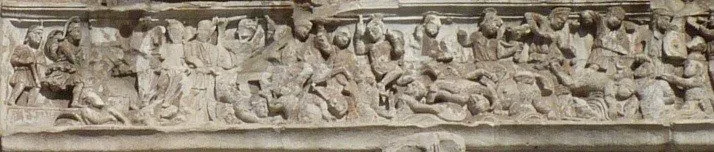
After losing northern Italy, Maxentius was in trouble. Immensely superstitious, he moved out of the palace in the days before the battle to the house where he'd lived before becoming emperor, and placed the man who had held the high office of Prefect on the day he had seized the throne on October 28, 307 back in office as a sort of good luck charm. Recently Italian archaeologists excavating Maxentius' palace on the Palatine Hill found some of the imperial gear that he left behind when he moved out. On the morning of October 28, 312, he drew up his army with the Tiber and the bridge at his back. Constantine must have recognized the act of a desperate man trying to force his men to "do or die." Maxentius' own people seem to have recognized the same thing and the battle ended when Constantine ordered his men to advance. Maxentius' army fell apart and Maxentius drowned in the Tiber when his horse fell off the Milvian Bridge. Visitors to Rome can see this scene today on the arch that was erected next to the Colosseum in Constantine's honor by the Roman Senate in 315.
People looking at the arch will not find any mention of the famous story that Constantine converted to Christianity because he saw the sign of a cross in the sky with the words "In this Sign Conquer." The reason for this is simple--the story was invented years after the event and after the arch was dedicated. At the time, Constantine simply told people that he had had a personal encounter with a God who had shown him the path to victory. It was a God he had seen in "the watch post" of heaven as he sought answers to the question of how he could be a better, more successful ruler. After the Battle of the Milvian Bridge, Constantine knew that he'd found his God and the Roman Empire soon joined him on a new spiritual path.
Constantine the Great and Christianity - Wikipedia, the free ...
Eusebius: The Conversion of Constantine - Internet History ...
Why Did Christianity Succeed? - Legimitization Under Constantine ...
Does God take sides?
In the case of a teenage peasant girl in 1429 who delivered Orleans from certain conquest, destroyed a multi-generational enemy power and crowned timid Charles VII king; yes, the evidence seems points in that direction.
Areas such as the marginalization, persecution and eventually the virtual elimination of all other religions in the Empire except for Judaism, where the Christian were so kind as to stop at marginalization and persecution.
Jesus answered them, "Is it not written in your law, I said, Ye are gods? ;" lets entertain the possibility. All things are relative, God would always be "ahead" on the "evolutionary" scale because
--He has xxxxTerabillion years head start
--and expands His awareness through us even as we expand ours so in that regard,
--we could never catch up
['cowardace to need a god,] yet there she is, struck by arrow in shoulder, later thigh, hit on the head by a dropped stone cannon ball, climbing a siege ladder up a fortress wall, leading the men into battle, whom so often before, they retreated from due to their timidity, against a foe they have been fighting for 80 years...
Says it all.
Those who believe absurdities will commit atrocities . . .
History teaches us that no other cause has brought more death than the word of god . . .
from the atheist handbook.
I think the truth is much more that, around the time of that battle, Constantine had decided that Christianity was already so powerful that it had become a waste to continue to try to wipe it out. He thought it would be wiser to ally the Empire with Christianity. As far as "his God" and his "spiritual path" are concerned, I don't think it's possible to know what Constantine believed concerning religion. As many people have pointed out, his every action seemed linked to political, not spiritual concerns. Some people have drawn the conclusion from this constant political focus that he didn't care about religion one way or another except as it affected politics. I think that's speculation, but not entirely unreasonable speculation.
Deification of Roman emperors went all the way back to Julius Caesar and was inspired by the deification of Alexander the Great, who in turn borrowed the practice from the widespread deification of rulers he found in the Asian territories he conquered. I'm just saying, by Constantine's time it had become pretty routine. And even if an emperor did not promote such pretensions during his own life, if he hadn't been too much of a monster, chances are that he would be deified after his death. According to Suetonius, The emperor Vespasian's last words were "Vae, puto deus fio." If that's true, Vespasian went out with a pretty good joke, and it seems to indicate that not everyone took the whole business with deification terribly seriously. It means, "Oh dear, I think I'm becoming a god."
The Christians started persecuting everyone else.
This, I believe, is a better explanation for all the "miracles" described in ancient religious tomes than the explanation that posits they actually happened.
Same thing.
Far more plausible that the symbols were on the shields because Constantine worked to rally Christians to his cause; his cause being to make himself emperor.
A day that lives in infamy.
a- A 7.7 earthquake in B.C Canada,
b- We got that "Sandy" was going to be a "frankerstrorm",
c- 5 eartquakes in Mexico.
This year 2012 is resulting strange.
.
More in ddxinet2 at wordpress.com
Maybe is not a simple coincidence that the day 28 happened:
1- A 7.7 Quake in Canada,
2- We knew "Sandy" was going to be a "frankerstrorm",
3- 5 quakes in Mexico.
This year 2012 is resulting quite strange.
-----------------------------------------------------
More in ddxinet2.wordpress.com
The day 28 is thus several degrees removed from anything that would resemble a strange pattern.
Even if it were the same "day 28," you can search any of 365 days and find a few disasters that happened.
Regardless of your point, it's rendered moot with a quick Google showing earthquakes and storms occurring in October throughout recorded history. But one of many examples is the October 28, 1707, Hoei earthquake in Japan so massive it triggered a monster tsunami rivaling the disaster of 2011.
It seems that October of every year is a common month for disastrous weather, just like April of every year is guaranteed to have floods, tornados and cyclones around the globe. These weather events seem to occur regardless of which god a nation believes in and how much sin is committed that angers said god.
The more we learn about this globe, the more childish, naive and absurd-appearing are those adults who claim an unseen entity is intentionally quaking and flooding the earth as a message to his favorites or punishment of disbelievers.
It's more than a little ironic that the "educated" West labels pagan tribes as savages for holding the very same superstitions we do about god and weather, with the only difference being tribes blaming these events on a different god, but fear and worship god they do, just like us "civilized" folk.
How do you like it?
How many armies have advanced with that belief/hope, no matter the god, the army, or the country?”