David Roberts

David Roberts

Posted: August 28, 2009 01:03 PM

On the Impact of Personal Eco-Behavior

digg Share this on Facebook Huffpost - stumble reddit del.ico.us RSS
What's Your Reaction?

grist.org

The other day I highlighted a new piece from Elizabeth Kolbert in the New Yorker, which was critical of No Impact Man and other “stunts” in hyper-green living. Mainly I used it as an excuse to point to my old piece on the civic sphere, which, ahem, you should read.

I should have made it clear in the post that I have not read the No Impact Man book (or the other books mentioned in Kolbert’s piece), so I’m not really qualified to comment on whether her criticisms are fair.

Not surprisingly, Colin Beavan—No Impact Man himself—doesn’t think so! Kolbert’s main charge is that personal lifestyle changes like his, no matter how committed or extreme, tend to obscure the fact that the big changes needed are collective—social and political. One person changing doesn’t amount to much.

Beavan wrote me to protest that a) he agrees with Kolbert’s point entirely, b) his book actually contains a whole section toward the end about volunteering for NGOs and going to lobby Congress, and c) he has consistently used his platform to push for social action. One of Beavan’s supporters also mounts a convincing defense in this post. It does seem that, whatever you could say about the other books in Kolbert’s review, she did seem to squeeze Beavan into a box to make a point, a box in which he doesn’t really belong.

You could argue, I guess, that whatever Beavan’s intentions, and whatever he may have said in his book or blog, it was inevitable that the stunt—going without toilet paper, etc.— became the focus. The net cultural effect, even if unintended and explicitly disavowed, was roughly what Kolbert charged. Then again, you could just as easily counter that it’s hard to get people involved in social change, period, and that you have to do whatever you can to get people’s attention to begin with; that’s what the stunt was, something flashy to draw people in and get them thinking. Not like other methods of pulling people into social change are working!

I certainly don’t know the answer; if I knew how to make change, I wouldn’t be a misanthropic shut-in blogger. I will say, though, that it’s extremely easy to second guess other people’s choices, much easier than taking action yourself. Whatever you might think of No Impact Man, Beavan has put skin in the game—real, intense, sustained effort—and that’s a hell of a lot more than most people do. So props.

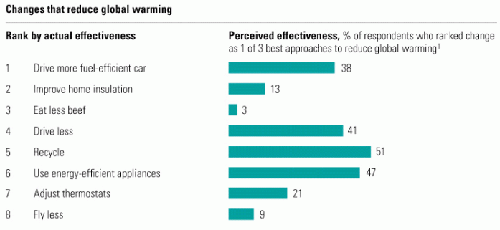
A final point: if people are going to do these kind of personal-behavior performance pieces, it’s important that they convey accurate information about the impact of personal behaviors. That is information the public desperate needs. McKinsey found, in a 2008 survey of consumers:

Our study shows that more than one-third of the consumers who want to help mitigate climate change don’t really know how. The top three ways for them to reduce their own emissions are to drive more fuel-efficient cars, improve the insulation of their homes, and eat less beef. Yet when we asked the consumers in our study to name the top three, they fingered recycling, energy-efficient appliances, and driving less. Few consumers knew how eco-friendly it is to shun beef.
2009-08-28-indychange.gif

As you can see, the American people are deeply confused about how to reduce their impact, even if they wanted to. I cringe every time I see someone on TV going on about unplugging power strips—the most time-consuming, irksome,  low-impact change a person can make. If you want to reduce your impact, replace your car with a Prius or take public transit, insulate your home, and eliminate beef from your diet. Do that and you can relax about, say, toilet paper.


Follow David Roberts on Twitter: www.twitter.com/drgrist

grist.orgThe other day I highlighted a new piece from Elizabeth Kolbert in the New Yorker, which was critical of No Impact Man and other “stunts...
 
Comments
8
Pending Comments
0
iPhone App Promo

Want to reply to a comment? Hint: Click "Reply" at the bottom of the comment; after being approved your comment will appear directly underneath the comment you replied to

View Comments:
photo

"I cringe every time I see someone on TV going on about unplugging power strips. . ." So do I. It's fashionista eco, and it makes me queasy. These people manage to entirely miss the real point of living a more ecofriendly life, which is that if you start from a position of knowledge and respect for the planet, your actions change as a result of that evolution.

These bandaid measures imply that a viewer can "go green" simply by purchasing a couple of low energy lightbulbs or growing a tomato. It's the equivalent of saying you'll be closer to Jesus if you wear boxers, not briefs.

    Favorite    Flag as abusive Posted 11:04 AM on 08/30/2009
photo

I don't understand how driving fuel efficient cars is better than driving less. Surely, arranging your affairs so as to not need a car is better for everyone than spending and consuming more (fuel efficient or not).

The list above is delivered "commandment style". I'm with you, but I need a little more explanation.

    Favorite    Flag as abusive Posted 09:34 AM on 08/30/2009
- JulieSA I'm a Fan of JulieSA 165 fans permalink
photo

Buy grass-fed beef, from local sources if possible.

This business needs to be supported. Ranchers maintain the open spaces we depend on for various services, like clean water and wildlife habitat, and they pay property taxes on that land to boot. If they go out of business, they're commonly replaced by subdivisions.

It's better for the environment if you encourage this, rather than just saying "don't eat beef".

    Favorite    Flag as abusive Posted 11:16 AM on 08/29/2009
- sunnybunny I'm a Fan of sunnybunny 16 fans permalink
photo

Or eat venison and use paper for packaging things (timber comanies that make paper keep large parcels of land for trees that are still good for wildlife habitat even if they are clear cut, but hopefully most are selectively cut. This is land that is NOT becoming a subdivision) Animals that live in the wild all their life enjoy a much better quality of life than any farm animal.

    Favorite    Flag as abusive Posted 03:07 PM on 08/31/2009
photo

in addition, TONS of rainforest are cut down every year
to raise cattle... (and for full disclosure, soybeans as well)

read more about the amazon devastation here:
http://www.guardian.co.uk/environment/2004/apr/02/conservationandendangeredspecies.internationalnews

----------­----------­----------­---------

check here for some PBS insight
http://www.pbs.org/wgbh/pages/frontline/shows/meat/
or here for some real serious insight (please)
http://www.petatv.com/
or, for a lighter view, animation style
http://www.themeatrix.com/
and take action to ease chicken suffering
http://www.mccruelty.com/

----------­----------­----------­----------­----

just look into the energy used in producing one lb. of beef
(scroll down the page to see stats and sources)
http://www.vegansworldnetwork.org/topic_environment_meat_eating.php

----------­----------­----------­----------­----

just for fun, consider starting a new tradition of abstinence,
meetless mondays perhaps, or one week a month. its easy!!

    Favorite    Flag as abusive Posted 07:48 AM on 08/29/2009
- RMankovitz I'm a Fan of RMankovitz 48 fans permalink
photo

Although terms are left undefined, I presume the reference to beef in this article is to feedlot-raised grain-fed beef.

Let's look at beef the way nature intended: from grass-fed free-range cattle or buffalo. I know of no studies comparing the environmental impact of this animal food to plant-based protein crops, so I will take a crack at it. Let's compare the footprint of a pound of wheat or soy protein to a pound of grass-fed free-range buffalo protein, using the following metrics:

Artificial fertilizers and pesticides (derived from fossil fuel); diesel fuel to run agricultural machinery to plow, cultivate and harvest; and artificial irrigation (fossil fuel powered pumps and water).

I suggest that a pound of grass-fed buffalo protein requires essentially none of the above, while plant protein from commercially produced annual monocrops requires large amounts of all of the above.

All of the demonizing about beef is based on the feedlot-raised grain-fed stuff. New studies (posted on HuffPo) show that it is the feeding of grain that causes the cow burp-methane issue, and that feeding them grass normalizes their digestive system. There is some anecdotal evidence that termites may produce more methane than grass-fed animals.

One could make the argument that shunning plant proteins in favor of grass-fed meat is the way to go to reduce environmental toxins and minimize climate change. Hopefully, future research will determine the answers.

Roy Mankovitz, Director
http://www.MontecitoWellness.com

    Favorite    Flag as abusive Posted 12:35 AM on 08/29/2009
- drkazmd65 I'm a Fan of drkazmd65 52 fans permalink
photo

While I haven't given up beef, pork, lamb or poultry,.. I eat a substantial amount less of them all than I used to. Beans, lentils, and such with a nice yogurt dressing and fresh veggies are fantastic,... a little chiorzo added for flavor doesn't hurt either.

One can eat some dandy vegetarian, or nearly vegetarian dishes and almost NOT notice the difference a couple of times a week. Cheese, olives, and a nice salad are good choices too.

My Car already gets ~38mpg day after day. We shop locally as much as possible for food. And adding window insulation, weather stripping, and caulking are all on the list of things to do before winter. Should probably look into getting a new insulating blanket for the water heater too.

But every little bit helps,... even unplugging a power strip or two is a good thing and should never be belittled.

    Favorite    Flag as abusive Posted 11:29 PM on 08/28/2009
Comments are closed for this entry

 You must be logged in to comment. Log in  or connect with 

Connect