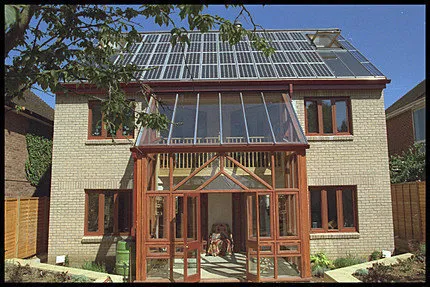
 Yesterday, a company called Sungevity announced the availability of what they're calling the cheapest solar system in the world: a rooftop solar panel system, fully installed, for $2,000.
That's as much as I paid for my computer.
For that price, the average home will save $21,000 in electricity over 25 years -- a 45 percent return on investment.
From a simple web interface, customers can plug in their address and Sungevity will use satellite and aerial imagery to assess their rooftop solar potential and offer them a range of options within 24 hours. Ordering can be done online, as easily as ordering a book from Amazon. (The company fills out all the necessary permits and mails them for a signature.)
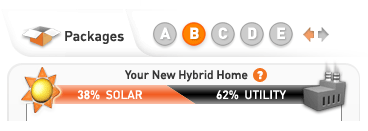
Rather than the months of a typical PV order, the entire process, from quote to installation, takes just a couple of weeks.
Now, to bring us back to earth, the caveat -- and it's a doozy.
This system is available only to residents of San Francisco, and only temporarily, as it is pegged to the $1.5 million in incentives the city will begin handing out today through its Solar Energy Incentive Program. The program will offer up to $6,000 to individuals and $10,000 to businesses to install PV. In non-SF reality, Sungevity's 1.5kW starter system is around $8,000 installed.
Still, the company's got plenty to boast about. In fairly short order, it has undercut the price of other solar providers in California by up to 10 percent. How? By taking steps to commoditize the PV market.
"There's so much money being spent on the hardware and technology end of the business," says Sungevity CXO and president Danny Kennedy, "and yet 50 percent of the cost the customer pays -- which is the only price that matters -- is downstream of the factory gates. Even if a Nanosolar panel came out and it was free, it would still cost $5/watt to get it up on a roof." While press and investor attention largely focus on whizbang new generation technologies like modular CSP, nanotubes, and printable films, Sungevity is focused on distribution, installation, and customer service.
Kennedy worked for years as a Greenpeace organizer, pushing for solar support in California. Now, with a group of fellow green expatriates, he's knee deep in commerce. (Says Greenpeace USA head John Passacantando, "Danny Kennedy was one of our greatest warriors fighting for a green and peaceful future. But I always knew victory would be at hand when some of the warriors would shift their focus and raise the capital to literally build the green energy future with real green jobs.") When I spoke with Kennedy, what he's most excited about is a recent milestone: "We made our first fully online sale! It was to an octogenarian, which sort of blew away our assumptions about who the customer was."
Sungevity only went state-wide in California a few months ago, one of many businesses pulled into the slipstream of the state's Million Solar Roofs program, but its ambitions are large. Right now the company is limited to Calif., because that's as far as its installer subcontracting network goes, but Kennedy expects to go nationwide, or at least to top solar states, within a year or two. And he wants to start building a nationwide network of reputable, certified installers:
The whole point of Sungevity is to facilitate the scaling of solar by making it easier, not just for customers -- that's the first innovation -- but also for installers and other contractors to get in the game. Our view is that to save the planet with solar we've got to something like 700x the solar installed capacity. You're not going to do that just by growing the mom-and-pop shops. With all due respect to them -- and they're wonderful people, and I've known and loved and worked with them for over a decade -- that high-end, low-volume, high-cost business will always have a place for the premium and elite customers, but there also has to be a Dell.
(And sure enough, Fortune's Todd Woody has dubbed Sungevity "the Dell of solar energy.")
Because rooftop assessment can be done remotely and on the cheap, Sungevity can size up large numbers of roofs at once. Kennedy is open to working with larger customers, "be it a city that wants to reduce its carbon emissions, a corporate that wants to support its staff to do the green thing, or a utility that wants to value add to their grid and preserve them from the need to invest in substation upgrades or new transmission."
For a small East Bay town called Albany, the company remotely assessed around 3,500 roofs and discovered that roughly 2,000 were solar-appropriate. "If every one of those customers went solar with Sungevity, the 2,000 homes combined would save that community $30 million in electricity over the next 25 years and 40,000 tons of CO2," says Kennedy. The company sent direct mail to those 2,000 addresses; each mailer had a picture of the house with a PV installation on it, a price quote, and a pitch for the investment benefits of PV. Through this kind of marketing, Sungevity is attempting to scale the solar market beyond the LOHAS choir.
As it happens, the aforementioned octogenarian was one of those Albany customers.
"This is a serious way to make the dream of a million solar roofs in California real, or tens of millions across America real," Kennedy says proudly. "We now can effectively model, aggregate demand for, and design a cost-effective way to deliver that dream."