iPhone app iPad app Android phone app Android tablet app More

Featuring fresh takes and real-time analysis from HuffPost's signature lineup of contributors
David Schonauer

David Schonauer

GET UPDATES FROM David Schonauer

Remembering the Lost Era of Board-Track Motorcycle Racing, When America Fell In Love with Speed

Posted: 04/ 2/11 04:42 PM ET

Their names are now just footnotes in the history of American motorsports: Jim Davis. Gene Walker. Fred Ludlow. Albert "Shrimp" Burns. Ralph Hepburn. Ray Weishaar. They were young men from farms and small towns who earned fleeting fame in the early decades of the 20th century by riding motorcycles around banked wooden tracks at speeds exceeding 100 miles an hour. They thrilled the large crowds that turned out to watch, and why not? It was time when Tin Lizzies still shared dirt roads with horses. When people went to see those boys whipping around the tracks, faster than anything they'd ever seen before, they were looking into the future. They were falling in love with speed.
2011-04-02-AFV62128AurthurMitchell.jpg

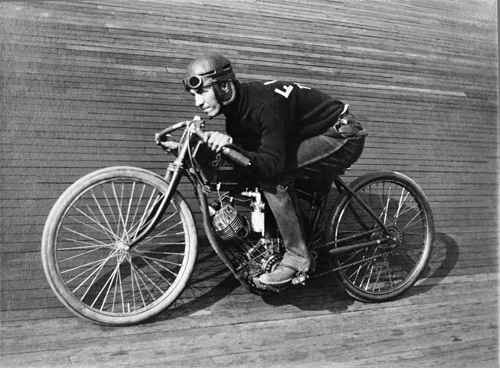
Board-track racer Arthur Mitchell, from the A.F. Van Order Collection

The era of board-track motorcycle racing was a fascinating piece of American history, as I learned while researching a story that appears in the April issue of Smithsonian magazine. The first mass-produced American motorcycle, the Indian, appeared in 1901; it was followed in 1903 by the Harley-Davidson. Less than a decade later those storied brand names, along with other companies, were fielding teams of riders who competed against each other in large tracks built especially for motorcycle racing. A promoter named Jack Prince put up the first tracks in Los Angeles--one would eventually be built on the site now occupied by the Beverly Wilshire Hotel--but soon they were being built all over country, from Denver to Sheepshead Bay, Long Island.

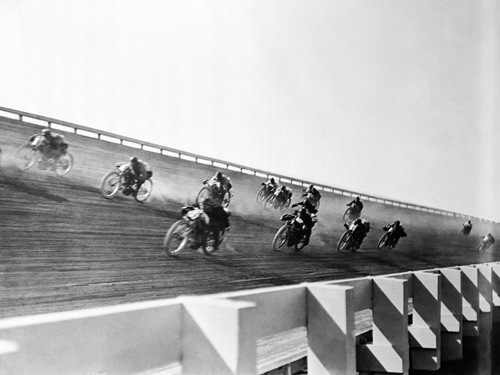
The tracks, called motordromes, were made of rough-cut lumber and banked steeply--sometimes more than 60 degrees. The early racing motorcycles were essentially bicycles with powerful engines but no brakes. Collisions and crashes occurred regularly; often, riders would be upended when their bikes hit 2x4s that had become worn or warped. What followed was terrible: ghastly injuries from hundreds of splinters, deaths from cracked skulls. Shrimp Burns, one of the most popular riders, died in 1921 after crashing at a track in Ohio. Ray Weishaar, who rode for Harley-Davidson's "Wrecking Crew" team, died in 1924 after dueling with Gene Walker, who rode Indians, during a race in Los Angeles. Walker died just two months later on a track in East Stroudsburg, Pennsylvania.

My piece for Smithsonian focuses on a photographer who documented the board-track era. A.F.Van Order grew up in Illinois, where he worked in his family's livery business. Apparently he got his fill of hooves and harnesses, because in 1907, when he was 21 years old, he bought a Wagner motorcycle and set about changing his life. He moved to Southern California so he could ride year round and compete in races. After an accident, he quit racing; to feed his obsession, he bought a camera and started taking some remarkable pictures.
2011-04-02-AFV3349HarryCrandelp.jpg

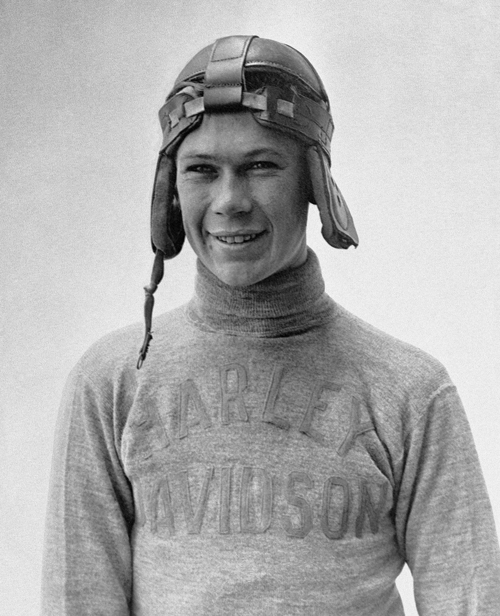
Rider Harry Crandall

Charles Falco, professor of optical sciences and physics at the University of Arizona and the co-curator of "The Art of the Motorcycle," an immensely popular exhibition that opened at the Guggenheim Museum in New York in 1998, is an admirer of Van Order's pictures. "Photography is great for documenting things like this, and great photography is better than just snapshots. And Van Order was much better than just a snapshot photographer," he told me. Van Order's primary goal as a photographer was to preserve and memorialize, but his pictures go further, as documentary photographs so often do. In the blurred action shots, and especially in the portraits of riders--all smiles and confidence--an irresistible narrative emerges. The young men seem satisfied, if not happy, to have traded horses for horsepower; the danger that came along in the deal was something that they, and the rest of society, were more than eager to accept, even as the carnage at the tracks became appalling.
2011-04-02-AFV6447A14ridersontrack.jpg

An early action shot

On September 8, 1912, Eddie Hasha, a.k.a. "the Texas Cyclone," was competing in the final event of the day at a motordome in Newark, New Jersey--a five-mile race against five other riders--when disaster struck. Hasha began the race in the lead, but in the third lap the engine on his bike developed a misfire. Another rider sped by him. Hasha dropped one hand from the handlebar, adjusted the engine, and quickly picked up speed. In the next instant he shot up the banked track and struck a rail at the top, along with a number of spectators looking down into the bowl from above. The number of dead varies from four to six, depending on the account. Hasha ended up hitting a post and being thrown to his death among the spectators. The press began referring to motordromes as "murderdromes."

By the early 1920s, local governments began to crack down, closing tracks, and the motorcycle companies that sponsored teams began instituting rules to limit speeds. But the public had grown weary of the sport. There had been a World War--another, far greater spectacle of death, in the meantime--and by the end of the decade board-track racing was a thing of the past. The 20th century was well underway.


  • Comments
  • 11
  • Pending Comments
  • 0
  • View FAQ
Comments are closed for this entry
View All
Favorites
Recency  | 
Popularity
photo
HUFFPOST SUPER USER
Edy Williams
01:37 AM on 04/04/2011
Hey Bikers, you will have fun picking your Kentucky Derby winner,May is coming,.Zenyatta stole the show last year. What a dazzling dame on the track Ck. it out!
photo
morris111
fac fortia et patere
12:53 AM on 04/04/2011
What a crazy sport! Those guys had some balls! Great article.
photo
HUFFPOST COMMUNITY MODERATOR
motoGpifupleez
watching with amusement
04:13 PM on 04/03/2011
People have always loved racing and those with the courage to actually take to the track. Most recognize the vast gulf between their own courage and abilities and those who thrill them with their exploits.

Of course, there are always those who attend for the specter of potential carnage.

I am truly fascinated by the pioneers of these motorized endeavors, from motorcycles to automobiles to aviation. The purity of being the one who develops the technique, writes the "rulebook" for how it should be done, and the sheer audacity it took to not only step up to the challenge, but master it when there was no other before to guide the way.

I have had the pleasure of being on the other side of the fence, though not to any grand level of accomplishment, and have always been glad that I took that step and shared that experience for it gave me an even greater appreciation for what it takes to do it at it's highest levels.

If any of you are ever in the area of Leeds, Alabama, the Barber's Motorsports Museum is located there and has in it's collection a boardtrack display and some of the motorcycles that were actually used. Seeing them in person gives you an even greater respect for those daring young men. It's worth the price of admission to see how the technology progressed to where we are now.

All thanks to Huffington Post for including this story.
photo
Lao2stroker
I love the smell of 2stroke smoke in the morning..
11:49 PM on 04/03/2011
Barber Motorsports Museum was the first time I got a real glimpse of what this side of motorcycle racing entailed. Their display is truly amazing and informative. Barber itself would leave any enthusiast drooling. So much so, my friend said he was coming back to have his wedding vows renewed!

These guys were true pioneers, doing for the thrill. I am guessing fame, money, and Monster energy contracts were few and far between...although, Coke may have had a few riders;)

Keep the rubber down, fellas!! SPeed speed speeeeed!

Brraaaaapppp!
HUFFPOST SUPER USER
johnnygoodwud
09:19 AM on 04/03/2011
great article. somewhere i have a pic. of my great uncle with his indian motorcycle, in full long driving coat, with long gloves and goggles, my petite aunt on the back of the bike.
photo
TexasMike
No False Equivalence Here
07:38 AM on 04/03/2011
Interesting article and glad I now have the Smithsonian as a bookmarked website. No offense, huffpo, but sometimes I feel I'm wasting my time here that could be better spent at places like Smithsonian or Scientific American.
02:38 AM on 04/03/2011
A fascinating glimpse of Americana. Thanks for the interesting article.
HUFFPOST SUPER USER
realitytrumpsbull
Two 'alves of coconut!
12:40 AM on 04/03/2011
The quest for 'better, higher, faster, more powerful', has led to things like the entire space effort.   Back then, a trip to the moon was still the stuff of Jules Verne, but the Wright flyer had just become a reality, and they had wireless, sort of.  A lot of people and their machines have been 'sacrifices to the gods of speed', there was the Stanley Rocket, and the famous time trial at Daytona, and tragic consequences, and you can lump on every track death that's happened over the intervening decades, car, or motorcycle.   As time went by, it became apparent that to go faster, you had to break free of the surly bonds of earth, and people like Howard Hughes were always pushing to get that last 5MPH out of a machine before the wings finally fell off. Then, along came a man named Chuck Yeager, and an aircraft called the X-1, and today, breaking the sound barrier is 'no big deal', barely a century after they first 'cracked the ton'.  They have the SR-71, they have the recent NASA ramjet success, they have the shuttle, no slouch at 23,000 MPH, someday, they may even be able to go faster than light. We probably won't live to see that day, but don't say it can't happen, if someone really wants to do it, they'll find a way.
photo
HUFFPOST SUPER USER
ringmaster
I know I spelled it wrong.
11:20 PM on 04/02/2011
The motordromes stated as bicycle tracks in the gay ninties. Bicycle racing was a hugely popular sport in the eighteen nineties,and the biggest money winner was a black guy.
photo
HUFFPOST SUPER USER
Okillia
Lets eat the rich!!
11:50 AM on 04/04/2011
Those are very interesting links. Thanks!