
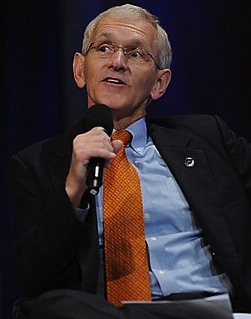
Since former Congressman Steve Gunderson (R-WI) was named in January as the new head of the largest for-profit college association, APSCU, there has been talk that he might take a "kinder, gentler" approach to leading the troubled industry, which has pursued a take-no-prisoners lobbying approach in Washington. But having read Gunderson's pronouncements in recent months, and having attended last week an off-the-record small group discussion with him, I'm concerned that what kinder and gentler means is: Currying favor with lobbyists for traditional non-profit and public colleges, but not yielding an inch to the interests of taxpayers who have been fleeced and students who have had their lives ruined by bad actors in his industry.
For-profit colleges, many marked by deceptive recruiting, low-quality programs, and sky-high prices, have 13 percent of U.S. students but nearly 50 percent of student loan defaults. Recent data show that four-year students at for-profit colleges graduate less than half as often as other students. The for-profit college industry gets most of its $30 billion-plus annual revenue from federal financial aid; many for-profit schools obtain 90 percent of their income through federal student grants and loans. They use a good chunk of this money to lobby Congress and provide campaign contributions to Members with the aim of avoiding accountability for their destructive subprime programs.
Instead of using his stature to lead his industry to a more responsible place, Gunderson appears only to be pursuing a strategic alliance with traditional colleges to avoid accountability measures. This is consistent with the pre-Gunderson APSCU strategy, apparently urged by House Republicans, described in a 2011 internal APSCU draft memo first disclosed by Republic Report. That memo stated that, "as directed by House Republican leadership," APSCU would stress, in lobbying for a bill to overturn standards on credit hours and state government oversight, that traditional colleges agreed with their position. That bill did pass the House, with every GOP vote a yes, in February after Gunderson took the helm at APSCU.
Gunderson told the Chronicle of Higher Education, "You will never hear me or other APSCU officials criticize any of my colleagues in higher education.... I'm going to change this culture. We've got to be seen as partners and allies." In turn, Terry Hartle, chief lobbyist for the higher ed group the American Council on Education (ACE), said, "Steve Gunderson is thoughtful, experienced and highly respected and will be a great asset for APSCU.... Steve's career ... has given him a great deal of experience in building bridges and sustaining coalitions. That's an excellent background for his new post." Gunderson reports that he has applied for APSCU to rejoin ACE, which it quit several years ago after being excluded from key councils.
It's great that everyone's getting along. But what about a more reasonable approach from the for-profits -- acceptance of the fact that their industry is basically a federal program, and, accordingly, acceptance of federal policies that would reduce waste, fraud, and abuse by rewarding schools that actually help students learn and get jobs, and penalizing schools that systematically fail to help their students?
There, apparently, Gunderson can't help us. In a recent op-ed, he maintained the APSCU hard-line in attacking a key reform pursued by President Obama - the sensible "gainful employment" rule that would cut off financial aid to programs that, year after year, leave the vast majority of their students with insurmountable debt. Repeating meaningless slogans from last year's industry barrage, Gunderson wrote that the rule "establishes a one-size-fits-all approach for deciding which institutions will be eligible for federal student aid and in the process limits the options of nontraditional students seeking skills and training for the purpose of securing employment." Even though intense lobbying by the industry weakened the final measure significantly, APSCU filed a lawsuit to block the rule almost as soon as it was issued. There's no sign that Gunderson wants to withdraw that complaint. Gunderson has said he wants to revise APSCU's voluntary code of conduct for members. He didn't say exactly how, but he did make clear why: "Self-regulation can prevent government regulation."
Gunderson's op-ed also charged, not very kindly or gently, that "some in Congress" were hindering his sector "for the purpose of scoring political points." Is that really why Senators like Tom Harkin, Dick Durbin, Jim Webb, and Marco Rubio have been pushing reforms - to score political points? Despite intensive advocacy on both sides, the issue of for-profit colleges has certainly not become a central issue cited by voters, and the people most harmed by abuses -low-income, struggling veterans, people of color - are those who face the greatest challenges and often have the least amount of political clout. Although, Gunderson may indeed be worried about the fact that veterans groups have become increasingly active and vocal in working to protect vets and active duty military from for-profit college abuses.
Consistent with a strategy of stroking the traditional education sector, Gunderson also has touted as a success story the new "collaboration," announced in December 2011, between the University of Florida and for-profit Full Sail University. This arrangement, according to a UF press release, will "make it easier for students who graduate with certain degrees at one institution to have access to the next level of degree program at the other institution. It also will help clear the way for co-promotion of such degree and certificate programs...." The press release, however, reveals that some key issues need to be resolved before there is an actual partnership; for now it seems to be more of an endorsement of Full Sail by UF.
If you know that Full Sail is a very expensive school of, at best, a mixed quality, then you might be concerned about why the University of Florida would lend its prestige to its for-profit neighbor. Such worries would be magnified by the news, announced in late March, that UF was naming its new undergraduate business school after major donor Bill Heavener, the CEO of, yes, Full Sail University. If all of this sounds familiar, it's because Full Sail is the same school praised late last year by Mitt Romney as the future of higher education - while Heavener and other Full Sail executives have contributed hundreds of thousands of dollars to the Romney campaign and Super PAC. Heavener apparently likes it when he can get something for his money.
This is the conflicted world Gunderson has entered, and no doubt APSCU's demanding board of directors, comprised of wealthy for-profit college executives, is watching his every move. And while APSCU reportedly had a difficult time finding takers for its CEO job, Gunderson may have come with his own baggage. When he announced in July 2011 that he was leaving his job as CEO of the Council On Foundations (COF), Gunderson stated, "This is the right time for a transition." But others may have been ready for him to go. A COF financial statement issued soon thereafter reports that the Council "entered into a separation and release agreement with its President and Chief Executive Officer (CEO). The agreement provides for the Council to make payments to its former President and CEO totaling approximately $400,000 beginning September 1, 2011 over a period of 12 months." The amount Gunderson was to receive from this severance agreement, $400,000, was about equal to his 2010 compensation package.
There was no indication that the APSCU board, having successfully pressured the Obama Administration to water down the "gainful employment" rule, wanted a new CEO to tell them to clean up their act. And, sadly, there's no indication that Gunderson, fresh from leaving his previous CEO job, is going to do so.
The original version of this piece appeared on Republic Report.