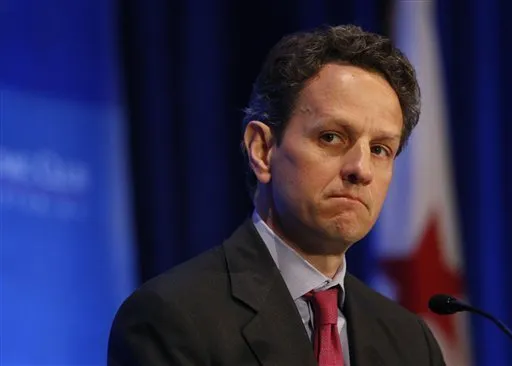
In most areas of public policy the Obama administration has given the country a sharp and welcome break from the policies of the prior administration. Unfortunately, this is not the case with his financial policy. To a large extent Treasury Secretary Timothy Geithner has continued the Bush-Paulson "save the banks" first approach.
Geithner has continued policies initiated in the Bush administration whereby the banks received vast amounts of money from the public trough while offering relatively little in return. Most of the executives at these banks continue to earn multi-million dollar compensation packages and the shareholders and bondholders have been enriched at the taxpayers' expense.
It is undoubtedly painful for the public to see their tax dollars going to reward the people who are most directly responsible for the economic crisis. The Wall Street banks played a game of high-stakes poker over most of the last quarter century. In the process, the major actors got incredibly wealthy at the expense of ordinary working people.
Now this game has blown up in their face, effectively bankrupting most of the big players, and bringing the economy down in the process. But rather than leave the bankers to suffer the consequences of their own actions, Geithner and Co. are rushing to the rescue with gigantic buckets of taxpayer dollars.
The rationale for this policy is not clear. We have been warned about an implosion even worse than that created by the Lehman bankruptcy if the government follows normal procedure and puts bankrupt giants like Citibank into an FDIC receivership, as is done all the time with smaller banks.
While Secretary Geithner believed that the system could absorb an uncontrolled Lehman bankruptcy last fall, he is now effectively telling the country that even the controlled failure of a major bank would lead to catastrophe, and that taxpayers should be prepared to spend hundreds of billions and possibly trillions of dollars to keep the zombie banks afloat.
It is hard to understand this logic. First, Geithner, along with Federal Reserve Chairman Ben Bernanke and then Treasury Secretary Henry Paulson, were not crazy to believe that the system could withstand an uncontrolled Lehman bankruptcy, even if was in fact a mistake to let Lehman go under. More importantly, we have a number of safeguards now in place to protect against the sort of panic that followed the collapse of Lehman. There seems little justification for continuing to spread the wealth around to those at the very top of the income ladder.
To justify the upward redistribution implicit in the Geithner policy there have also been serious misrepresentations of the state of the financial system. While the banks certainly are not functioning normally, their condition is not the major obstacle to recovery.
Households with good credit have no difficulty whatsoever getting mortgages as a result of the policies of the Fed and Fannie Mae and Freddie Mac. Mortgages are readily available at near record low interest rates. Those with poorer credit histories do have trouble, but this would almost certainly be the case even if the banks were fully solvent.
Large businesses with investment grade credit can readily issue commercial paper through the Fed to deal with their short-term credit needs. In recent weeks, several major firms have also issued bonds at relatively low interest rates, indicating that long-term credit channels are returning to normal for these firms as well.
While smaller and less creditworthy businesses are undoubtedly having more difficulty than usual obtaining credit, this is not the main factor depressing the economy. The basic story is that households are in the process of losing $8 trillion in housing bubble wealth. This has both collapsed housing construction and forced consumers to cut back spending.
The fall in consumer spending is not due to lack of credit or insufficient confidence, it is due to the fact that the average homeowner is losing more than $100k in equity and is now trying to save to make up this lost wealth. There was also a bubble in non-residential real estate, which is now collapsing, further depressing the economy.
In the short-term the only way to make up for the shortfall in demand is with government spending. We will need far more stimulus to make up a gap in spending that is in the neighborhood of $2.5 trillion over a two-year period.
In the longer term we will have to get the trade deficit down to a sustainable level. Moving to more balanced trade will require a large fall in the value of the dollar, which is the key step in correcting our large trade imbalance.
The Obama administration has yet to get serious about setting the long-term economy on a sound footing by bringing the value of the dollar down to a competitive level. Instead it has focused on rescuing the banks with taxpayer dollars. Throwing money at the banks will make the bankers happy - rescuing them from their own incompetence - but it will not set the economy right.
In the area of financial policy the Obama administration gets poor marks for its first 100 days. Instead of a letter grade, we'll just say: "needs improvement."
From serving as wholesale lenders, then as brokers of the securitized loans, then as promoters and buyers of the naked CDSs against those crap loans.
Where were the stakes? The only stake was how much it would cost to buy two administrations willing to sell US out.
Case in point: what Mr Baker is saying is almost 180 degrees from what Krugman and even Ms Huffington are saying. He says that the condition of the banks, and the amount of credit and lending going on, is not a critical problem right now. "While the banks certainly are not functioning normally, their condition is not the major obstacle to recovery."
It's an interesting discussion that he gives -- about the loss in home values, for instance, being a greater burden by inhibiting consumer spending in favor of household savings -- but this is in stark contrast to Krugman and Ms Huffington's belief that the "zombie banks" will continue to drag the economy down. They believe the "zombie banks" are THE big problem, and their criticism of the Administration is that its approach to the bailouts is propping up these "neither dead or alive" banks, instead of either killing them off or making them sound and healthy.
- Craig
I was shooting the breeze with some MBAs and naïvely said---Why don't the Post Office get into banking?---and the idea has snowballed since: http://www.federaltimes.com/index.php?S=4034396
Gregg Carlstrom wasn't one of the people I shot the breeze with, MY vision of the Post Office doing banking is one of credit cards with REASONABLE RATES [i.e., 5 to 18% depending on your credit rating], doing the FICO scoring and handling the mortgage bailouts.
As I just listened to Obama, almost flippantly say that he's into neither running the banking OR car industries...but the former is so screwed up that the latter is almost irrelevant!
With BoA and Citi on shaky grounds, ALL the other banks are gonna be stingy with the money WE THE PEOPLE "gave" them...so why not give them some good STIFF competition in the form of the Post Office doing banking?
MY food allowance for work is five dollars a day [ I cannot take food to work because of the nature of my job---picking up & delivering bio-hazardous materials to doctors and hospitals...MINIMUM WAGE with NO HEALTH CARE]....but what IRKS me the most??? The fact that these banks can rob me with impunity!!!!
On the economy, Barry gets an F minus
isnt it MORONIC to be doing these two things at the same time.
1) ask the govt. for forgiveness/restructuring of mortgages, car debt, student loan debt, credit card debt
AND
2) saying that banks are not extending enough credit.
you can do either of the 2 but not both.
I agree that there is, and was, no excuse for pouring taxpayer money into insolvent banks without taking them over and reconstituting them into healthy entities (for the same reasons, taxpayer money might have been better spent on solvent banks whose managements didn't make the mistakes that the insolvent ones made).
As Dean says, why should bankers and other players in the toxic asset scam be allowed to continue to be in charge if no one else in any other industry would be allowed to continue under similar circumstances simply by reason of crucial business errors, putting aside fraud? They and others in the financial industry (and government) are fundamentally no different than environmental polluters - they polluted the money and financial paper reservoir. Why shouldn't they be treated as polluters; why shouldn't they even be asked to help pay for the damage? That's the opposite of what is happening. Not having had a role in the creation of the financial toxic assets, my role and that of most citizens has been defined by Treasury and congress to be: pooper scooper.
There are things we all need -- roads, schools, transit systems -- that can and should be run in the interests of 'the public' (not private profit maximizing interests). We don't want privatized roads why should we have private (unregulated gangster, making up stuff like derivatives) banking.
That may seem odd. But it is no more odd than the neoliberalist agenda to privatize water, air, schools, even human dna.
Fire Geithner.
Hire Baker.
therefore, everyone in office should be voted out. Now what is more powerful than that? Even the FED
cannot interfere here.
We are being ripped off more each day.
These people who in 1980 made 20 times the average worker NOW MAKE 400 Times the Avg Worker!
Remember $10 to $100 Million Christmas Bonuses on top of $10 to $50 Million salaries!
They ruined their OWN Banks and want to continue while WE the taxpayers Bail their Banks OUT!
THEY RUINED THEIR OWN BANKS!
and sold those mortgage packages over and over again. And for that they still want to be rewarded.
Something stinks to high heaven here.
A conversation about the economy
A conversation about the economy with Bill Ackman, major investor and hedge fund manager of Pershing Square Capital Management LP, Kate Kelly of The Wall Street Journal, Andrew Ross Sorkin of The New York Times and Joseph Stiglitz, economist and a member of Columbia University faculty
http://www.charlierose.com/view/interview/10251
Wide consensus that the plan is not working and that we need a shift -- break up the "too-big-to-fail" banks, restructure them, force the bondholders to take equity for debt.
$12,800,000,000,000 has been pumped into Wall Street (per Bloomberg) but almost nothing to Main Street other than a few half-baked low funded complicated programs that take forever to work!
As stated in the NY Times Wall Street OWNS the TEAM and it shows!
Obama could Fund a Government Bank that loans directly to Main Street over the Internet at low rates and fees to solve this problem. Even putting a couple $Trillion into local Community Banks and Local Credit Unions would be far more productive.
Instead we see another small program for second mortgages that will take forever to happen!
Is Main Street doomed to SUFFER while Wall Street claims Profits from the Team's funding?.