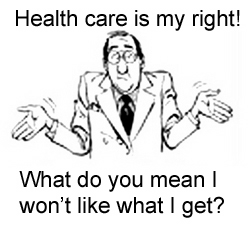
Neither the President nor any member of Congress will ever say it, not if they want to get re-elected. I hold no elected office and as a doctor I am obligated to tell the patient the bitter truth. Health care is not a right. There, I said it.
Health-care-as-a-right distorts behaviors, destroys the possibility of supply balancing demand, and drives people out of working in healthcare. Health care is not, cannot be, and should not be a right.
Health care is not an unencumbered right.
To most people, you don't have to work for a right. It is natural privilege, unencumbered by any responsibility - just like Bill of Rights.
Our Founding Fathers did not elucidate the responsibilities in the Bill of Rights because it never occurred to them that people could believe rights come without responsibility.
Free speech (1st Amendment) means Pro-Choice advocates cannot muzzle Pro-Life proponents and vice-versa. Right to bear arms (2nd Amendment) prohibits citizens from using those arms against other citizens. The Sixth Amendment guarantees the right to a fair and speedy trial, which places a responsibility squarely with the legal system not to hold us indefinitely or without due process.
There is no such thing as an unencumbered right. Rights without responsibilities do not exist. You have a right to police protection. You have responsibility to obey the laws.
Health care cannot be a right.
Health care cannot be a right, unless you want to bring back chattel slavery or at least serfdom. Health care is a service provided by a small group of people for the benefit of a larger group of people. If the majority has a right to demand this service, that means they can require providers to serve them.
Only in the military system can one person require another to act. In all other parts of our society, we are free to accept an order or to reject it from another private individual. If people have guaranteed access to health care, because it is their right, someone must provide that care whether the provider wants to or not. If health care is a right, then the health care worker is no longer free. What if no one goes to medical or nursing school? What happens then to the right to health care? Health care cannot be a right.
Health care should not be a right.
You do not want health care to be a right. You will not like what you get: strict government rationing, a sickly population, and the kind of providers you want to avoid.
Rationing
Call it control of resource utilization, central balancing of supply with demand, or just plain rationing, decisions must be made about how much money, time, people and supplies are used. As there is no natural limit to the demand for health care services, without some limiter or brake, we will literally use up all the resources.
The "rationer" of your health care can either be the government or you. In every country with universal health care, the government balances the services provided with the money expended (rationing). The same is partly true for the USA where MediCare, MediCaid and private insurers all ration care.
We could have a system where the individual controls the flow of his or her health care dollars (not insurance based) just as we do when buying groceries or car maintenance. Interestingly for a consumer-driven system, one blogger recently quipped, "The key element missing in the health care debate is the consumer."
Unhealthy populace
Health-care-as-a-right makes us sick because having no personal responsibility lets us treat our bodies badly and then expect the healthcare system to fix our obesity, our emphysema from smoking, and our cirrhotic (scarred) livers from drinking.
The lack of personal financial responsibility produces unhealthy thinking called the moral hazard: we change our behavior when we are personally insulated from the consequences of our bad choices. In the Atlantic magazine David Goldhill quantified the moral hazard in healthcare. "The average insured American and the average uninsured American spend very similar amounts of their own money on health care each year-$654 and $583, respectively. But, they spend wildly different amounts of other people's money- $3,809 and $1,103, respectively." When the money we spend is someone else's, who cares?
From the purely commercial viewpoint, health care is infrastructure maintenance and repair. The government engages in no preventative [health] maintenance. The entire system is focused on one desire: cutting immediate costs. If we treated our bridges and roads as we do our people, they all would be broken. Why doesn't the government focus on restoration and long-term preservation of our health? Answer: because health care is considered a right.
Providers waiting for happy hour
Health-care-as-a-right rejects people "called to service" in favor of following a manual of policies and procedures and complying with regulations handed down from Washington. If the public treats providers as menials fulfilling the individual's right to health care, then the public will get rote behaviors by individuals who work their shift (and no more) while waiting for happy hour.
Health care should be a partnership.
Effective health care should be a two-level partnership: a voluntary association of two or more people where both partners know their respective roles and where both benefit. The two levels are individual and national.
On the individual level, there should be a doctor-patient partnership. Each has rights and responsibilities. The entire system should be a win-win scenario: when the patient stays healthy or returns to full good health quickly after being sick, the doctor should do well financially.
Further, the patient should pay something out of his or her own pocket to the doctor. The person most likely to economize and to make the best decision is the consumer, not the government. For major medical expenses, there should be a national shared risk pool that should include rate adjustment based on "personally controllable health risk factors."
On the national level, there should be a partnership between the people and the government, again structured as win-win scenario. When the populace "wins" - when we remain healthy and live longer - the country "wins" by greater productivity and spending less on sickness care.
The good CEO protects the assets that give the company sustainable competitive advantage. For Corporation USA, people are the prime asset. Those who manage our Corporation, what we call government, should protect the people's health and restore health when they are sick. That is not a "right." That is just good business.