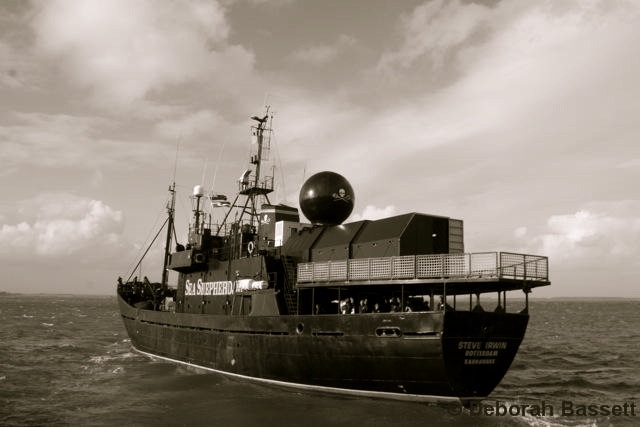
The Steve Irwin departs Bluff, New Zealand for the Southern Ocean whale sactuary, photo: Deborah Bassett
Earlier last week I met up with Captain Paul Watson and the Sea Shepherd crew at the bottom of New Zealand's South Island as their flagship vessel, The Steve Irwin, embarked on it's annual mission to the Southern Ocean whale sanctuary to defend the great leviathans of the deep against the blatantly illegal annual hunting spree by the Japanese government. Perhaps there is no translation in the Japanese language or maybe they just missed the memo, but a "sanctuary" as defined by Noah Webster is understood by the rest of the world as: (1) a place of refuge and protection (2) a refuge for wildlife where predators are controlled and hunting is illegal.
Yet, year after year the Japanese whalers (read: predators), endorsed by the government of Japan and the International Whaling Commission, travel to this remote and pristine area of the world armed with explosive tipped harpoons in an effort to annihilate up to 1,000 of the world's largest and most gentle marine mammals under the false guise of scientific research in a transparent and insulting mockery of human intelligence, sheer disregard for international law and complete disrespect for non-human life.
No one knows the saga more than Captain Paul Watson. As the youngest founding member of Greenpeace, Watson went on to form The Sea Shepherd Conservation Society back in 1977 in order to pursue more direct action and consequently more controversial approaches to conservation issues. He has since become an open critic of Greenpeace's armchair anti-whaling campaign which he points out is based primarily in wasteful mass fundraising appeals and non effective efforts such a the creation of a silly interactive "save the whales" video game and sending cutesy origami whales to the White House. Meanwhile, he and his crew will once again be the only organization braving the treacherous Southern Oceans this holiday season.
Just hours before his departure to endure some of the fiercest conditions in the world in yet another high stakes campaign, "Operation No Compromise", the veteran mariner maintained his usual cool, calm and collective demeanor -- of course not surprising for a man who has taken on numerous governments and navies on the high seas throughout the years including: Russia, Norway, Iceland, Canada and countless pirate poachers across every ocean to protect threatened species and habitats. For Watson, it's simple: If the oceans die, we die. "Everyone wants to save the world by driving a Prius and recycling plastic bags, but no one wants to admit the real problem- there are not enough resources and too many people. The real problem is not global warming, but rather the diminishment of species."
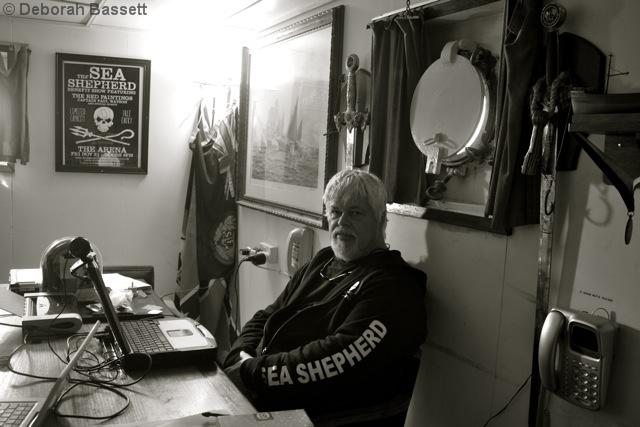
Paul Watson busy at work in Captain's Quarters aboard The Steve Irwin, photo: Deborah Bassett
Watson does not intend to let the great whales go unprotected on his watch and his track record has proven to be more successful each year since his first voyage to Antarctica seven years ago.
"Last year we saved 528 whales," stated Watson, "and we are hoping to have a bigger impact this year. Every year we head down stronger and they come back weaker. They are already 200 million in debt and we intend to continue to sink them economically. It really would be great if this would be the last time we had to go down there."
The Steve Irwin received a warm welcome by local mayor and long time Sea Shepherd supporter, Mayor Tim Shadbolt when the vessel pulled into port earlier in the week, proudly flying the New Zealand and Maori flags, in order to pick up a needed part and additional crew member. Shadbolt was on hand once again to send off the courageous sea farers who may spend up to six weeks in Antarctic waters before returning to Australia or New Zealand for more fuel. Three vessels with 88 crew members, representing 22 countries comprise "Neptune's Navy" this holiday season, which for many has become a way of life. According to Head Chef and veteran crew member Laura "Dilly" Dakin, who spends the majority of her days in the ship's galley where she prepares 3 daily meals for the 40 person crew of the Steve Irwin:
"Every year we save the lives of more whales and frankly I don't know why the Japanese even bother to come back when they know that we are stronger than ever. They should really stop embarrassing themselves already. I believe there is a strong possibility of stopping them from getting a single whale this year, which is the ultimate goal. What a great christmas that would be."

Laura Dakin prepares delicious vegan fare for the crew of The Steve Irwin, photo: Deborah Bassett
The good news for Dakin and ultimately the whales is that this may in fact be the last year that the Japanese factory ship, the Nisshin Maru, otherwise known as the Cetacean Death Star, is in operation due to a ban of "Bunker C" oil by the International Maritime Organization that will take place in 2012. Watson suspects that the whalers will be hard pressed to find another factory ship to meet the new regulations and explained that "this could be their way to get out of whaling and to save face." He warns however that there is also the possibility that, "they could just thumb their noses at this like they do to the regulations on whaling."
With the growing popularity of Watson's number one hit TV series on Animal Planet, Whale Wars, combined with the recent success of this year's Academy-Award-winning film, The Cove, the controversial issue of Japanese whaling has been brought to center stage in the international arena and has put Japan in the hot seat with animal lovers, environmentalists and concerned citizens around the world. According to Watson and recent behind the scenes reports, the very reason why the Japanese where delayed in leaving port this year by almost a month was caused by their own PR faux pas.
"They've been calling us eco-terroists for so long that no one wanted to lease them another supply boat since their previous one was scrapped. They've started to believe their own propaganda and they're afraid of us. That's what happens when you scream out propaganada too loud."
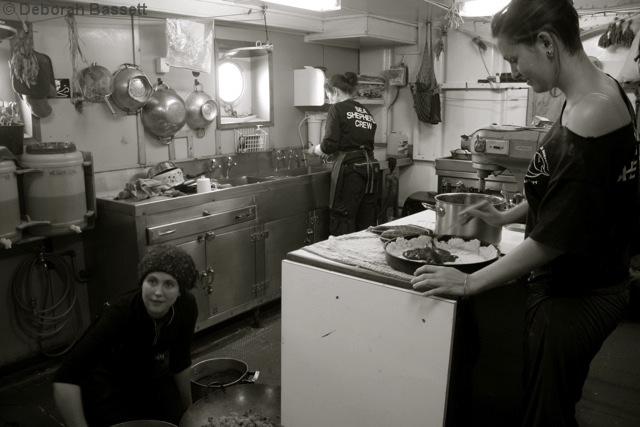
The Galley Crew of The Steve Irwin hard at work, photo: Deborah Bassett
The tireless crew of all volunteers will forfeit their holiday parties this year in order to join the rest of the fleet this week including the MV Bob Barker, named after the popular game show host who donated 5 million to the organization last year to help purchase the new vessel as well as the Gojira, a super hi tech and ultra fast interceptor vessel that replaces the Ady Gil (former Earthrace) which made international headlines last year when it was split down the middle by a collision with one of the Japanese whaling ships.
"There's no surf down here," added Kiwi crew member Howie Cooke and co-founder of Surfers for Cetaceans, "but it's great to be with Sea Shepherd who are making waves on behalf of the whales of the Southern Ocean sanctuary. Surfers for Cetaceans is honored to be in continued support of Captain Paul Watson and The Sea Shepherd Conservation Society and we look forward to the end of this barbaric and brutal slaughter of the ocean's great and noble monarchs."
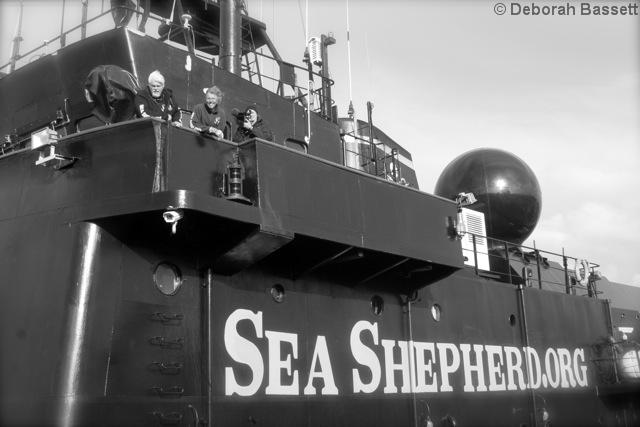
Captain Paul Watson and Howie Cooke ready for departure of The Steve Irwin, photo: Deborah Bassett
For more information and campaign updates, please visit: www.seashepherd.org
For more photos, please click here.