
iPhone app iPad app Android phone app Android tablet app More

Featuring fresh takes and real-time analysis from HuffPost's signature lineup of contributors
GET UPDATES FROM Deborah Rozman Ph.D.
 
GET UPDATES FROM Doc Childre
 

No Time to Meditate? Try This Quick and Effective Method

Posted: 05/25/10 09:30 AM ET

We've all heard about the many benefits of meditation. It can calm the mind and body, reduce the negative effects of stress and release tension. Meditation also helps us gain more inner balance and peace. More medical professionals are now recommending meditation to patients as a way to decompress and relieve stress.

A 2004 Center for Disease Control and Prevention survey found that 19 million people in the United States practice some form of meditation. While meditation has become an accepted way of reducing stress and anxiety, there are still many people who either have little time to dedicate to the art of meditation; or have been told by their doctor they should meditate but don't know how. Perhaps they feel frustrated trying to sit still and quiet their mind.

A key goal of meditation is to calm a racing mind. When we can learn how to turn down mental noise and tap into an inner stillness, we connect with deeper feelings and the intuitive guidance of our heart. However, quite often many of us find that we spend a good portion of our meditation trying to chill and quiet the persistence of the mind. It's hard to unplug when your mind won't turn off. Many people tell us they are so fatigued that they fall asleep during their meditation time.

While we all need to unplug and recharge, the most common struggle is finding something that works and making time for it. There is a solution that can give you a lot of the benefits of meditation within a few short minutes.

Through 20 years of research on the effects of emotions on physiology, the Institute of HeartMath developed a simple yet powerful technique called Quick Coherence(R) that enables you to recharge in as little as three to five minutes. Using this technique a couple times a day brings you more inner clarity and balance.

You're probably wondering what "coherence" is. It's a term used by researchers to describe a highly efficient psycho-physiological state in which your nervous system, cardiovascular, hormonal and immune systems are working together efficiently and harmoniously. How do you get into this state of coherence?

Research has found that the pattern of your heart rhythm reflects the state of your emotions and nervous system dynamics. For example, when you are feeling tense, irritable, impatient, frustrated or anxious, your heart rhythm shifts into a disordered and incoherent pattern, like the diagram below. No wonder you can't calm your mind in this state.
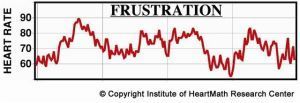


Your heart signals "incoherence" to the brain, which inhibits your higher brain functions and triggers a stress response. You can't perceive as clearly and old emotional issues can start coming to the surface.

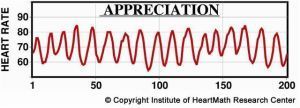
On the other hand, when you're feeling positive emotions, like sincere appreciation, care, compassion or love, your heart rhythm shifts into a more harmonious and coherent pattern, reflecting the emotional balance you feel inside. Your heart sends coherent signals to the brain and the brain synchronizes to the heart's coherent rhythm. You get into this state of coherence by learning how to shift your emotional state, and then heart coherence helps to calm your mind.

Heart coherence also triggers positive hormonal releases. This makes it easier to experience peace, positive feelings and a deeper meditative state more quickly.

You can use the Quick Coherence techniqueto bring your heart rhythms into coherence and enable your brain to synchronize with your heart's coherent rhythm. Start by learning how to shift into a heart-focused, positive emotional state through three simple steps.

Quick Coherence Technique

  1. Heart Focus: Focus your attention in the area of your heart, in the center of your chest.
  2. Heart Breathing: As you focus on the area of your heart, imagine your breath flowing in and out through that area.
  3. Heart Feeling: As you continue to breathe through the area of your heart, recall a positive feeling, a time when you felt good inside, and try to re-experience it. It could be feeling appreciation for the good things in your life, or the love and care you feel for someone.

The next step is to take this technique and make it a habit. Do this by picking certain times of the day when you can give yourself a guilt-free three to five minutes to focus on your heart: Start of your day, right before lunch, just before bed. Waiting in line is also a great time to use this technique instead of getting aggravated. You'll be amazed at how different your experience of waiting can be. Instead of draining your energy by focusing on the negative you're using the time to recharge. The more you practice, the more quickly heart coherence emerges and the easier it is to sustain.

Think about where else you can fit in a Quick Coherence moment. At a stop light? Right before lunch? Doing the dishes? There are many little opportunities throughout the day; it is now just a matter of doing it.


Now that you have this powerful recharge tool, you may want to see for yourself how it affects your physiology. HeartMath has developed the emWave (emotion-wave) technology that actually tracks your coherence level using lights, sounds and visuals, training to help people increase coherence for longer periods. Using this technology leads you to periods of high coherence, a state that many people who meditate spend years trying to achieve.

Adding coherence to your meditation - or whatever method you use to unplug and recharge - can enhance your results. Some people use the emWave handheld device at the start of or even during their meditation, to help them activate heart rhythm coherence. John Gray, the author of the popular book, Men are from Mars, Women are from Venus, uses the emWave and told us, "The emWave can take people quickly to where they try to get to through years of meditation."

Remember that taking mini breaks to "get in coherence" can go a long way in helping help you gain inner balance and save a lot of energy along the way.

Note: There are a number of additional ways that you can learn to increase your coherence. You can check out the free webinars that HeartMath provides or if you prefer personal coaching you can find a licensed HeartMath Provider in your area that will work with you as you are building your new skills. There are also an increasing number of healthcare clinics and hospitals around the country that are now offering stress reduction classes using HeartMath tools and the emWave technology.

We welcome your insights and comments. Put your comments in the section below or send us an email at dr@heartmath.com.

Doc Childre is the founder of HeartMath, co-author of The HeartMath Solution and From Chaos to Coherence. Deborah is a behavioral psychologist and business executive, and co-author with Doc of Transforming Stress, Transforming Anger, Transforming Anxiety and Transforming Depression. You can find out more about Doc Childre, Deborah Rozman, and HeartMath at www.heartmath.com.


Follow Deborah Rozman Ph.D. on Twitter: www.twitter.com/heartmath

We've all heard about the many benefits of meditation. It can calm the mind and body, reduce the negative effects of stress and release tension. Meditation also helps us gain more inner balance and pe...
 
 
  • Comments
  • 58
  • Pending Comments
  • 0
  • View FAQ
Comments are closed for this entry
View All
Favorites
Bloggers
Recency  | 
Popularity
Page: 1 2  Next ›  Last »  (2 total)
08:54 AM on 05/28/2010
Teaching patients Tai Chi for Health @ Cleveland Clinic - I appreciate HeartMath research immensely.
Another efficient approach: Link floating the arms (up and down "wave") in time with in- and out- breath . . . Arms have two heart meridians [heart & pericardium] on the little finger underside . . . "coherence" with heart and breath and brain becomes automatic (reports of lowering high blood pressure at doctor's office).
It's especially useful for those whose minds race when sitting still and breathing. The fluid arm motion engages the observer in the brain. Slow motion + Watch your breath.
12:01 PM on 05/27/2010
Creative visualization (CV) technique described here is only marginally related to meditation.
It is helpful-- as a quick snack when there is no time for a nourishing meal..
Of course, experienced mediators understand this.

Let's avoid creating an image ( pun intended!!) in the minds of neophytes that
CV is a viable substitute for infinitely more effective meditation.
09:49 AM on 05/27/2010
This article certainly has hit a nerve. I practice heart rhythm meditation, as well as vipassana (insight meditation). I use the PC version of the EmWave biofeedback program myself and with students. I find it extremely helpful, especially when teaching people how to meditate on the heart center or specifically lovingkindness (metta) meditation as made popular in the West by Sharon Salzberg of the Insight Meditation Society. Most people really benefit from seeing their heart rate and heart rate variability on the screen (some do react with performance anxiety at first, but that usually dissipates with skillful coaching). They see the progress and it motivates and empowers them. How can this be a bad thing? I find the more vitriolic comments from skeptics and actual meditators fascinating. I hope those for which this article has struck a nerve will take some time to reflect on why they feel the need to try and discredit what is simply one more tool made possible by our own amazing intelligence via technology. Of course, eventually, we must let go of all tools for our enlightenment, even our teachers....until then, keep your toolbox well stocked and often used.
09:40 PM on 05/26/2010
48 hour days, 14 days a week..... I always feel I am still doing double-time when I want to sleep. I used to do number puzzles for a few to "clear" my mind of the daily stress, but I think this will be my last 3 minutes before I lie down. Sounds a lot like my trainer before a marathon last year--breathe deeply, focus inward, and still keep yourself moving--and it made that race go so quickly!
12:31 PM on 05/26/2010
Most of us work madly all day ... many of us come home to cook and take care of children ... some of us still try to squeeze in a romantic and social life and hobbies! Phew, who's got time to meditate or emotionally recharge?

May I suggest a brief Stressbusting MP3 as an excellent method of reducing stress and recharging?

The Soul Therapy Stressbuster MP3 is only 5 minutes long. It has been designed using advanced scientific hypnotic relaxation and subtle energy principles. It is gorgeous to listen to during a lunch break, on the train or bus home, just before sleep ... in fact, any time you need a deep relaxing stressbuster to recharge your mind, emotions and spiritual energy.

The high quality MP3 format allows you to download to any MP3 player, phone, computer or other device. Each MP3 has a fade at the beginning and end of the soundtrack, allowing optimum volume to be achieved a few seconds after play has begun.

You can LISTEN to each soundtrack for free by clicking on the link below.

http://www.soul-therapy.com/Awesome_MP3_Downloads.html
This user has chosen to opt out of the Badges program
08:56 AM on 05/26/2010
just tried it...and it worked quick

maybe the rest of you should before allowing your judging mind to take over
This user has chosen to opt out of the Badges program
photo
08:40 AM on 05/26/2010
Bio-feedback is not meditation.
Meditation does not have a goal.

My only complaint here is use of the word meditation, not bio-feedback or people's desire to relieve stress. Meditation itself is a different order of reality.
photo
SurreyTaiChi
Tai Chi instructor,Management Consultant, Investor
07:40 AM on 05/27/2010
hear hear!
06:52 AM on 05/28/2010
Can not having a goal be a goal in itself?

"Self liberate even the antidote."
photo
SurreyTaiChi
Tai Chi instructor,Management Consultant, Investor
02:42 PM on 06/23/2010
yes, indeed. one of many paradoxes.
04:21 AM on 05/26/2010
I'm a meditator of some 25 years (mostly Witness consciousness/tantric centering techniques) I've used HeartMath biofeedback products and I was surprised that if I consciously moved myself into a state of bliss and overflowing appreciation (until I feel like my whole body is smiling) then my heart coherence score went very high. (I actually found some of my own techniques more effective than the HeartMath ones).
I was impressed to say the least. Definitely a correlation between coherence and a positive emotional state.
However when I went to research the company and people involved it is a really mixed bag. Lots of published studies but few in substantive journals. Good science seems to be mixed in with some very unorthodox science. I couldn't research much about "Doc" Childre. Is he a doctor? Apparently not. That is his given name. But there seems to be no understanding that if they want their work to be accepted by the mainstream (scientific, medical and ultimately lay community) then they need to have top notch credentials, rigorous studies published in good peer reviewed journals and to distance themselves from alternative medicine/alternative science points of view.
They need to publish their algorhythms and have their equipment and software externally verified.
This is a pity because I think they have hit on a truly essential piece of information which will prove invaluable, however their lack of scientific professionalism (and how to play that game) will hold up the field.
photo
SurreyTaiChi
Tai Chi instructor,Management Consultant, Investor
03:25 AM on 05/26/2010
two non-clinical comments: first of all i'm skeptical of shortcuts and gimmicks in this area. like "learn tai chi in 5 minutes". no doubt one can achieve certain benefits with these "short forms" but one sacrifices texture and depth. also, because it is focused on one area, ironically, those finding it most effective are likely to develop imbalances at some stage. in taoist terms, there are four other elements to think about (lungs, liver, kidney, and spleen), it's a system. secondly, it appears to borrow from traditional buddhist and taoist meditation practices, yes?
01:29 AM on 05/26/2010
well america is now marketing toys for meditation. if you really want to meditate you will meditate. easiest is to sit in lotus pose or vajrasana and close eyes and think what you want. these two poses have the power to take you to meditation. best time for meditation is early morning. or do it after shower like a short prayer. Doing pranayama ( breathing technique ) will also calm your mind. At work i do 10 reps every hour. You think clearly than your co workers. Most important thing to go towards meditation is motivation. You get motivated if you know what benefits you are going to achieve. Before getting into this you can also do small inversion or semi inversion poses to reduce your stress and calm your mind using yoga. there are many ways to do this. i usually read couple of yoga magz to keep me in the zone and keep the momentum going. then you devise your schedule.
09:44 PM on 05/25/2010
I was curious as to the academic credentials and moniker of "Doc" Childre; they are not listed on the website; neither were the affiliations of Ms Rozman. Given the long biographical experiences of the involved parties, this is not simple oversight.

The site also claims:

"IHM's emotional physiology, organizational, educational, and clinical research has been published in peer-reviewed scientific journals and presented at numerous scientific conferences worldwide."

But why are the references not listed? Being "published in peer-reviewed journals" can result in positive or negative results, yet the journal and article references are conspicuously absent. I would honestly like to read them.

If the method has been verified by scientifically controlled clinical trials, why does the website depend on "testimonials" to sell their product?
photo
HUFFPOST BLOGGER
Deborah Rozman Ph.D.
10:14 PM on 05/25/2010
Hi,
I have a doctorate in psychology and Doc Childre has been a stress researcher for over 30 years. We don't post CVs on the web site. The website you went to www.heartmath.com focuses on HeartMath training programs, but if you click on research tab it will take you to what you're looking for. You can find find many of the research publications and research studies at www.heartmath.org
05:33 AM on 05/27/2010
In an era where people like Barbara DeAngelis gets a PhD from a correspondence school and uses said academic "credential" to give advice and sell books, it is important that CV's be specific and posted to corroborate authority. It doesn't qualify the advice as good or bad; however, it does provide the academic transparency that is necessary for proper evaluation.
HUFFPOST SUPER USER
Kathryn Maver
03:12 PM on 05/26/2010
Doc isn't a doctor and doesn't make any claims to be. It's just a nickname.
HUFFPOST SUPER USER
Kathryn Maver
04:56 PM on 05/25/2010
Yet another infomercial masquerading as an article. I had to research HeartMath for an organization I worked for that was thinking of using it. I got their book of studies, and actually talked to one of the people from a reputable university about the study that involved his school. He said the research they have is preliminary at best, with extremely small sample sizes. Biofeedback works, and, to a large extent, this is biofeedback, but the goofy coherence babble probably isn't worth the price of any HeartMath system. Also, if you're "too busy to meditate," you don't get the point of meditation.
photo
HUFFPOST BLOGGER
Deborah Rozman Ph.D.
10:24 PM on 05/25/2010
Well this is an interesting comment. If you really take the time to study the peer-reviewed research publications (e.g. the American Journal of Cardiology, Journal of Stress Medicine, and many, many more, and peruse the name of our scientific advisory board who review our research (both available at www.heartmath.org) or talk to the many hospitals and health care organizations using HeartMath tools and technologies, you will find you may haven't looked deeply enough. Psycho-physiological coherence is a very real state that has been independently validated by many universities. I would be glad to give you references. As a 30 year meditator myself, the point of meditation to me is to get to the state of peace and insights that meditation provides and if I can get to that state more quickly, then I spend meditation time there rather than winding down to get there. I appreciate that.
photo
HUFFPOST SUPER USER
MeetJohnDoe
MadTeaparty
12:26 AM on 05/26/2010
What tradition is that?
HUFFPOST SUPER USER
Kathryn Maver
01:03 PM on 05/26/2010
Actually, I looked pretty deeply. I checked out the credentials of one of your researchers ("Dr." McCraty--PhD from unaccredited correspondence school) and everything. Again, most of the findings are preliminary, with very small sample sizes. I checked in with the researcher from Stanford, specifically, who agreed that the study done with Stanford didn't necessarily prove anything about HeartMath, per se. Just sayin'.
12:37 AM on 05/26/2010
"Infomercial masquerading as an article" is exactly right. Huffington Post is going to lose credibility if they keep on doing this.
This user has chosen to opt out of the Badges program
04:27 AM on 05/28/2010
In this topic area, "Living", often they go into woo-woo territory. Some woo-woo can be incorrect, flaky, and advantage-taking of ignorant people. You have to read with a critical mindset. Many of the "blogs" here are advertisements for other sites, books, supplements. It's a way to get original content without paying writers. Merely appearing on this site does not mean that a topic or author is credible.

Years ago I bought a Heartmath Institute book. The contents seemed to make sense, although I decided not to practice the exercises. Their books/products/courses sell well, apparently, even though they aren't a household name. The institute's background and member credentials seemed a little shadowy, but not moreso than many other types of spiritual-medical-philosophical groups, esp. west-coast ones. :-)

If what they say makes sense and works, then there can be something real and beneficial occurring. Not everybody has to have a Harvard degree to be taken seriously or do good work (even some who do have such a degree spout nonsense!) Not every procedure has to be tested at a major university and written up in a "big name" journal to be worthwhile and effective. (Besides, the academic/journal communities are not always corruption-free, fair, or accurate, sadly.)

These "coherence" and biofeedback effects can be aimed for without using any machines or expensive coaching, so it is a public service, I think, to explain them and promote their healthfulness.
photo
HUFFPOST BLOGGER
Suzie Heumann
Tantric Sexuality & Consciousness
04:23 PM on 05/25/2010
Great article, thank you.
The emWave is indeed a very nifty little devise. It's about the size of your iPhone and quickly accelerates you to a much higher level of meditative wave length. We need 'ads' like this, otherwise we never learn about these wonderful tools. The author gave us a useful technique and told us more. I don't see the problem with this at all.
The more focus we develop the stronger the neuronal signaling and the more the multiple neurons involved on our focus sync together. This creates a positive feedback loop for developing better focus. When you get good at this you have more tools you can draw on to keep you happy and balanced.
Brain training at it's best!
photo
HUFFPOST BLOGGER
Deborah Rozman Ph.D.
10:27 PM on 05/25/2010
Suzie,
Of course I agree with you, but it's not because I "promote" the emWave, it's because it does exactly what you say and I use it everyday to keep that postive feedback loop going. It gets me mentally and emotionally clear very quickly. I'm glad you experience something similar.
photo
lakat
Haiti lives.
03:13 PM on 05/25/2010
I would totally agree with those commenters who feel this is nothing more than an infomercial except for one little detail. They GAVE us the technique. I hate reading about something useful to me and then find out I still don't know anything because they are making me buy the book or CD to find out. This article did not do that. Thank you for the technique, I will try it as I am no doubt killing myself with my stressful life.
photo
HUFFPOST BLOGGER
Deborah Rozman Ph.D.
10:32 PM on 05/25/2010
I use the technique myself all the time an it works to de-stress and stay in a state of ease. I hope it does the same for you. We have more free techniques that can help you at www.heartmath.org Our social mission is to research and provide research-based tools and technologies to help us all in these challenging times. I'd like to give everything away for free but it cost something to do the research and manufacture the technology. I sincerely hope you do use the technique.
HUFFPOST SUPER USER
coldwatermd
02:38 PM on 05/25/2010
Great post - but I would not try it in a public space where you might need all your attention focusing on your surrounding.

Do this at home - best with an egg timer running for five minutes. You will be amazed what five minutes of meditation - or "coherence" - can do for you!

Alexa Fleckenstein M.D., physician, author.
photo
HUFFPOST SUPER USER
Gregory Ashby
the health maestro
02:48 PM on 05/25/2010
I agree Doc, but with practice you can use all these techniques at will and still be aware of your surrounding. I have may best meditations while riding my bicycle or jogging.
photo
HUFFPOST BLOGGER
Deborah Rozman Ph.D.
10:35 PM on 05/25/2010
Good point Alexa. After you practice the technique awhile, you can use it with your eyes open in a meeting to de-stress as you go or while talking to someone to connect with them and listen with more balance and ease. I use it this way.