Why You Can't Sleep At Night And What You Can Do About It

digg Share this on Facebook Huffpost - stumble reddit del.ico.us RSS

It's harder to sleep in these times. Articles are written every day about the subject. Your reason for tossing and turning at night may be different from mine. But the result is the same. We're foggy and tired the next day. We keep ourselves alert with coffee, sugar or other stimulants. Then we crash and drag and can't remember where we left our car keys. Up and down we go. We stay up late to get things done, like "just one-more-email" which stimulates one more. We watch TV to chill before bed but then the theme of the last show we watched takes over our brain and creates restless sleep - if we're lucky. For many of us, worries and concerns we've been pushing aside finally get their time to play out on the stage of our minds without distraction. Where's that sleeping pill to shut it all off? But that sleeping pill just leaves us dragging again the next day.

We all know the statistics. Not enough sleep affects our emotional well-being, our cognitive clarity, our relationship communications, our performance on the job or elsewhere, our sense of connection to spirit or self, and ultimately our long-term health. (Anything we've left out?) We get anxious about not sleeping, which only makes it harder to sleep. Anxiety releases adrenaline which prompts body and mind into action--the opposite of what we need for sleeping. It's a catch-22. Many of us have tried a lot of the recommended common sense remedies and still often find ourselves lying awake a good part of the night. What are we to do?

If this describes you or someone you care about, there is one place you may not have looked for help that's about one to two feet under your nose, depending on how tall you are. That place is your heart.

Three Ways Your Heart Can Help You Sleep Better
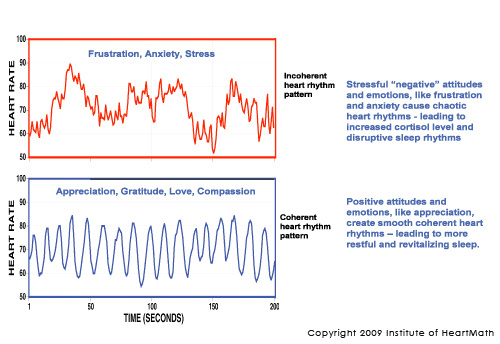
Your heart beats in a rhythm. Research at the Institute of HeartMath shows that when you are worried, anxious, frustrated - stressed - that rhythm becomes irregular. The more stressed you are, the more chaotic your heart rhythm pattern becomes. So what makes the heart rhythm smooth out quickly? Research shows it's positive feelings, like love, care, gratitude, appreciation, compassion or joy. These feelings not only feel good but are good for you. They order your heart rhythms, reduce cortisol and increase DHEA (the vitality hormone) to help you sleep more soundly and wake up more energized and refreshed.

When your heart rhythm pattern becomes smooth and ordered, it's called a coherent rhythm. Below is a picture. You can see how jagged and incoherent the heart rhythm pattern is when you're anxious or frustrated and how smooth and sine-wave like (coherent) it becomes when you're feeling appreciation.
2009-08-06-HeartRhythmsGraphic.Childre.Rozman.jpg

What's cool is that both graphs are of the same person feeling one way then the other within a period of a couple minutes. What's even cooler is that scientists have found that the smooth, coherent rhythm is the pattern your heart rhythm naturally goes into during deep sleep. So why not give it some help? Here's how you can:

When you close your eyes at night, tell yourself you aren't going to overdramatize your concerns about sleeping. Here's a heart-focused technique we call Attitude Breathing® to help create the coherent rhythmic pattern that can facilitate deeper and more effective sleep:

* Gently breathe an attitude of calm, ease and relaxation for a minute or two.

* When relaxed, then breathe an attitude of appreciation, gratitude or love for someone or something--a pet, a time in nature, etc.

* Do this for a few minutes or so to activate the heart rhythms that help release beneficial hormones which reduce stress and restore your system.

If you go to bed with that stressed, jagged heart rhythm pattern, it can disrupt your sleeping rhythms. During deep sleep your breathing and heart rhythms are quieter, your metabolic rate slows and hormonal rhythms change. The stress hormones cortisol and epinephrine (adrenaline) decrease. However, when these rhythms are disrupted, then sleeping restfully or waking up refreshed is hard to come by.

Have you ever noticed what happens when you go to bed without resolving a real or imagined conflict with someone? Your mind won't stop rehashing what you could have or should have said. Your heart can help.

Respect yourself and the other person. If you can, communicate with her before you go to bed and with open-heartedness and latitude, try to work it out. Check to see if there's something you need to correct within yourself to help the situation. Apologize if you need to and listen from your heart with an attitude of genuine care. Ask questions to sincerely understand where she is coming from, even if you think you know. If you can't reach the person, talk about the problem with someone who won't just agree with you but may provide another point of view. Then talk to the person as soon as you can. Don't chicken out. Even if the situation doesn't resolve right away, you can release yourself more knowing that you tried. Breathing the attitude of self-compassion has helped many people in "hard-to-resolve" situations.

Realize that what you do during the day also affects how you sleep at night. When you allow stress to build-up during the day, it throws off your body's rhythms and can lead to overload, headaches, backaches, indigestion, energy drain and more. Your heart generates the strongest rhythm in the body, and your brain and nervous system entrain to your heart's rhythm, whether coherent or incoherent. This exciting research is available if you want to learn more.

Getting your heart into a coherent rhythm a couple times during the day helps release stress as you go and helps reset your body's rhythms for better sleep at night. Here's how.

Take a coherence break in-between activities, at your desk, on a break, or anywhere. Shift focus to your heart (look at picture of a loved one, remember a favorite pet, or recall a time in nature) and feel appreciation or gratitude. It's important that the appreciation be heartfelt (not just from the mind) to activate heart coherence and hormones that help bring harmony and stability to your mental and emotional processes. Breathe the true feeling or attitude of appreciation through the area of your heart for a minute or two (without mentally multi-tasking as you do this). Taking coherence breaks also increases balance and resilience and helps you listen to your heart's intuitive guidance on what else you need to do to release stress or prevent stress build-up.

It can take a little time to reset your natural rhythms if they've been out of whack for awhile. To help speed up the process we developed a heart rhythm coherence feedback technology called the emWave Personal Stress Reliever, which recently won the Last Gadget Standing People's Choice Award at the 2009 International Consumer Electronics Show. You can use the emWave mobile device with the emWave Solution for Better Sleep Guide. This guide provides you with helpful heart-focused practices. Even if you don't sleep like a baby on the first night, you will start to accrue benefits from the practice.

If you think this is important information for the sleep-deprived but not readily accessible yet, what would you suggest to get the word out? Send us your comments, suggestions, and thoughts on this. Put them in the comments section below or send us an email at dr@heartmath.com.
***
To learn more or to download HeartMath's free booklet Solving Sleeplessness click here.

You can find out more about Doc Childre, Deborah Rozman and HeartMath at www.heartmath.com. Doc is founder of the non-profit Institute of HeartMath and the co-author of The HeartMath Solution and From Chaos to Coherence.

Deborah is a psychologist and business executive, and co-author with Doc of the Transformation book series including Transforming Stress, Transforming Anger, Transforming Anxiety, and Transforming Depression.

We invite you to join our Facebook and Twitter pages and our YouTube channel where the latest stress relief resources are often announced and made available. We also offer a Stress & Well-Being Survey™, the most comprehensive and accurate assessment tool that's available free over the Internet. The survey takes five to ten minutes to complete, and will provide you with a comprehensive picture of how much stress you are experiencing, your energy level and what areas are most stressful in your life. Results are followed by tips for improving your scores.

Follow Deborah Rozman Ph.D. on Twitter: www.twitter.com/heartmath

It's harder to sleep in these times. Articles are written every day about the subject. Your reason for tossing and turning at night may be different from mine. But the result is the same. We're foggy ...
 
Comments
19
Pending Comments
0
iPhone App Promo

Want to reply to a comment? Hint: Click "Reply" at the bottom of the comment; after being approved your comment will appear directly underneath the comment you replied to

View Comments:
- timezone I'm a Fan of timezone 10 fans permalink

I actually went to an overnight sleep study which confirmed I don't go into a totally deep sleep. I get to sleep, but wake up after a few hours feeling NOT rested, drift back off and awaken after a few more feeling more less than totally refreshed. They just gave me a print out with the usual tips: darken room, make sure cool, no stimulants like caffeine after morning, etc. I have found listening to cd's dedicated purely to helping you sleep do make a difference, as well as no watching tv or movies an hour or two prior (reading seems to be fine for me and in fact can help me become sleepy). I also have a sleep mask because if I awaken as the sun is coming up, putting that on helps me get a few more hours sleep. Not eating late at night is a big one as well. It may not bother everyone, but your body working overtime to digest food probably not a big help for insomnia.

    Favorite    Flag as abusive Posted 02:41 PM on 09/01/2009

I've had trouble sleeping for years, and nothing really helps. And I've tried everything! After reading this article, I tried the breathing techniques recommended here, and found that they do help a bit. Still not sleeping through the night, but if I do the breathing, I find I'm nodding off a bit better. Thanks!

    Favorite    Flag as abusive Posted 04:26 PM on 08/11/2009

I have had problems sleeping since I can remember, looking at my clock ticking away, when I was four/five years old. These problems have followed me into adult life. I take medication for sleep to help with anxiety and insomnia but I would love to attempt, in my latter 30's now, to find a natural, alternative method. I've done the reading boring reading material routine, chamomile tea, breathing techniques, calm and soothing music, yoga, comfortable bedding, etc. It's extremely frustrating. I do not drink much caffeine (except green tea) which I do not drink after 2pm. I'm in a terrible cycle of television and sleeping medications which aren't as effective as they were in my 20's. Sometimes, I just throw in the towel, get on the laptop or watch an interesting program because staring at the walls and clock causes anxiety itself.

    Favorite    Flag as abusive Posted 02:57 PM on 08/11/2009
- bgraceg I'm a Fan of bgraceg 2 fans permalink
photo

Ive had lifelong problems too..i have found some relief recently using a little light box (you can buy them online, different brands, I got mine at costco), they have an online quiz to determine the best time to use it (I do mine in the morning). Since using it I can go to sleep by 12 or 1, instead of 4 or 5..apparently some of us have circadian rhythm issues. Worth a try.

    Favorite    Flag as abusive Posted 02:01 AM on 08/12/2009
- edwoodjr I'm a Fan of edwoodjr 6 fans permalink
photo

Sleep.....WAY OVERRATED. ;-)

    Favorite    Flag as abusive Posted 08:27 AM on 08/11/2009
- VivaZapata I'm a Fan of VivaZapata 63 fans permalink
photo

There might be something to this. Anecdotally speaking, I was in a situation a month ago that really got to me and I felt my heart beating like it was going to burst through my chest. Lots of trouble sleeping.

I also find that doing facial exercises helps release jaw tension and can be beneficial.

I think I'll go to bed now.

    Favorite    Flag as abusive Posted 08:23 AM on 08/11/2009
- dora rice I'm a Fan of dora rice 10 fans permalink
photo

But if nothing else helps you make take once in a while a sleeping pill, we all know that, but don't want to admit it, because of stigma of drugs. A sleeping pil is better than laying awake half of the night, and being unproductive the next day.

    Favorite    Flag as abusive Posted 08:19 AM on 08/11/2009
- normathumb I'm a Fan of normathumb 26 fans permalink

Breathing attitudes?! Sorry, does not compute. The vibes ain't right. Your aura is the wrong color and terribly distorted. You want some crystals for that?

    Favorite    Flag as abusive Posted 07:45 AM on 08/11/2009
photo

Thank you for the informative information. Better go to sleep now.

    Favorite    Flag as abusive Posted 02:46 AM on 08/11/2009
- JT16682 I'm a Fan of JT16682 4 fans permalink

Makes sense. Listening to my favorite (or simply beautiful music) before bedtime improves my sleep quality.

    Favorite    Flag as abusive Posted 01:38 AM on 08/11/2009

or count sheep ?

WTF

    Favorite    Flag as abusive Posted 11:35 PM on 08/10/2009
photo

I was diagnosed with sleep apnea, and now go to bed with a C-PAP machine. This device has saved my life--I also stop drinking anything with caffeine after 6:00 pm and no longer eat chocolate for dessert after dinner (I eat it during the day). These remedies have helped but I can tell when I'm stressed, I cannot fall asleep. I have limited my Lunesta meds to 1 or less per week and will try these breathing techniques as well. Thank you for a great article and I will try these methods when needed.

    Favorite    Flag as abusive Posted 05:29 PM on 08/10/2009

Thanks for another great article. I sometimes have a problem falling asleep. It seems to come and go in waves. I often just lay quiet in hopes that I'll either fall asleep or at least let my body rest. I make a point of not looking at the clock too, that just makes it worse. I have an emWave, the little handheld one, I'll try it next time I can't sleep. It makes a lot of sense that reseting our heart rhtyhms could help. Thanks for the free download - haven't gotten it yet but plan to. Here's to good zzzz's.

    Favorite    Flag as abusive Posted 12:19 AM on 08/10/2009

I've been thinking about cutting caffeine out completely..I'll need to take inbuprofren for a while until I stop getting head aches..but it is a start.Nothing seems to work.Getting up early every day means nothing..I still will not sleep that night..sometimes not at all.Caffeine and nicotine can't help matters.But I know plenty of people who consume both and sleep fine,any time they want in fact.I also notice I feel less stressed or anxious if I DO go give in and sleep during the day.But having tried everything and experiencing epic fails for years..I dunno.I could lie in bed and listen to soft music ..even instrumental music to relax myself..take melatonin and fantasize im a butterfly floating through the galaxy..but inevitably..still awake hours later.

    Favorite    Flag as abusive Posted 01:37 PM on 08/08/2009
- Deborah Rozman Ph.D. - Huffpost Blogger I'm a Fan of Deborah Rozman Ph.D. permalink

I know that if I drink coffee after 8 p.m. it can keep me up all night (I usually go to bed around midnight). There are other things to experiment with to see if they help -- like don’t exercise, drink alcohol or take any stimulants after 6 p.m. and don’t watch TV before bed. Laying in bed reading a boring magazine or scientific journal you don’t fully understand (unless you’re a scientist) can be helpful for putting me to sleep. Sincerely try the exercises mentioned in our blog and others in the free booklet or webinar you can download. Let me know if any of this helps.

    Favorite    Flag as abusive Posted 09:31 PM on 08/08/2009

thanks

    Favorite    Flag as abusive Posted 05:31 PM on 08/09/2009
photo

Excellent advice. Maybe I will get a subscription to People magazine.

    Favorite    Flag as abusive Posted 06:39 PM on 08/10/2009
- Clairvaux I'm a Fan of Clairvaux 48 fans permalink
photo

ZZZZZZZZZZ­ZZZZZZZZZZ­ZZZZZZZZ ...

    Favorite    Flag as abusive Posted 12:09 PM on 08/08/2009
Comments are closed for this entry

 You must be logged in to comment. Log in  or connect with 

Connect