
In May, Debra Messing went to Zambia on a trip with PSI and Alere, the largest manufacturer of HIV testing technology. While there, she met with families, communities, health ministers, and doctors to learn about what HIV interventions are producing results on the ground -- and what gaps need to be filled. This week, Debra is in Washington, D.C., to participate in the 2012 International AIDS Conference. Below is the first in a series of three personal journal entries that she wrote while in Zambia.
Sunday, May 20: JoyFM radio show in Lusaka
The plane descended through the clouds, and I could see the city of Lusaka from my window seat. I began to think about the people I'll meet this week: people who are helping prevent HIV in Zambia, people who are living with HIV and thriving thanks to treatment and support services, people who are suffering and stigmatized. It had been two years since my last trip with PSI, so I was feeling excited and nervous.
Nervousness quickly turned to awe when I met Connie.
Along with colleagues from PSI and my new friends from Alere who are traveling with me (they are donating 1 million HIV testing kits to PSI -- more about them later), Connie and I were guests on the radio show of Mannasseh Phiri (a vegetarian, pig farmer, doctor, AIDS activist, radio host, and columnist... for real), which educates Zambians about HIV. Mannesseh is an amazing host, and Connie is just full of fire and passion. Her story is one of the most difficult and compelling I have heard. The two make an inspired team.
Connie had three children, but unbeknownst to her, she was HIV-positive. All three children died of AIDS complications because she didn't know her HIV status. That was also the reason she didn't take the medication that would have prevented her children from getting HIV. After a long and very difficult struggle to regain her mental and physical health, Connie became a formidable figure in Zambia, fighting to educate anyone and everyone who would listen about HIV, and giving support to those who are affected by it. She turned her pain and loss into something very powerful. I felt it as I sat next to her. I was determined that this woman be my friend and teacher.
On the radio show she spoke with people calling in, and she answered questions coming in by text. She was so comfortable and direct. She joked and put people at ease. I really enjoyed watching her.
My friends from Alere are here discussing a campaign called Make (+) More Positive. The campaign is about reducing HIV stigma and letting people know that you can live a healthy and productive life regardless of your status. The great part of the campaign is that for every "like" on Make (+) More Positive's Facebook page, or for every new follower on the Twitter page, one HIV testing kit is donated.
I thought about the campaign as I sat next to Connie. She is a living example of everything the campaign is about. I'm going to work on her becoming a very visible part of this effort. She is, in every way, an empowered woman. She's confident and outspoken. She doesn't dance around sensitive topics because they might make people uncomfortable. She thinks if we are going to stop HIV, we need to be able to talk about safer sex openly and honestly. I agree. I wish every woman had her confidence. Heck, I wish I had that kind of confidence. I'm seeing Connie again later this week to meet one of the support groups she is a part of, and I'm so glad. I can't wait!
I'm in Zambia this week as an ambassador for the global health organization PSI, representing their local program, Society for Family Health (SFH). I'm here to see and learn how "combination prevention" can help to stop the spread of HIV. From what my PSI colleagues have told me, it's actually common-sense stuff: When multiple interventions are used together, the likelihood of HIV transmission is greatly reduced. I plan to observe, absorb, and let the many people I meet this week be my teachers.
PHOTOS:
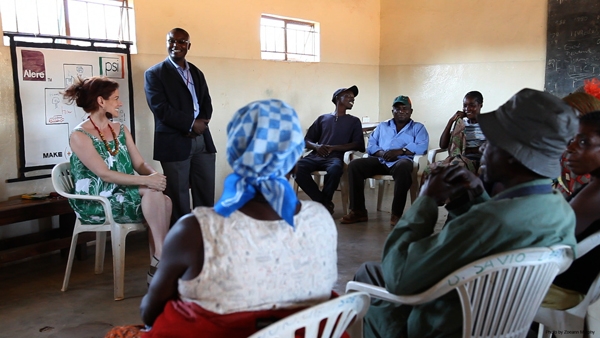
Visiting with people living with HIV at an HIV support center (photo by Zoeann Murphy)
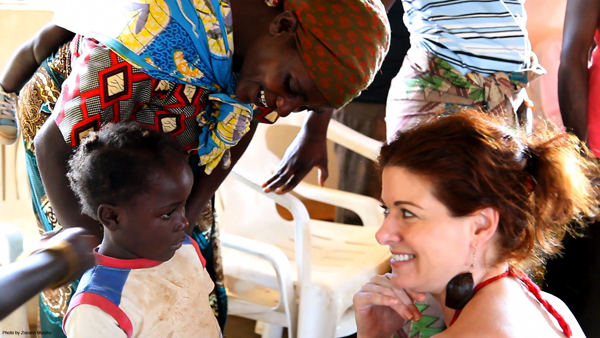
Meeting Irene, who is living with HIV, and her children (photo by Zoeann Murphy)
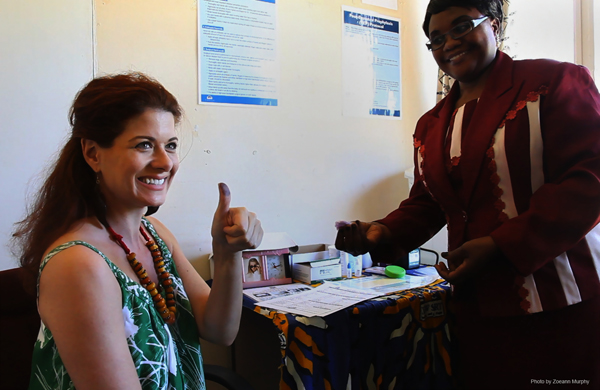
Getting tested for HIV (photo by Zoeann Murphy)
WATCH: