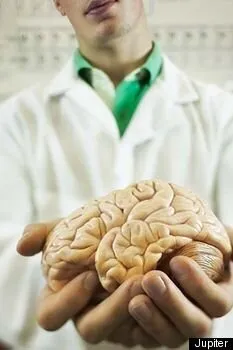
The mystery of the human brain recently took a step closer to being solved. This didn't happen through a single breakthrough or because of an Einstein moment. Instead, an old belief was overturned by many separate researches. The old belief held that the brain couldn't heal itself. Unlike almost every other organ, healing supposedly didn't exist in the brain, so that once wounded or impaired, the damage was permanent. Now we know that's not true.
The human brain not only can heal itself, but it turns out to be amazingly adaptable to trauma. The term for this is neural plasticity, and once discovered, it sprang up in many areas. Stroke victims have learned to regain function after paralysis. The blind have acquired new abilities in the visual cortex. Skills limited to the right or left side of the brain have jumped across to the other hemisphere. Thanks to neural plasticity, we've learned to see the human brain not as a fixed structure with brain cells dying every year -- the old view -- but as a fluid, constantly evolving process.
The brain has been so liberated, in fact, as to be barely recognizable. We now know that the aging brain can continue to develop new connections. Stem cells continue to give rise to new neurons throughout the human life cycle. Most important of all, the experiences you have at any time of life create new neural pathways, and it's these pathways that form complex patterns far more vital than new neurons. At this moment, your brain is adapting to everything you see, hear, touch, taste, and smell.
I don't want to go into technical details, simply to note that there's a next step that is even more liberating. A recent study by the Preventive Medicine Research Institute showed that people who adopt beneficial lifestyle changes, such as improved diet, exercise, and stress management, trigger changes in expression of over four hundred genes. Like the brain, your genes are tuned in to your experience, and when you decide to change your life, the millions of molecule signals that tell your genes what to make and when--the epigenome--respond accordingly. They must, for any new function in any cell requires translation into chemical reactions, and those are mediated by the gene.
Now put these two discoveries together, the changing brain and the changing epigenome, and the whole is far greater than the sum of its parts. Every thought, intention, wish, dream, insight, and memory you have is creating change at the genetic level. Your genome and epigenome together are nothing less than a quantum computer, making thousands of decisions per second in every cell. These decisions aren't mechanical or preprogrammed. They await your intentions; the quantum computer runs on behalf of your consciousness.
Since every cell contains the same strand of DNA, the quantum computer is in very cell, and it is coordinated with every other. This computing ability, by which a heart cell knows what a brain cell is doing, the liver communicates with the kidneys, the endocrine system eavesdrops on the emotions being triggered in the limbic centers of the brain, is infinite. What will finally liberate our brains is the realization that infinite intelligence, creativity, and organizing ability isn't a pipedream or spiritual wish fulfillment. It's the very basis of the human body.
I've left out dozens of discoveries that support this revolutionary contention (an excellent source for reading up on the breakthrough research is Sharon Begley's well-written book, Train Your Mind, Change Your Brain). As the title implies, it's by changing the mind first that the brain adapts, and there seems to be no limit to this adaptation. What is human evolution, after all, but neurons learning new skills over a very long period of time, and then passing those skills on through genes to new generations?
Unlike our evolutionary ancestors, we have the opportunity to consciously shape our brains, using this newfound knowledge of neural plasticity. Medicine has already made inroads, for example, as in the intensive recovery programs for stroke victims that teach their brains to use new, undamaged areas. Stroke recovery is therefore miles ahead of where it was twenty years ago. But medicine deals with trauma and disease. The liberated brain has enormous potential in everyday life, which will be the topic of my next post.
(To be cont.)
Follow Deepak Chopra on Twitter: www.twitter.com/DeepakChopra
Deepak Chopra - Wikipedia, the free encyclopedia
Deepak Chopra - Offical Website
One only has to watch all the ads for pharmaceuticals on Tv to see what a fraud all this pill taking has become.
At least twice as many prescription drugs are prescribed now than just 10 year ago.
It has led to MORE anxiety and depression than less.
they'll scare the hell out of you!
Thank you Dr. Chopra for an excellent article.
Martin
www.mindsparke.com
signals that tell your genes what to make and when--the epigenome-
-respond accordingly. They must, for any new function in any cell
requires translation into chemical reactions, and those are mediated
by the gene."
I will go out on a limb here and take this one step further, saying differently
what you have said--everything in life, molecules, genes, epigenomes, etc.,
everything--has consciousness.
Thank you for bringing this all together.
...or better yet, meaningless is meaningless.
In the 19th century, gullibles like you believed séances were way to communicate with the dead.
Thanks for your wonderful effort. This is new, but not new. This is new for them who are around science, but not new who are around spiritual world. It is nothing new as more than 2500years ago the Buddha had taught about liberating the mind. Not to just believe but to find out the truth. He also point to the mind as the forerunner of all things. He taught the method to attain cessation of suffering. So your effort trying to bridge between scientific and spiritual worlds.
Read more at: http://www.huffingtonpost.com/deepak-chopra/how-the-brain-got-liberat_b_319677.html
That doesn't include Bush, Cheney, Palin or any of their peers. Their brains are trained in denial. I doubt seriously that any of them even understand Dr. Chopra's words.
Whether or not this altered gene expression is significant enough to change what is transmitted to the next generation is something to investigate.
As another poster pointed out, this likely requires us to change our understanding of evolution, as this phenomenon of conscious directed gene expression is different from natural selection/adaptation and genetic drift.
If genes are changed by life processes, why wouldn't those changes be passed if they occurred prior to reproduction? Especially on behavioral characteristics, or inherited neural wiring? (the repeated adaptive wiring for "sabertooth tiger danger" probably shaped the basic package we get at birth.) Maybe the significance of genetic expression in a social animal is the collective expression of the genes modified by "individual" effort?
Isn't it fascinating that our "understanding" of evolution is evolving? Possibly, as we learn more, what we thought was genetic drift or mutation, has a greater intentional component than the perspectives of the past hundred years could imagine. In either case, the more evolved persist if they are better adapted.
Which raises an interesting question-- what experiences do we promote in our young before reproduction which might find genetic expression? Violence and war? Trivial self-preoccupation, greed, and consumerism? On the other hand, what about spiritual worship, caring, compassion, and cooperative effort?
Therefore the test must first estimate changes due to both the passive processes, and then measure/estimate changes attributable to the active conscious direction. Next, it must demonstrate that the change is significant, Further, it must show that this change is inherited, and lastly show that the inherited traits produce a similar change in behavior in the offspring. A very tall order, but worth investigating.
,
Note: I am not trying to define consciousness. I simply assume that the ability to make a choice indicates consciousness.
Dr. Chopra has a wonderful talent for tying together vast amounts of scientific data and showing what it means. The potential of our species is awe-inspiring!
Thanks for the perspective.
It is nothing new more than 2500years ago the Buddha had taught about liberating the mind. Not to just believe but to find out the truth. He also point to the mind as the forerunner of all things. He taught the method to attain cessation of suffering.
People who strongly hold on to beliefs cannot simply be liberated. To throw away their beliefs is like pulling away the floor where their ego stand on. There will be a feeling of uncertainty, of being lost because they have never experinced what a freed mind is like.
In your previous article I told you to let them be but I did not emphasize.
"Man always goes from lesser truth to higher truth and not from error to truth" - Vivekananda
Holding on to a belief is alright and anyways one must take it to it's logical conclusion one day. We are living one big experiment and experience is our only teacher.
9:13pm
Alexandria,VA
True.
Great.
Wonderful.