Featuring fresh takes and real-time analysis from HuffPost's signature lineup of contributors
HuffPost Social Reading
Donald S. Lopez, Jr.

GET UPDATES FROM Donald S. Lopez, Jr.
 

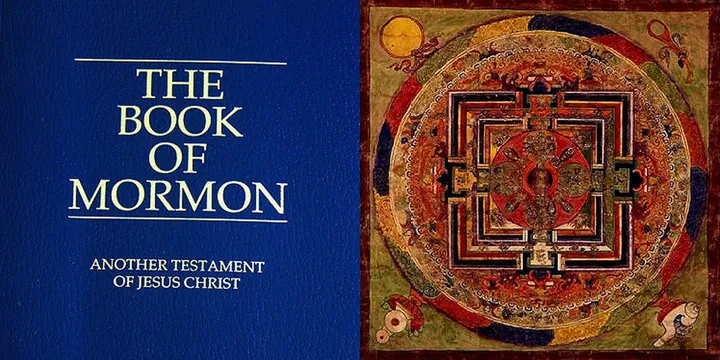
A Tale of Two Scriptures: The American Book of Mormon and the Tibetan Book of the Dead

Posted: 01/31/2012 6:31 am

On Jan. 14, the New York Times published a piece entitled, "The Theological Differences Behind Evangelical Unease with Romney." According to the article, one of these differences is scriptural: Mormons revere several scriptures that (other) Christians reject. The most famous of these is The Book of Mormon. The doctrinal differences between the various Protestant denominations and the Church of Jesus Christ of Latter Day Saints have been widely reported throughout the Republican primaries. But these differences do not derive simply from the contents of the Mormon's holy scripture. For many Christians, it is also a problem of time and space: The Book of Mormon is too modern in time and too close in space to be a Holy Scripture.

On the night of Sept. 21, 1823, Joseph Smith, not yet 18, received a visitation from the angel Moroni at the family's farmhouse south of Palmyra, N.Y. According to Mormon belief, Moroni had once been a mortal, a prophet and general of the Nephites, an Israelite tribe that had left Jerusalem and sailed to the Americas, 2,000 years before Columbus. Prior to his death, Moroni inscribed the Record of the Nephites on metal plates and buried them in a stone box on a hill in what is today Ontario County, N.Y. The angel told Smith where the plates could be found. Smith was eventually able to retrieve the stone box, as well as two crystals, called the Urim and Thummim, set into a pair of spectacles. He later described the plates as golden in color, six inches wide and eight inches long, about the thickness of a sheet of tin, bound together by three rings into a book about six inches thick. The angel Moroni instructed Smith to translate the plates, which Smith said were written in "Reformed Egyptian." His method was to put on the crystal spectacles and then place a stovepipe hat over this face. From the darkness, the text would appear in English, which he would read aloud for dictation. The book that Smith translated has come to be known as The Book of Mormon.

In the late 1300s, a young Tibetan named Karma Lingpa had a vision. Following the instructions he received, he unearthed a book from a mountain in Tibet. He said that a great Indian saint had buried the text there more than 500 years before. However, the text was not written in Tibetan, but in a secret script that only Karma Lingpa could decipher. It consisted largely of mortuary rituals, concerned especially with a period called the bardo or "intermediate state." According to Buddhist doctrine, between death in this life and rebirth in the next, there is a period that can last as long as 49 days. It is a time of both danger and opportunity, and special instructions are provided for avoiding a bad rebirth and finding freedom from all rebirth, instructions that are sometimes read to the corpse. The buried text that Karma Lingpa translated was thus called Liberation in the Intermediate State through Hearing. It changed in size and content in the centuries after his death, remaining a relatively minor collection of prayers and rituals for the dead, used especially by one of the four major sects of Tibetan Buddhism. Yet, by the 20th century, it was the most famous Buddhist book in the world.

We can blame it on colonialism. The British invaded Tibet in 1903 and demanded trade concessions that allowed British officers to travel between Tibet and their colony India. In 1919, a Major Campbell acquired a copy of Liberation in the Intermediate State through Hearing and took it to Darjeeling, where he sold it to a credulous American spiritualist named Walter Evans-Wentz. He was a spiritualist not in the modern sense of "I'm not religious, I'm spiritual," but because he believed in spirits. In the wake of the carnage of the First World War, there was a renewed interest in spiritualism, the belief that it is possible to contact the dead. Evans-Wentz took the Tibetan text, which he could not read, to the English teacher at the local boarding school for boys and asked him to translate it. His translation was good, but Evans-Wentz buried it under various prefaces, forewords, introductions, afterwords and footnotes filled with his own, often irrelevant, musings. Then he named it The Tibetan Book of the Dead, because it reminded him of The Egyptian Book of the Dead (the secrets of ancient Egypt were central to his particular form of spiritualism). Published by Oxford University Press in 1927, it would become an international best-seller, with its own reincarnations, one with an approving preface by Carl Jung, another as an LSD handbook by Timothy Leary, another as an audiobook read by Richard Gere, still another as a video narrated by Leonard Cohen.

There is likely a lesson here. A text unearthed in upstate New York less than 200 years ago becomes a source of inspiration for a community of believers, but the object of condemnation and scorn for their neighbors, who drive them out of Ohio and Illinois, and finally all the way to Utah. In America, The Tibetan Book of the Dead, sanctified by the sands of time and the lofty peaks of distant Tibet, has become a timeless spiritual classic; its rather dubious pedigree remains a tale untold. Yet The Book of Mormon, unearthed not so long ago from a more modest hill in upstate New York, is still an object of contempt in many Christian quarters in 2012.

It should not be surprising that what we know about the historical origins of a holy scripture differs in important ways from its creation myth. The further removed those origins are from the present, the thicker the patina of sanctity becomes. But assuming it were possible, just for a moment, to set aside the thorny question of divine inspiration, it is likely that the origins of all sacred texts would seem equally mundane.

Donald S. Lopez, Jr. is the Arthur E. Link Distinguished University Professor of Buddhist and Tibetan Studies at the University of Michigan. His most recent book is The Tibetan Book of the Dead: A Biography published by Princeton University Press.


On Jan. 14, the New York Times published a piece entitled, "The Theological Differences Behind Evangelical Unease with Romney." According to the article, one of these differences is scriptural: Mormon...
 
 
  • Comments
  • 365
  • Pending Comments
  • 0
  • View FAQ
Comments are closed for this entry
View All
Favorites
Recency  | 
Popularity
Page: 1 2 3 4 5  Next ›  Last »  (6 total)
rdk70816
Yellowhammer
10:54 PM on 03/08/2012
Many folks are surprised to find that the values and characteristics of evangelical Christians are very similar to those of modern Mormons. The theological pinning or path to reach Christ may differ, but if the end result is the same, should it really matter?
07:23 PM on 03/05/2012
Did you intend to undermine the credibility of W.Y. Evans-Wentz and the Lama Kazi Dawa-Sandup by introducing them in such a menial and dismissive way? You introduce Evans-Wentz as a 'spiritualist' ... "he believes in spirits', not mentioning that he was highly trained in the teachings of the Theosophical Society, on the very nature of reality (including spirits). He also held a B.A. and M.A from Stanford University and studied social anthropology at Oxford, which later conferred on him the rare honor of D. S. in comparative religion. The Lama (also noted you omitted this title) Kazi Dawa-Sandup had worked as an interpreter to the British government and was writing a Tibetan-English dictionary, and had also translated works for the renowned scholar Alexandra David-Neel, long before becoming a boy's school headmaster.
photo
HUFFPOST SUPER USER
roger stillick
its 2012 not 1878
06:00 PM on 02/25/2012
The Dead Sea Scrolls belong in this group of lost, then found items... all cultures bury or hide things they dont want to lose... manufacturing an artifact to found a new religion is probably cheating... L Ron said so...
12:56 PM on 02/20/2012
L. Ron Hubbard obviously didn't originate the idea but he probably described the process best: "You don't get rich writing science fiction. If you want to get rich, you start a religion."
photo
HUFFPOST SUPER USER
roninroshi
Oni ni Kanabo (鬼に金棒 )
06:57 PM on 02/19/2012
Great article...an excellent expose of the confused mind and it's results transformed into print circulated amongst the masses and presto more confusion by the power of 10!
03:07 PM on 02/17/2012
If your contention were anything like accurate, the Mediaeval 'Ars Moriendi' should now be as popular as the bar do thos grol... to my knowledge, it aint.
You also seem to be ignoring the fact that there are several gter ma (as in thousands of) but only one Book of Mormon (whose validity or otherwise i am not contesting here).
photo
MCope
Just another everyman
02:48 PM on 02/17/2012
Context is everything. The Bardo Thodol (TBD) was written at a time when the invention and promulgation of such texts was common. Thousands of different instructions for visualisation and inner transformation were created, and there was a social order which understood them and used them.

The Book of Mormon appears in an entirely different context, and there are not lots of other similar (but not competing) texts about.
05:02 AM on 02/16/2012
Mitt Romney has my respect, so does President Obama. Both are decent men who have upheld the importance of protecting the innocent not the dangerous, both are decent men with decent wives. God bless them, and yes there is a superior being and beings in heaven, both are respected by heaven. God bless them forever.
photo
HUFFPOST SUPER USER
Bob Kellerman
Let's have more sanity toward each other
03:17 AM on 02/13/2012
SOMEBODY TELL ME -- I HAVE MISSED IT

Where in the book of morhole does it grant you the right to forget the US Constitution and actively go after another sexual minority by lying and manipulating???????????
01:14 AM on 02/11/2012
No comment-- just a "like". The last paragraph is brilliant. Thank you.
10:29 PM on 02/05/2012
A religion based on the word of a manipulative, teenager, albeit one with a vivid
imagination.
Metal plates that were never shown to anyone. A magic hat and spectacles.
A visit to America by an Israeli general for the purpose of burying clues.
Just follow the white rabbit down the hole and you'll find all sort of wonders.
01:25 AM on 02/07/2012
I assume you are being factitious because you are wrong on a number of points.
02:35 PM on 02/04/2012
I'm not convinced that the Tibetan Book of the Dead was as widely popular as suggested here. Did it ever have any following or readership in Theravada Buddhist countries? Or China? In the end, the popularity of the TD resembles a fad, the kind of thing popular culture fixes on for a year, or a decade, or even longer, but then fades. The comparison between the TD and the BoM is interesting and suggestive, but I'm not conviced that the precedent of the TD in the west is instructive for the future of the Book of Mormon.
01:22 PM on 02/07/2012
No, TBotD is unknown and unrecognized except in Tibetan Buddhism, just as the BoM is unknown and unrecognized in any other Christian denominations.
01:19 AM on 02/11/2012
I disagree that it is unrecognized. It is not recognized as the word of god. In many Christian denominations, it is regarded as a work of the devil intended to deceive. This is not a value judgement, only an observation of something that was spoken directly to me.
photo
HUFFPOST SUPER USER
roger stillick
its 2012 not 1878
05:48 PM on 02/25/2012
The Dead Sea Scrolls were left out of this why??? Every Culture on Earth buries or hides things that are too hot for their times... Now making an artifact to found your new religion is probably cheating... but hey, Im a TV Buddahist and I dont have time to waste thinking about that stuff...
01:19 PM on 02/03/2012
No mention is made of the fact that large portions of the Book of Mormon were copied from earlier works, including the King James Bible (including some of its sentences that were later found to be wrongly translated).
01:27 AM on 02/07/2012
The Book of Mormon has sections of the Book of Isaiah. There is no evidence of any other earlier works as you claim.
09:08 AM on 02/07/2012
Yes there is. There is clear evidence of copying from, besides the KJB, View of the Hebrews, The wonders of nature and the Apocrypha.
08:57 AM on 02/03/2012
The Tibetan Book Of The Dead is a psychology book that actually deals with the changes we are experienceing right now in this moment. Death and rebirth are occuring all the time in this life. Every time we experience change, there is a sense of loss and bewilderment. The TBOTD is tremendously valuable in penetrating and clarifying self delusion.
photo
HUFFPOST SUPER USER
mheister
Raconteur. Blog michaelheister.com
02:36 AM on 02/03/2012
The author neglects to note that not all buried texts are created equal.