iPhone app iPad app Android phone app Android tablet app More

Featuring fresh takes and real-time analysis from HuffPost's signature lineup of contributors
Mark Hyman, MD

Mark Hyman, MD

Posted: February 26, 2011 11:49 AM

Grass-Fed Fish?


The Romans conquered the Andalusia region of southern Spain two centuries before the birth of Christ. They thrived on its fertile lands, rivers and valleys. At its peak, Rome had 20,000 citizens, while at its peak, the city of Cordova in Andalusia, had over 500,000 citizens and was the largest city in Europe flourishing from the fruits of the land.

But what do the Romans have to do with fish?

The Roman Empire fell in part because of environmental degradation, deforestation, desertification, erosion, and salinization of lands from poorly designed irrigation methods. Today, Western civilization may decline because we are overfishing the rich ocean -- our "fish basket" -- polluting the oceans, contaminating most wild fish with mercury from coal burning power plants, and destroying coastlines with over packed, waste-producing, pesticide -- and antibiotic-using fish farms.

My recent article in The Huffington Post, Fish: Wild or Farmed?, was my attempt to grapple with the questions of how we preserve the oceans, maintain wild fish stocks, eat fish that doesn't poison us with mercury or find "sustainably" raised fish. The blog generated violent opposition and comment. However, the all or nothing thinking of "farmed bad," "wild good," often encouraged by environmental groups may just have found its match.

I asked a simple question for which I had no answer at the time. If we all agree that feedlot fish is bad for the environment, and us, then we must ask, what is the equivalent of grass fed fish? Is there a way of producing fish that comes as a byproduct of restoring ecosystems, of regenerative practices that require not 10 to 20 pounds of small wild fish (ground into fish pellets) to produce one pound of the fleshy fish we humans so love to consume?

Now, back to southern Spain.

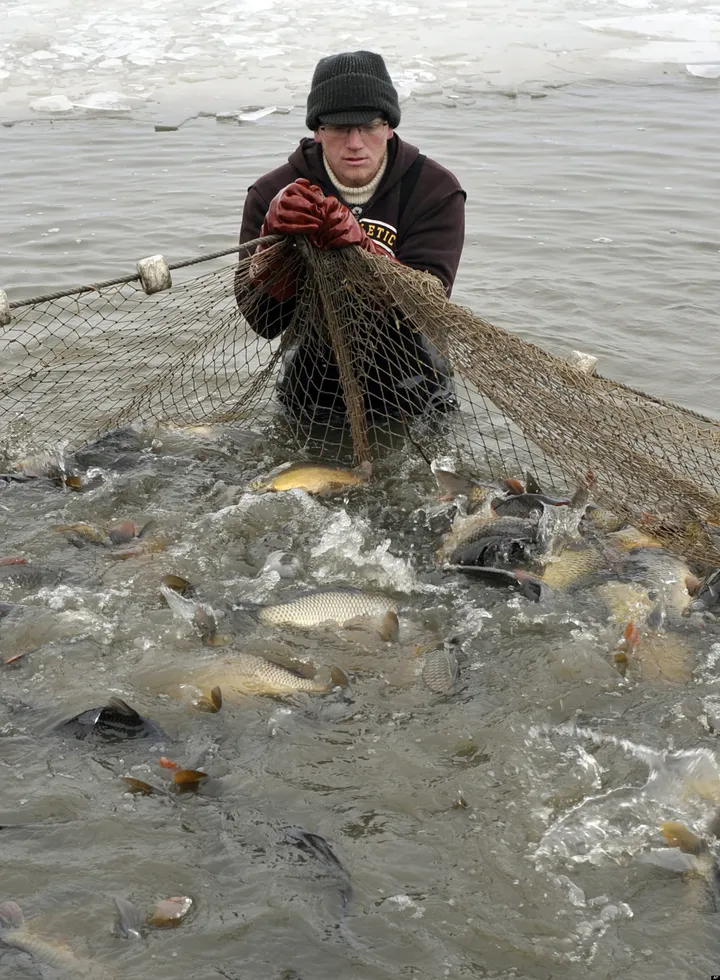
I recently visited Seville and Cordova, near the most extraordinary fish farm. Well, it was not exactly a fish farm. It was a bird sanctuary, thriving wetlands, and a phytoplankton and algae farm. Fish was a by-product, just as cows, chickens, lamb and pigs are by-products of grass farms. Luis Contreras began working at the farm seven years ago and helped transform this fish farm from an abandoned beef feedlot into a thriving oasis for healthy fish. He shared the details of his farm with me over a glass of Spanish Rioja and a meal of sweet, moist, delicately textured grilled sea bream and gray mullet harvested that morning from his "phytoplankton farm."

Farming "Grass Fed" Fish

Veta la Palma, initially started in 1994, is now a thriving 8000 acre wetland estuary ecosystem in a national park that happens to produce 2000 tons of delicious, omega-3 rich, toxin free sea bass, sea bream, shrimp, eel, and sturgeon a year. It is actually a restored wetlands, and the largest bird sanctuary in Spain with over 220 species of birds -- pink flamingo fly 150 miles each way to feast on the high quality fish this "farm" produces. In fact the birds consume 50 percent of all the shrimp and 20 percent of all the fish produced.

At Veta la Palma, they measure the health of their "farm" by the health of their predators. Imagine ranchers measuring the health of their lands by the health of the wolves that feed on the sheep. Six years ago there were no birds at Veta La Palma, just cows. The transformation that has taken place there in just a few years is truly astounding.

Most sustainable fish farms farm intensively, while Luis farms extensively. Typically, high inputs of energy (a 10 or 20 to one ratio of fish feed to edible fish), and large amounts of waste are created in order to make our food. Producing fish this way is, at best, a short-term solution to the fish problem. Veta la Palma does things differently. It is the fish-farming equivalent of a "grass farm".

It starts with a hatchery cultivating diverse species. These baby fish need some fish feed, and some electricity is used to manage the water flows in the estuary. But there are very low inputs of energy for huge outputs of biomass. This is the opposite of industrial agriculture and feedlot fish farming.

For most of their lives, the fish are never fed, except by Mother Nature, eating their "local, seasonal, organic, indigenous foods." They eat the phytoplankton and microalgae that transforms light, carbon dioxide, and nitrogen and phosphorous into enormous biomass (fish) that feeds birds and humans. The "farm" acts as a treatment plant filtering pollutants, purifying water and producing food. It buffers global climate change. Luis also explained how the "weeds" called Salicornia grows abundantly over marsh. Fed to farm animals this weed lowers cholesterol 50 percent and is now being used by chefs across Europe.

Some may wonder where we can find similar lands available to re-create this amazing ecosystem. No question it will require a radical rethinking of what's possible. I am a doctor that addresses the ecology of health, not an aquaculture or wetland expert, but Veta La Palma seems to me a model of the future of fish farming. Nurturing, supporting and restoring diverse natural ecosystems makes sense for our health and it is a better way to produce food long term.

I imagine the possibility of damaged and neglected wetlands across the planet modeling this simple idea -- restoring ecosystems and creating food for birds (and humans get to snack on the leftovers). National parks, coastal wetlands, estuaries, governments, ecologists and entrepreneurs together may create a solution to our fish problem. Perhaps one day soon, the estuaries around New York City will once again produce seemingly endless quantities of giant oysters and lobsters, and prisoners will riot again, as they did in the 18th century because they are sick of eating lobster and oysters.

The TED talk by chef Dan Barber tells the story of Veta La Palma in more detail. For skeptics of fish farming, watching the talk is a brisk wake up like the sea breeze on a winter day in Cape Cod. I strongly recommend it.

For more on food culture, food politics, and to learn how you can eat a nourishing diet see www.drhyman.com.

Now I'd like to hear from you.

What do you think of the possibility of converting neglected wetlands into "grass-fed" fish farms?

Do you think changes like these make a difference in our individual health and the health of our world? If so, how?

What ideas do you have to improve our food supply while supporting sustainable environmental change?

Please add your thoughts by leaving a comment below.

To your good health,

Mark Hyman, M.D.

Mark Hyman, M.D. is a practicing physician, founder of The UltraWellness Center, a four-time New York Times bestselling author, and an international leader in the field of Functional Medicine. You can follow him on Twitter, connect with him on LinkedIn, watch his videos on YouTube, become a fan on Facebook, and subscribe to his newsletter.


Follow Mark Hyman, MD on Twitter: www.twitter.com/markhymanmd

The Romans conquered the Andalusia region of southern Spain two centuries before the birth of Christ. They thrived on its fertile lands, rivers and valleys. At its peak, Rome had 20,000 citizens, whil...
 
 
  • Comments
  • 98
  • Pending Comments
  • 0
  • View FAQ
Comments are closed for this entry
View All
Favorites
Recency  | 
Popularity
Page: 1 2 3  Next ›  Last »  (3 total)
10:35 AM on 03/04/2011
The abandoned wetlands where the Colorado River used to empty into the Sea of Cortez would be a perfect candidate, except that the Colorado is practically empty now.
06:27 PM on 03/03/2011
Rome had close to a million people, it was the largest urban center of its time. The Roman Empire lasted almost a thousand years. The Eastern Roman Empire until 1453. Roman technology was in many ways outstanding. Disagreement over the end of the Roman Empire persists since the decline of the Empire had been a long and gradual process rather than a single event.

ps. Linseed oil, nuts, etc... are just as good no need for fish.
03:01 PM on 03/03/2011
Doctor, you're going on some really nice trips checking out these fish farming possibilities, and who can argue with San Francisco and Sevilla as being inspirational, but could it be that your infatuation with fish farming is Part of the equation, and that doing research into preserving natural systems that exist can be another part? Next stop, restored run of wild fish, and they do exist. I may be a bigger optimist than you.
I enjoy your posts and your optimism and enthusiasm, but this whole subject is as much farm vs wild as it is a Pixar production versus real life. There are Important differences. Of course wetlands should be restored to be economically viable sustainable systems, what a wonderful model you write of. YES! Fish feed made from smaller fish has to get tossed out of the equation - PLEASE. You do get that this feed is made of wild fish. Waste and disease spread by fish farms can decimate wild populations and ecosystems.
Some trips to ugly places with lousy tapas bars like Sacramento and Baton Rouge and Washington DC may be necessary to get some real change made.
Natural, wild wetlands and nurseries and runs that exist NOW are endangered and are worthy of your focus and attention. Me thinks this is going to mean a walk with a politician or two. Pack along something good to eat.

And thanks for these posts!
02:41 AM on 03/01/2011
I've been thinking about this very thing for a long time. I love fish, but am trying to eat only vegetarian fish so that I know they are at least not being fed wild fish fry or endangered fish dredged from the ocean. It's a start in the right direction. Also, like someone said early in the comments: shellfish is really very good as far as the environmental cost. With intelligence and care, we can have our environmental cake and eat its seafood, too.
Great Article!
photo
HUFFPOST SUPER USER
mssreader
eat, read, sleep, read and be happy
02:16 PM on 02/28/2011
Feeding grass to fish would be like feeding fish to cows. Just eat less meat, or none at all, and eat more legumes and lentils. The Indians, in India do and manage just fine with plenty of protein. I do a plant based diet and consume very little that harms the planet if any at all. I'm happy and healthy.
10:20 AM on 02/28/2011
I tend to think Rome fell because of corruptness and immorality
HUFFPOST SUPER USER
bansheeboy
Don't point that thing at me...
12:42 AM on 02/28/2011
I would refer all those interested in this matter to Paul Greenberg's excellent book, FOUR FISH.
photo
HUFFPOST SUPER USER
khanti
Cultivator
07:14 PM on 02/27/2011
In South East Asia and some Far East countries grass fed fish farming had existed for decades. There are three types of fresh water carp that have been bred for thier meet. The popular grass carp and the big head carp. While the grass carp grows to about 4kilos the big head carp can reach 30 kilos. Both these specoes are from China. There is another grass eating fish call the lampang.
The grass carp favours the topiaca plant leaves whereas the root is where the edible cassava flour is made from. The big head carp is a plankton feeder and also consume animal waste. These fish grows quickly. I believe these species are already found in some of US lakes and tributaries but considered to be invasive species.
05:55 PM on 02/27/2011
Nice article
04:53 PM on 02/27/2011
The easiest is probably mussels farmed on ropes suspended from rafts in coastal estuaries. They filter-feed on phytoplankton and require no external inputs, while delivering lean protein and the highest concentration of omega-3 EFAs of any shellfish.

In the 1970s, the New Alchemy Institute developed a production system which would later be known as aquaponics. They raised schooling herbivorous fish in closed recirculating tanks inside greenhouses, cultivating algae in the fish tanks and filtering the water through hydroponic pebble beds, where root-colonizing bacteria break down the fish effluent into nutrients for vegetable crops planted in the beds.

NASA developed a single-vessel aquaponic system for long-duration spaceflight in two versions designed for use with or without gravity. The primary producer is a tiny rootless aquatic vascular plant known as duckweed (genus Wolffia), which feeds tilapia, facilitated by a culture of ammonia-oxidizing bacteria to convert fish effluent into plant-available nitrates.

Algae is really the key to sustainable aquaculture, not only because of the photosynthetic efficiency and in-situ cultivation possibilities, but also because algae is the source of omega-3 EFAs in wild fish. Some herbivorous fish, most notably catfish and tilapia, can be successfully raised on a mostly soy-based diet, but the resulting product is almost devoid of omega-3.

We're still learning a great deal about aquatic ecosystems. The state of the art is still some years away from developing managed aquaculture systems that include more than two trophic levels. In order to efficiently farm highly-nutritious small oily fish such as smelts, for example, fish farmers not only have to become phytoplankton farmers but also zooplankton farmers, raising tiny prey animals such as copepods.

These aquatic ecosystems are extremely productive, and if aquaculturalists can figure out how to distill these ecosystems down into a minimal set of effective species representing the various trophic levels that can be cultured together in closed production environments, this would offer among the best opportunities for humanity to produce an abundance of nutritious food sustainably.
photo
HUFFPOST SUPER USER
loudneighbor
Now %10 Quieter
12:09 PM on 02/28/2011
Excellent post.
04:47 PM on 02/27/2011
is this setting the stage for propaganda for genetically engineered salmon? is this an attempt to rebrand genetic engineering as green?

all genetically engineered fish must be destroyed.
04:45 PM on 02/27/2011
as long as it doesnt involve genetically engineered fish in any way shape or form then fine yeah do it.
photo
HUFFPOST SUPER USER
Axlotl
12:53 PM on 02/27/2011
Ok. I'm a last-quarter limnology and biosciences undergrad applying to grad schools. If it's about fresh water, and I don't know the answer, I at least know someone else who does.

The good news - the part that ought to tell you you're on the right track - is that freshwater aquaculture is among the most productive on earth, for whatever you put in. I apologize for not having the figures for you, but I've seen the comparisons between land-based, oceanic, and freshwater "pound of meat" production/energy consumption, and they're good for freshater aquaculture. Really good.

The bad news is, it's not magic. Nitrogen and phosphorous, especially the P, are what runs the show (Nostoc and nitrogen-fixing bacteria will find N, if there's enough P available). Most of the reason these farms are very productive, is that they're shallow; nutrients get smacked up from the bottom, unlike in the ocean where they sink out of circulation and are lost.

Summary: I think if we start harvesting the heck out of freshwater ecosystems, we'll deplete them just like we do farmland, unless we're also fertilizing them just like we do farmland. That's a different concept than the little grassy estuary paradise you're describing. In fact, it tends to be waste-fed, hyper-eutrophic and ugly, just like any other CAFO (Concentrated Animal Feeding Operations) ...but it does feed people, and I think you can expect to see more of them.
02:14 PM on 02/27/2011
Humanity is not sustainable.. For one thing there are too many people with power & money that don't care about sustainability, and even if they did, it'd take such drastic reforms that it would never happen.

What will it take to wake enough people of the world up to enact such mass change required for our species to be sustainable? The threat of apocalypse?
photo
HUFFPOST SUPER USER
Axlotl
03:07 PM on 02/27/2011
Nothing. To the best of my knowledge, there is no self-regulating life form out there, including us. Any and all life - you put it on a growth media, or in a new environment, and it'll grow and replicate until it's used every last available resource, until a predator comes along and keeps it in check. Exponential growth curve: boom and bust, waaaaay up, and then a horrible, horrible crash when the party favors run out.

The question in my mind, is will we hit peak oil and starve first, or warm up the planet until we cook & drown? I'm leaning towards peak oil winning; for whatever mindless reason, we still show no interest in weaning ourselves off it voluntarily, even though viable electric cars that can be run off the grid have been a reality for decades now. It's gonna be one of those two that finally checks the growth curve, though.

The Amish will inherit the Earth, and they know it, curse them. It's a shame, because some of what we've done with all this basically free energy has been really remarkable.
03:18 PM on 02/27/2011
I don't think this approach argues for "harvesting the heck" out of these systems. The harvest rate from La Palma is about 10-20x less than most conventional CAFO style fish farms and would be, in theory no greater than what the system could handle under natural conditions. In fact, if you do the math, this approach would work quite well in the US under current conditions. It would work even better if we started restoring the sickening number of wetlands that have been lost in the last century...
photo
HUFFPOST SUPER USER
rsense
12:29 PM on 02/27/2011
Dude, where did you get that 20,000 population number for Rome? Typical estimates set the number at 1,000,000.
Low estimates are at 400,000+, high end at 14,000,000.
This user has chosen to opt out of the Badges program
09:58 AM on 02/28/2011
I was wondering the same thing. The colosseum held more than 70,000 people...so, why build an aphitheater with 3 times as many seats as the entire population of Rome?
02:47 AM on 03/02/2011
Actually, by the end of IInd century, when Roman empire reached maximum size, the city of Rome was over 1,000,000 people, but probably a small percentage of them had full citizenship rights: the Patrician. This figure of 20,000 is surely the size of Patrician population.
HUFFPOST SUPER USER
nypapajoe
10:46 AM on 02/27/2011
The Republicans would never intertain this concept and would block any funding or research because this is workable! No if it doest pollute or controlled by the corporate sector it won't work!
This user has chosen to opt out of the Badges program
photo
schotts
Strength and Honor
12:31 PM on 02/27/2011
Really? I'm a republican and a huge believer in sustainability. In fact, in my business practice, we help green/cleantech companies find funding to execute on novel - but feasible, business plans.

Why do you think republicans condone polluting?

You realize that without private corporations and the dream of making a lot of money from being creative and innovative, we would still live in the dark ages.
photo
HUFFPOST SUPER USER
Axlotl
01:14 PM on 02/27/2011
I'm a democrat, and I'll argue you points.
-We think that Republicans condone polluting, because Republican politicians are consistently and reliably anti-EPA, anti-pollution regulation, in favor of "self-regulating" corporate pollution limits that no one thinks for a moment will work, and my personal favorite, try their best to limit lawsuits resulting from harm caused by corporate polluting. Politicians you all put in office do their level-best to gut environmental legislation, reliably. Bush in particular was pretty much working to reduce the EPA to 3 guys in a rowboat with pH strips; I know, because I worked in that industry while he cut regulation.

-No, we wouldn't "still live in the dark ages." The idea of the modern corporation is actually new, particularly this crazy concept that corporations should enjoy constitutional rights that justice Scalia in particular has pushed for. Most "great works" have been government funded & driven, be it the printing press, reliable utilities, roads, atomic energy, the internet...whatever. Big Government (tm) brought that to you, not some social climber with a celphone in a BMW.

I'm not going to say "all Republicans are evil." There's plenty that are just poorly informed, too.
04:44 PM on 02/27/2011
if you are a repugnican then GTFO. the world hates you and rightly so. absorb that.
HUFFPOST SUPER USER
Jeff Rosenbury
I love all people -- in the abstract
02:28 PM on 02/27/2011
Lol. It is the Greens who make this plan unworkable. Try developing wetlands for commercial (or agricultural) purposes. It can't be done, at least not without several million dollars in legal fees.

Greens and liberals in general don't understand how even simple laws like wetlands protections limit economic growth and sustainability. The laws are structured to preserve existing problems and ways of doing things. Innovative solutions can not be applied.