iPhone app iPad app Android phone app Android tablet app More

Featuring fresh takes and real-time analysis from HuffPost's signature lineup of contributors
Mark Hyman, MD

Mark Hyman, MD

Posted: November 8, 2010 07:00 AM

Conventional medicine has lost its battle with cancer. But that doesn't mean the war is over. Let me explain why we may finally be heading in the right direction.

I just returned from TEDMED, an extraordinary gathering of brilliant minds from science, medicine, business and technology--a veritable intellectual orgy. During the conference, there was a theme that emerged: synthesis.

Instead of dividing everything into diseases and labels, emerging science is pointing to a different way of thinking about diseases. The thread that ran through the conference was that disease is a systemic problem and we have to treat the system, not the symptom; the cause, not the disease. This completely redefines the whole notion of disease. The landscape of illness is changing.
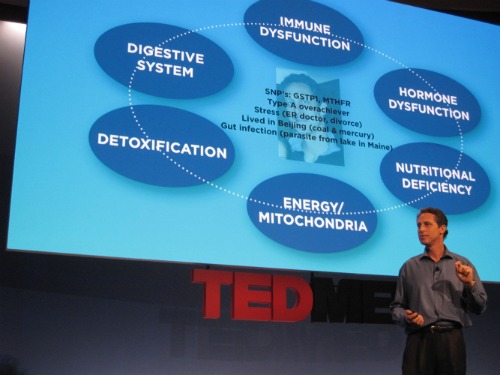
2010-11-06-HymanTedmed.jpg


At TEDMED I spoke about a new way to define disease, to navigate the landscape of illness. It is called functional medicine, which is a systems-biology approach to personalized medicine that focuses on the underlying causes of disease. That definition of functional medicine is a mouthful. But in a word, it is the medicine of WHY, not WHAT.

Conventional medicine is focused on naming diseases based on geography, body location and specialty, instead of by the cause, mechanism or pathway involved. Doctors say you have a liver, kidney, brain or heart disease. But this approach to naming disease tells you nothing about the cause, and it is quickly becoming obsolete as we understand more about the mysteries of human biology.

Instead of asking what disease you have and what drug should be used to treat it, we must ask WHY the disease has occurred--what are the underlying causes that lead to illness and how do we look under the hood to find out what's going on. Modern medicine is like trying to diagnose what's wrong with your car by listening to the noises it makes without ever looking inside to see what's going on. Functional medicine allows us to look under the hood. It gives us a method for identifying the conditions in which disease arises and shows us how to begin changing those conditions.

This shift toward a more functional, systems-based, environmental approach to treatment is happening in cancer research right now, and this change was one of the main topics explored at TEDMED this year.

Looking at Cancer a New Way: Treatment in the 21st Century

The problem with conventional cancer treatment is simply this: We look at the disease the wrong way. This reality was illustrated over and over again by the leading thinkers in the field of cancer treatment at TEDMED.

For example, Greg Lucier, Chairman of Life Technologies, talked about how thinking about specific cancers is essentially flawed. How we label cancer is no longer synced up with what we know about the origins of cancer or the fact that two people who have cancer with the same name--like breast cancer--can have two completely different diseases which require different treatments. Just because you know the name of your disease, it doesn't mean you know what's wrong with you or what to do about it.

Classifying tumors by body site--lung, liver, brain, breast, colon, etc.--misses the underlying causes, mechanisms and pathways involved in a particular cancer. The fact that cancer appears in a given region of the body tells us nothing about why the cancer developed in the first place. What's more it gives us no information about how it manifested in a given patient. Two people with cancers in different parts of the body may have developed it for same reasons. Similarly, two people with cancers in the same part of the body may have developed it for different reasons. A patient with prostate cancer and one with colon cancer may have more in common with each other than two patients who have colon cancer. Historically we have practiced medicine by geography--where a disease occurs in the body. That doesn't make scientific sense anymore. Now we have the potential to treat illness by understanding the underlying mechanisms and metabolic pathways.

These and other misconceptions about cancer and cancer treatment are leading to terrifying results. From the perspective of curative and preventive therapy, we have lost the war on cancer. Clinton Leaf explained how fancy statistics manipulate the data to show that cancer deaths are going down, while they are in fact going up. Overall cancer rates or incidence is significantly increasing. Deaths from cancer are also increasing. In 2008, there were 565,000 deaths in the U.S. alone. One in three people will get cancer in their lifetime. While few are aware that solid tumors grow slowly for 30 years before they can be detected, 17 million Americans are walking around with cancer somewhere along the continuum from initiation of a cancer cell to detectable tumor.

In the "war" on cancer, we are fighting a losing battle for one simple reason: We're focusing on the wrong target. As a physician I was trained to focus on the tumor--to burn, poison or cut it out, and then wait, watch and pray for the cancer to stay at bay. Newer gene-targeted treatments will help to improve chemotherapy and improve survival rates, but they won't prevent cancer in the first place or even prevent it from coming back once you've had it. Hope is not the only way to straddle the scary territory between remission and recurrence. There is a different way of thinking about how to treat the system, not just the cancer that holds promise for a proactive approach to helping both prevent occurrence as well as recurrence.

Tending Your Garden: Treating the Soil in Which Cancer Grows

Dr. Anna Barker, deputy director of the National Cancer Institute, explained how new groups of researchers are collaborating to think differently about cancer--to understand and treat it as a systemic problem.

The problem with cancer--one which almost no oncologists think about--is not the tumor, but the garden in which the tumor grows. In caring for a garden, if the weeds get too big, we pull them out, just as we do with cancer using conventional therapies such as chemotherapy, surgery or radiation. But then what?

Traditionally, we have focused on late-stage curative care, and in doing so, we have missed the thinking and the treatments focused on changing the underlying conditions that led to the cancer in the first place. Diet, lifestyle, thoughts, and environmental toxins all interact with our genes to change the landscape of our health.

We have been asking the wrong question about cancer. We have asked "what": What tumor do you have? What kind of chemotherapy, surgery or radiation is needed for that tumor? What is your prognosis? Instead, we need to be asking "why" and "how": Why did this cancer grow? How can you change the conditions that feed and support cancer-cell growth? How did the terrain of your garden become a host to such an invasive weed?

Surprisingly, scientific literature is abundant with evidence that diet, exercise, thoughts, feelings and environmental toxins all influence the initiation, growth and progression of cancer. If a nutrient-poor diet full of sugar, lack of exercise, chronic stress, persistent pollutants and heavy metals can cause cancer, could it be that a nutrient-dense, plant-based diet, physical activity, changing thoughts and reactions to stress, and detoxification might treat the garden in which cancer grows? Treat the soil, not the plant. It is a foundational principle of sustainable agriculture, and of sustainable health.

In my oncology rotation in medical school, I asked my professor what percentage of cancer was related to diet. Expecting a gracious but insignificant nod to the role of diet as a cause of cancer, I was surprised when he said that 70 percent of all cancers were related to diet. The 2008-2009 report from the President's Cancer Panel found that we have grossly underestimated the link between environmental toxins, plastics, chemicals, and cancer risk. They have yet to acknowledge how thoughts, emotions and overall stress impact that risk--but it is sure to come. The facts that gravitate around cancer support evidence that will motivate us all to take a deeper look.

Consider this fact: Sixteen percent of all cancers are new, primary cancers in patients who have already had one cancer, not recurrences. This means that people who have cancer are more likely to get a second and independent cancer. Could it be the garden? I recently saw a patient after her third cancer, wondering what she could do to prevent cancer rather than waiting around for another one.

Consider this fact: The lifetime risk of breast cancer of those with the "breast cancer gene" or BRCA1 or 2 is presently 82 percent and increasing every year. Before 1940, the risk of getting cancer for those with the cancer gene was 24 percent. What changed? Our diet, lifestyle, and environment--both physically and emotionally. Might these factors be a better place to look for answers on how to address our cancer epidemic?

Cancers arise from a disturbance in your physiological state. Addressing that disturbance is the foundation of future cancer care. This approach might be called milieu therapy. Rather than treating cancer per se, we treat the milieu in which cancer arises.

And this is manageable. We can enhance immune function and surveillance through dietary and lifestyle changes, nutrient or phytonutrient therapies. We can facilitate our body's own detoxification system to promote the elimination of carcinogenic compounds. We can improve hormone metabolism and reduce the carcinogenic effects of too much insulin from our high sugar and refined carbohydrate diet. We can help the detoxification of toxic estrogens through modulation of diet, lifestyle and elimination of hormone-disrupting xenobiotics or petrochemicals.

We can also alter how our genes are expressed by changing the inputs that control that expression: diet, nutrients, phytonutrients, toxins, stress and other sources of inflammation. And we can focus on less divisive and more generative thoughts that, in turn, create more uplifting emotions--all good fertilizer for the soil in the garden of our body.

The future of cancer care must use medicine's understanding of the mechanisms of disease and we must use this information to create physiologic and metabolic balance, to design treatments that support and enhance normal physiology. The future of cancer care lies not in finding the best cocktail of chemotherapeutic agents, the right dose of radiation, or a new surgical technique, (all of which are still important and will continue to be refined) but in finding the right way to personalize treatment according to the individual imbalances in each person.

The pieces of the puzzle that hold the answers for cancer prevention and treatment are strewn about the landscape of medical science. They need only be assembled into a story that can guide clinical care. The time is ripe to accelerate this process. Thankfully, more scientists are now exploring the story of how to tend the gardens of our body, mind and soul.

To learn more about how to tend your garden and create metabolic and physiologic balance for yourself see www.drhyman.com.

To your good health,

Mark Hyman, MD


Follow Mark Hyman, MD on Twitter: www.twitter.com/markhymanmd


  • Comments
  • 85
  • Pending Comments
  • 0
  • View FAQ
Comments are closed for this entry
View All
Favorites
Recency  | 
Popularity
Page: 1 2 3  Next ›  Last »  (3 total)
02:04 PM on 11/14/2010
exactly. and bravo. very exciting.. thank you for the post.

just imagine - now that we can personalize ed - if we do. and if the 12+ years of 7 hours 5 days a week of school were spent following passion and curiosity.
what if it weren't compulsory. and what if we were not only solving real life problems... like people crave... but the fact that we're allowed to do that diminshes the world problems.

we don't zoom out often enough..
photo
HUFFPOST SUPER USER
Cathy M Rubin
11:57 PM on 11/10/2010
My dearest friend is dying of adrenal cancer, and the traditional treatments have been ineffective.
An excerpt from her daily diary as she fights to resuscitate her "garden".

Rare Day 18 of 42

I Am One in a Million - RARE is the personal story of Lisa Penry’s fight to live. The story is told with her friend, author C.M. Rubin, who lives in New York City. Lisa, who lives in Maidenhead, England, has Adrenal Cortical Cancer. She has had surgery, chemotherapy and has now begun an experimental drug therapy with OSI 906 lasting 42 days.

Where shall I begin Cathy?

Today has been a bit of a roller-coaster — a roller coaster that’s out of control. Highs – Lows - Blurred at the edges - Holding onto the rails for fear of falling off. I’ll just go with the moment, try to write it all down in my daily pink notebook, try to work it out as we go. I’ve had the absolutely weirdest feelings in my head and my body.

It could be any number of things. I know I have the best doctors all over me at the moment, examining every molecule, but I know that something is different this week. It could be the trial drug. It could be the side-effects from morphine, or my tumour secreting cortisol.
Read more at www.cmrubinworld.tumblr.com, when time permits.
11:50 PM on 11/10/2010
Dr. Hyman said:

"Consider this fact: The lifetime risk of breast cancer of those with the "breast cancer gene" or BRCA1 or 2 is presently 82 percent and increasing every year. "

Where are you getting your "facts"?

From cancer. gov:

"According to estimates of lifetime risk, about 12.0 percent of women (120 out of 1,000) in the general population will develop breast cancer sometime during their lives compared with about 60 percent of women (600 out of 1,000) who have inherited a harmful mutation in BRCA1 or BRCA2 (4, 5). In other words, a woman who has inherited a harmful mutation in BRCA1 or BRCA2 is about five times more likely to develop breast cancer than a woman who does not have such a mutation.'

600 out of 1,000 is a 6% chance that a woman with a BRCA mutation will develop breast cancer.

Your "fact" is completely *wrong*.
10:09 AM on 11/11/2010
Correction: 600 out of 1,000 is 60%.

My bad: math has never been my strong suit ;)
11:13 PM on 11/10/2010
Dr. Hyman said:

"Classifying tumors by body site--lung, liver, brain, breast, colon, etc.--misses the underlying causes, mechanisms and pathways involved in a particular cancer. The fact that cancer appears in a given region of the body tells us nothing about why the cancer developed in the first place. "

This is simply wrong. There are plenty of examples where the etiology of cancers can be linked to specific chemicals or pathogens. Gastric cancer and chronic gastritis induced by H. pylori infections. HCC (liver cancer) and chronic HBV infection. Cigarette smoke and lung cancer. There are also specific genetic mutations associated with cancers. Her2/Neu mutations and breast cancer is a well known example.

To suggest that the organ of tumorogenesis in no way indicates the etiology of the disease, is *wrong*.
photo
HUFFPOST SUPER USER
H P
Citizen
09:16 PM on 11/10/2010
FINALLY.. western medicine is doing what eastern medicine- wholeistic approach to a person and dis-ease has done for thousands of years... too late for many suffers.. BUT profits for big pharma still...
09:54 AM on 11/11/2010
Do you know of a single "holistic" approach that has actually cured a cancer? Say what you want about "big pharma" being greedy, but next to surgery, pharmaceuticals are the only thing that have ever been able to cure any type of cancer. Which "holistic" approach can do that? Where is the evidence?
photo
HUFFPOST SUPER USER
jgarma
04:05 PM on 11/10/2010
It's seems intuitive that seeking the underlying causes of cancer is the key to preventing it, rather than mainly focusing on fixing the problem once it's raging through your body.

There are many suspects -- the causes -- and my guess is that at some point we'll know that it's a fatal cocktail of stuff (pesticides, chemicals, garbage food) that combine to undermine and overwhelm immune systems, thus enabling cancer cells to dominate.

Is dairy a component in the cocktail? Some research suggest that it may be and some concludes that it's not. Interesting to note that women in Asia countries have much, much less breast cancer than those in America. Dairy is not eaten there.

Chemist and Professor Jane Plant fought breast cancer four times! This made her dive into the research. She wrote a book about how dairy may augment or help cause breast and prostrate cancer. A compelling excerpt of her book can be read here:
http://www.garmaonhealth.com/2010/11/dairy-cancer-link/
HUFFPOST SUPER USER
Binks
11:41 PM on 11/09/2010
Wow. The allopathic medical community is FINALLY waking up to three-thousand year old ideas? I hate to be cynical but I am. These three-thousand year old ideas are deeply rooted in Chinese Medicine.

The AMA world will never completely buy in to a 'change your diet, lower your stress, eat healthy, understand your stress triggers, change your toxicity level' because it doesn't put dollars in their corporate coffers. Unfortunately, these ideas will not be the new landscape of medicine. You will only find these ideas put to use with individual MD's who understand that cancer will never be solved the AMA way and who are willing to confront the truth about this disease.
02:25 PM on 11/09/2010
Dr. Hyman states, "Traditionally, we have focused on late-stage curative care..."

Exactly! And members of the highly profitable cancer industry hope this never changes. Most research funds come from companies which can then patent the resulting chemo or radiation treatments. Big bucks will never be made on prevention research.

Another excellent post from Dr. Hyman.
photo
HUFFPOST SUPER USER
SuperMom101
What's on your plate?
06:24 AM on 11/09/2010
Let food be your medicine and medicine be your food. - Hippocrates

Diagnosed and treated for Stage 1 Grade 1 breast cancer (IDC) at the age of 38 over 10 years ago. In conjunction with my renowned oncologist I declined chemotherapy.

When I discovered that I can cut my chances for a recurrence by changing my diet it was a no brainer. The garden that was feeding my cancer was hormone receptive (and most breast cancers are). So no more fake food products, growth hormones (natural or artifical) or highly processed food. I've discovered I don't need a science degree to know that a Non GMO apple is better for me than a poptart or yogurt?

To all those that say you can't afford to eat healthy, what's the price of your health? I suggest a walk to the store, buy real food, and cook.

Sadly, we Americans have never been fatter or sicker and we can't seem to figure out why.

Thanks for the post Dr. Hyman...I'm with you 100%...
photo
HUFFPOST SUPER USER
Rob Halpin
08:57 AM on 11/09/2010
Wonderful story and thanks for sharing. An example to live by, for sure. Continued good health to you!
02:11 PM on 11/10/2010
SuperMom101, I agree with you and Dr. Hyman. I'm very surprised by all the negative responses to this article and wonder if those people read the whole article or have a clue that our traditional western medicine is making things worse and Dr. Hyman is trying to correct that. He might have MD behind his name but he's one of the few with a conscience and a passion for helping people be well. Prevention is best, but for those that get cancer, there's got to be a better way... to help them reverse it.rather than yank it out or poison it.
01:24 AM on 11/09/2010
"The problem with cancer--one which almost no oncologists think about--is not the tumor, but the garden in which the tumor grows."

That's simply untrue. Oncologists do think about those things. They aren't idiots. The problem is that by the time they see a patient that is irrelevant because the patient already has cancer and eating your veggies won't make it go away.

It seems like every time someone identifies a problem in the understanding or treatment approach to a disease they jump to the conclusion that physicians are some unenlightened neanderthals incapable of realizing this who need some inspiration from lay people to offer generalities as suggestions. Forget the fact that to validate any one of these theories takes years of basic and clinical research. I'm not saying anything here is wrong (although if you think we're going to stop having cancers any time soon by means like this I have a bridge to sell you...), but I object to articles written for public consumption that imply that professionals don't know these things already. The difference between hypothesizing that a therapy exists and discovering, testing, and implementing it is very very large.
photo
HUFFPOST SUPER USER
Johnagain
WTFWJD?
06:13 PM on 11/08/2010
Sorry, but this high a dose of pop culture hooey in one sitting is bad for your health.

"We have asked "what": What tumor do you have? What kind of chemotherapy, surgery or radiation is needed for that tumor? What is your prognosis? Instead, we need to be asking "why" and "how": Why did this cancer grow? How can you change the conditions that feed and support cancer-cell growth? How did the terrain of your garden become a host to such an invasive weed?"

We've been doing precisely that for 30 or more years. The 'why' question has been central to all cancer research since its inception. This article might have had the slightest bit of relevance in say, 1970, but today it smells like a piece of cheese that's been in the trunk of your car for a week. It leaves the impression that those of us doing cancer research are still using leaches and magic spells to fight cancer, when in fact we've been approaching the problem from a 'systems biology' approach for a long time. The term 'systems biology' is for the most part of rebranding of what many of us have been doing in the cancer prevention and other cancer research fields. This author would learn an immense amount about how cancer research is evolving by attending the AACR (American Association of Cancer Research) annual meeting.
photo
HUFFPOST SUPER USER
Dustin Rudolph
Clinical Pharmacist & Certified Nutritionist
04:38 PM on 11/08/2010
This article brings reminds me of an ever increasing new area in treating cancer which is antiangiogenic treatment. Antioangiogenic treatment involves slowing or eliminating blood vessel formation to the cancer cells. This reduces or diminishes entirely the amount of oxygen and nutrients that end up feeding the cancer cells so they can't proliferate and grow. There are both meds and foods that have this effect. You can read more in an article that I wrote here - http://pursueahealthyyou.blogspot.com/2010/10/new-approach-to-fighting-cancer.html.
photo
farmilyman
everything is illusion
03:25 PM on 11/08/2010
I'm surprised more people don't have cancer considering the toxic soup we are forced to live in and all the junk food and GMOs readily available...........not to mention the 24/7 newscycle giving mostly bad news.
10:07 AM on 11/11/2010
GMOs don't cause cancer. Stop trying to stress people out by perpetuating lies.
This user has chosen to opt out of the Badges program
photo
Tlaltecuhtli02
here since BETA yet hated 4 getting it right
02:53 PM on 11/08/2010
ALL blood tests in America demonstrate contamination with industrial chemicals such as plasticizers, you know, that "new car smell."

ALL water tests in America return with pollutants and containments such as a popular gasoline additive. Well and stream water included.

Strangely, recent tests showed that vegetables and fruit have less residual pesticides on them than previously assumed.

If you are living in a newer place, or a remodeled home, an airtight place filled with new floors, furniture, electronics, etc, and consuming mostly processed foods, you are living in a chemical stew. Better to be poor and living in an older home that has stopped off-gassing, and eating the chickens and vegetables from your backyard.
This user has chosen to opt out of the Badges program
photo
03:01 PM on 11/08/2010
> ALL blood tests in America demonstrate contamination with industrial
> chemicals such as plasticizers, you know, that "new car smell."

Please forgive my skepticism, but where does the data to back up this claim come from?

I am not arguing that there aren't a lot of pollutants out there in the environment, but the claim that ALL blood tests show this seems a bit extreme. What was the sampling method? At what level were these pollutants detected? This sounds like hype to me.
This user has chosen to opt out of the Badges program
photo
Tlaltecuhtli02
here since BETA yet hated 4 getting it right
11:06 PM on 11/08/2010
A recent study done in Canada once again showed that ALL test results were contaminated, and interestingly enough, politicians as a group had the highest levels of contamination.
09:53 PM on 11/08/2010
the new car smell comes from bromide. its the same thing they use to flavor Mountain Dew. It's main deleterious effect is to displace iodine in the system. One would need to treat this with both kinds of iodine/ do your research. BTW you don't want iodine supplementation if you have hashimoto's thyroiditis.
This user has chosen to opt out of the Badges program
photo
Tlaltecuhtli02
here since BETA yet hated 4 getting it right
11:12 PM on 11/08/2010
way off the mark, dude!

unless you are speaking of methyl bromide, a banned pesticide, bromide is a natural substance in seawater, and NOT used to produce plastics.
photo
aaronf
wrapping my head around it all
02:43 PM on 11/08/2010
Check out this exciting lecture on cancer prevention!

According to this research, we should be loading up on foods like artichokes, berries, citrus, soy and tea to help prevent cancers from growing. Food IS medicine!

http://www.ted.com/talks/william_li.html