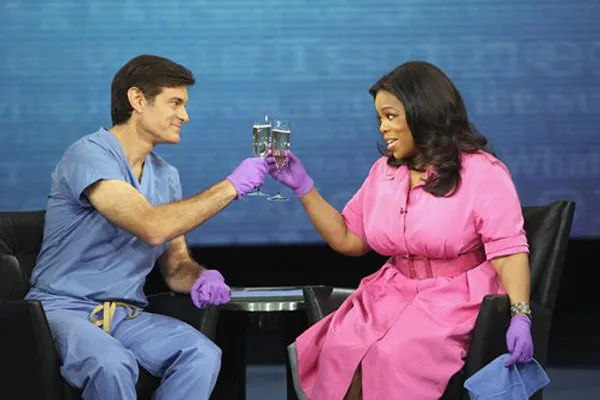
I just returned from the sun-drenched Rockies where the 2009 Aspen Health Forum, hosted by the Aspen Institute and TIME magazine was held. The clarity of mind induced by the fresh mountain air (or perhaps the neutral venue and balanced conversations) crystallized my vision for meaningful health care reform, which I shared with TIME magazine managing editor Rick Stengel as we answered questions from the his readers about "The Doctor Oz Show" and what role it might play in the larger framework of health in America.
Part of the challenge we face is that all eyes are focused on health care finance arguments in Washington, but the real action is taking place in our homes across this great land. We cannot have a wealthy country without being a healthy country, but health care finance solutions by themselves do not help us care for our health. An insurance card is correlated with, but does not guarantee a clean bill of health.
I am a practicing heart surgeon, but I also attended Wharton Business School and have joined Oprah Winfrey on TV and radio, so I have collected many insights from wise souls knowledgeable about this nation's battle for health.
My prescription for health starts with the fundamental reality that no health care finance solution will work without arresting the increasing costs of the health care business. I know this is painful news for many, but doctors are used to giving bad news and still maintaining the respect of our patients, so please keep reading.
To control costs without rationing care, we need to improve the quality of the services we buy for our money. Economists and the few remaining car salesmen would agree that this translates to better value. We have two principal options. First, we need to eliminate the 20% of services offered that are wasteful or harmful. For example, if you live in Texas, California, and Florida, your states offer some of the most expensive health care in the U.S. without providing measurable benefits. Their health care offers limited value primarily because some in the medical community lost their way. Many in my field have lost the art of listening - spending time with their patients so that they can address the true issues rather than offer quick-fix patches on the immediate problem at hand. Tests and complicated (not to mention, expensive) procedures are ordered all the time, but without a full and comprehensive understanding of a patients' needs. After all, it's more cost-effective - and better medicine - if we can make meaningful diet recommendations to patients rather than put them on diabetes medication for the rest of their lives. If we want true reform amongst our own ranks, we must move from a state of reactive use of technology and testing into a more proactive state of dialogue.
Doctors need to act like professionals and police our own for doing unnecessary tests and procedures but we also need smart patients to insist on second opinions that will change their diagnosis or therapy in a third of all cases. You heard right. Over 30% of patients will get materially different recommendations from a second opinion. Many of you are bashful about pushing to see another doctor, but when you get doctors to speak with each other about your case, they teach each other and every subsequent patient that sees your doctor will benefit because you were brave enough to drive quality into the system.
twitter.com/droz
The second major improvement requires revisiting the business model of medicine. Professor Christensen of Harvard Business School taught me on a show recently that two primary models exist for any business (excluding networking businesses). "Solution shops" offer intuitive insights into unpredictable ailments, something doctors (and lawyers) are superb at addressing. On the other hand, value-adding processes like building cars in an assembly line or managing correctly diagnosed diabetes with a specific plan for chronic management are far less expensive than solution shops and usually are more effective in offering reproducible results. In America, we lump these fundamentally different approaches together so we get highly trained doctors using sophisticated approaches to manage tasks that could often be better accomplished by other well-trained health professionals who actually like double-checking that you took your medications and watched your diet.
We speak of prevention a lot these days, but what does prevention mean? I moderated the last White House Town Hall on Health and came away from the experience understanding that America believes "prevention" is really about making the right thing easy to do. This includes everything from making healthy locally grown vegetables easy to find, bike racks available in our work places, and a health care system that provides a crutch to remind us that we forgot our colonoscopy. We cannot look to Washington for these changes without engaging the battle ourselves. I am transitioning from being a full-time doc to hosting "The Doctor Oz Show" because of a civic responsibility that all professionals have to speak out on issues that affect our communities. We are the ballast that steadies the ship of society heading into the troubled waters of health care reform. I am moving from an operating theatre to a television studio to affect this change, but we will only succeed if a willing audience of activist citizens follows and serves their fellow man by making the right health decisions easier to make.
"The Dr. Oz Show" premieres Monday, September 14 (check local listings).
Follow Dr. Oz on Facebook and Twitter!
Follow Mehmet Oz, M.D. on Twitter: www.twitter.com/droz.com
I agree we need to be educated and pro-active regarding our healthcare. I also agree that doctors need to spend adequate time with their patients, but won't the currently proposed reform make it even more difficult for doctors to have the time to do that? Won't government control make it even more difficult to be proactive if you do not have freedom to choose the care you feel you need?
I'm not clear on whether you support the current plan and whether you feel it will do anything to control costs, or how it will be financed other than through drasticaly higher taxes or through eventual rationing, especially when it morphs into a single payer plan as many in Washington have indicated that they desire it to do so.
Thanks-
pb
http://www.pbs.org/moyers/journal/07102009/watch2.html
"A team at King's College London found public understanding of basic anatomy has not improved since a similar survey was conducted 40 years ago. Less than 50% of the more than 700 people surveyed could correctly place the heart, BMC Family Practice says. Under one-third could place the lungs in their correct location, but more than 85% got the intestines right. There are concerns that a poor grasp of anatomy could potentially compromise patient care."
http://news.bbc.co.uk/2/hi/health/8092930.stm
http://www.diabetes.org/support-the-cause/banting-circle-supporters.jsp
(I am a Registered Dietitian)
PROFITEERING CORPORATIONS! It's certainly NOT about Your Health! LOL
I wish you would address those costs more. Where do they come from, unnecessary expensive tests? You touched on that. What about pharmaceutical company operations and profit margins? What about big insurance companies? What about the cost of all the uninsured citizens (and non-citizens, even) who need emergency care? What about the costs of not informing mothers about the "food" habits that lead to juvenile diabetes? What about the way hospitals process medical billing, item by item ad nauseum?
I admire the work you do in informing the public. Isn't it amazing how much we don't know about our own bodies?
The last presidential nomination process brought along this charming personable “down home” type of gal that many are attracted to. Notwithstanding the fact that her knowledge of current history is totally skewered or non-existent, Sarah Palin scored big with the politicos on the right. Much of her “knowledge” is not based on facts but on fancy.
As an author, she would probably write a fine fairy tale as fairy tales frequently assume facts not in evidence and make up stuff.
As her latest post concerning Health Care Reform posted on the net demonstrates, she is great for making up facts and presenting them as reality. There is nothing in the Health Care Bill that would foster euthanasia nor eugenics as her post implies.
Many have received government run Medicare and Medicaid and while there was never a question in their minds that it has been and is a good thing some still seem to believe the garbage being thrown at them by the supporters of the Health Insurance industry through the Far Right that The Health Care Bill would not be good thing.,
It would not be a good thing for the Health Care industry as they would be compelled to insure those with pre-existing conditions as they have not in the past and will be compelled to pay for life saving treatments that they have denied in the past.
That is a fact.
Palin’s words are not.
Polly Keene,
Florida
Dr Oz! It's so refreshing to see an actual doctor talk about health care and the solutions to our health care problems, than to have to listen to yet another financial wizard or shill for the insurance company.
You may be the first, and certainly one of the few people who seem to "get it" and realize that the problem here isn't one of prices being too high, it's a matter of prices being too high FOR WHAT WE GET, and what we get for that money is questionable at best.
Having watched you on Oprah every chance i get, I realized a long time ago that you're one of those who "gets it", and talks about real preventative medicine through diet and exercise, leaving the true issues of medicine to those who really need it, those who develop issues that can not be managed with diet and exercise...though it appears that nearly every disease can be managed with diet and exercise
Another question I haven't heard an answer to is, given that we already spend more than any other country per capita on health care, why does "reform" mean spending even more? And don't give me the "rationing" argument, we already ration healthcare just not very rationally. We need a means of establishing priorities and discard the unworkable assumption that we can do all things for all people all the time no matter the cost.
I'm not sure about Texas and California, but I suspect that Florida's high cost and reduced benefits has something to do with:
1. the high ratio of senior citizens and
2. the litigious environment and high ratio of attorneys.
I offer my own recent experience as additional fuel for discussion. I was diagnosed with allergic asthma after hacking for three week uncontrollably and coughing up clear sputum. I was prescribed five different medications, which I bought. After no relief in a month, I suggested to my physician's assistant that perhaps a chest-xray would help? But instead of a chest x-ray (which may or may not have made clear a diagnosis), I was immediately prescribed an antibiotic. My condition subsequently cleared in seven days. My physician's assistant did everything that was politically and professionally "correct" for this day and age - but clearly, I could have been saved a lot of pain and suffering if the traditional xray followed with an antibiotic was given to me first.
If there is a moral to this story, it might be that medicine can never be just black and white.
See http://nejm.highwire.org/cgi/content/short/347/2/81.
The issue here is that the results of surgery, medication etc has to a large extent to do with the expected results of the patient. The heart of the matter is that some believe they will heal and so they do. Some have doubt about their healing and they don't. Others are more suggestible to the persons around them, physicians and otherwise.
For an explanation of how this works see . http://www.thehealingattribute.com
PG 65 Sec 164 – This is a payoff subsidized plan for retirees and their families in community orgs (ACORN).
1. County Health Department
Epidemiology
Ecology
2. Medicare
Part A
Part B
Part C
Part D
3. Medicaid
Physician Visits
Pharmacy
4. Military Healthcare
a. Tricare Standard
b. Tricare Prime
c. Tricare for Life
d. Pharmacy
The above plans cover our population over 65, our Miliary population, our unemployed, our poor, women and children at risk and newborns. What is not covered is our working-poor. These are the people who work and cannot afford health insurance or the basic medical needs of their family. This is the target population that President Obama is trying to assist. It is the Father and Mother who wants what is best for their family like everyone else.