More

Featuring fresh takes and real-time analysis from HuffPost's signature lineup of contributors
Dr. Orin Levine

GET UPDATES FROM Dr. Orin Levine
 

Vaccines for Children: Why We Need to Create Incentives Now

Posted: 07/12/11 03:19 PM ET

By Dr. Orin Levine and Amanda Glassman

In low- and middle-income countries, children living in poverty are less likely to be vaccinated -- and more likely to die or become ill from a vaccine-preventable disease -- than wealthier children.

A perfect example of this can be found in Nigeria, where less than 5 percent of children in the lowest quintile of the wealth distribution were fully vaccinated in 2003 -- as opposed to 40 percent of children in the wealthiest quintile. (For more on inequalities in health, see here.)
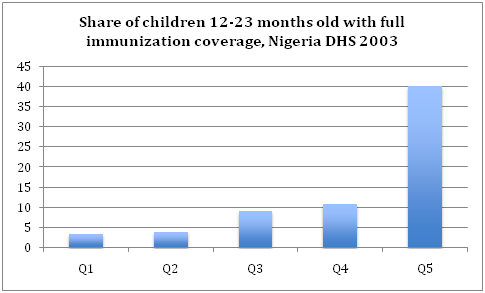
2011-07-06-GraphforOrinsBlog.bmp
Although a lack of effective supply and distribution systems limits the reach of immunizations -- especially to "last mile" populations -- much progress has been made and innovative strategies are underway to strengthen vaccine supply chains (see here for some examples).

However, as CGD's Charles Kenny noted last month in "Foreign Policy," few efforts focus on the "demand-side" -- the barriers that poor families face when considering whether or not to vaccinate their children. Yet according to recent impact evaluations, providing modest cash or in-kind incentives to poor families conditional on vaccination of their children has worked in at least five developing country settings. (See here and here.) Based on these positive evaluations, we believe that conditional transfer programs are a promising demand-side way to address vaccination coverage levels that should be tried and evaluated in multiple settings.

But will these schemes get the attention and evaluation they deserve? This depends in part on whether we can address the concerns of donors and policymakers who worry about the economics and ethics of cash and in-kind transfers for vaccination. Specifically, many worry that cash transfers for vaccination will diminish intrinsic motivations for getting children vaccinated and create long-term dependency on the transfer.

In our view, while legitimate questions to ask, these concerns are unfounded. Here's why:

Economics.

Since families benefit from vaccination by avoiding vaccine-preventable morbidity and mortality, policymakers question why a government should provide additional cash or in-kind subsidies. Yet we know that poor families don't invest sufficiently in their children's health -- the inequalities in health status and coverage make this clear. Poor families don't have enough money to cover costs of seeking care, nor do they engage preventive services as much for a number of reasons (high discount rate, intangible benefits, risk perceptions etc.).

There are also other sociocultural barriers that make health services "unfriendly" to poor and vulnerable households in addition to misconceptions about the safety of vaccination. The conditional transfer intends to adjust this cost-benefit analysis for poor households by bringing the benefits of vaccination more tangibly and immediately into view and by reducing the cost associated with obtaining the vaccine. Finally, the benefits of vaccination do not accrue only to the individual or household; so providing "compensation" to the poorest for giving the benefit of herd immunity to others is also a good argument.

Ethics.
Some policymakers argue that paying people commoditizes people or behaviors, or that such a transfer can be considered a "bribe." While important to support intrinsic motivations, is the counterfactual situation ethical? Is it okay to leave some children unvaccinated because their parents are too poor or lack sufficient knowledge? An unvaccinated child is more likely to become ill and die from disease than a vaccinated child. If repeated evaluations show that an intervention can significantly increase vaccination coverage among the extreme poor, is it ethical to withhold this intervention? (HT Mead Over)

Dependency.
Building off the U.S. preoccupation with welfare dependency, policymakers also worry that poor families will become dependent on cash or in-kind transfers, and that transfers are not sustainable over the long-term. We consider this highly unlikely to occur because (i) the amount of the transfer is marginal with respect to a beneficiary household's consumption, so it is unlikely to create a permanent change in consumption patterns or affect employment choices; (ii) households automatically "age out" of the conditional transfer -- if a family does not have kids below the age of five, then they do not qualify for the transfer; (iii) conditional transfers can be thought of as transitional programs to "educate" poor households on the benefits of prevention.

In Nicaragua, a conditional cash transfer substantially increased vaccination and use of preventive services. Once the demand-side transfer was eliminated (for political reasons), however, utilization of preventive services on the supply side was maintained at almost the same level, suggesting that families had learned the value of preventive care, or had become comfortable using the services because of familiarity with them.

Up to one in every five children in the world doesn't yet get the life-saving vaccines they need. Even more remain needlessly vulnerable because they are delayed in receiving vaccines. Overcoming this challenge will likely require a broad set of policy tools. Unfortunately, we have few demand side tools at this time in our tool box. In our view, conditional transfers represent a promising approach that warrants further evaluation. Concerns about the ethics and economics of this approach seem to argue for, not against, investigating these programs further.


Follow Dr. Orin Levine on Twitter: www.twitter.com/orinlevine


  • Comments
  • 22
  • Pending Comments
  • 0
  • View FAQ
Comments are closed for this entry
View All
Favorites
Recency  | 
Popularity
07:26 PM on 07/18/2011
Why can't the pharma companies make a safe vaccine? Why do they need all those poisonous adjuvents and preservatives in them? Mercury, formaldehyde, aluminum, squalene, antibiotics simply aren't good for you and are made worse when injected into the blood stream directly bypassing the first line of defense, our mouths and stomachs. It is simply unconscionable that they make them this way. How many babies are allergic to some of these things, not to mention eggs or other proteins used to incubate some of the ingredients. I'm sorry, but until they can make these things safe it's better to just say no to them.
Josephius
No, not microbio, molecular bio and biochemistry!
06:09 PM on 07/20/2011
Uh. The same tired arguments.

Are cars safe? What about bath tubs? What about the diseases these vaccine prevent? Are they safe? Compared to cars, bath tubs, and preventable infectious diseases, how does vaccine safety stack up? And yet I bet you have no problem putting your child in a car or allow them to bathe.

Poisonous ingredients? Really? What evidence do you have that anything in vaccines, at the concentrations used is poisonous?

Vaccines are not "injected into the blood stream". They are IM. And some vaccines are given orally.

Vaccines would not be used by any and all countries on the planet earth if there wasn't a risk to benefit ratio in its favor.
Josephius
No, not microbio, molecular bio and biochemistry!
06:16 PM on 07/20/2011
Why don't you tell us how medical formulations should be made then. Please...be as specific as possible. You seem to think you know about medical formulations, so share with us.
03:46 PM on 07/15/2011
So Dr. Levine, you would like to see more children's bodies damaged by these vile concoctions? The evidence is in doc, where have you been? It is overwhelming, irrefutable, and incontrovertible. That's just considering the poisons that are in the vaccines. Now consider the evil purveyors of the putrid poisons and how they use every trick in their handbook to sucker us in with their lies and under table payments. Sickening indeed. You should be ashamed and embarrassed that you are still a proponent.
05:27 PM on 07/15/2011
I would say the exact same thing about a person who tried to keep the world's children from receiving medicines that have saved tens, maybe hundreds of millions of lives. There's a reason smallpox, diphtheria, polio, measles, etc. don't exist anymore in much of the world. Do you think that was a coincidence?
05:28 AM on 07/18/2011
excellent. fully agree!
HUFFPOST SUPER USER
Taximom5
10:06 PM on 07/13/2011
Which "life-saving" vaccines are being offered in places like Nicaragua and Nigeria? The DTP, which caused enough seizures that it was replaced with an acellular vaccine in the US, but is still being manufactured for export? Or the live polio vaccine, which in some cases CAUSES polio? Or the flu shot, which has been shown to be about as effective as a placebo?
photo
HUFFPOST SUPER USER
John Richard Smith
Social Justice Advocacy
11:41 AM on 07/14/2011
Taximom5

http://www­.huffingto­npost.com/­2011/07/04­/studies-s­uggest-env­ironment-a­utism-caus­es_n_88904­1.html
photo
HUFFPOST SUPER USER
Dyson
debunking pseudoscience, one fallacy at a time.
08:10 PM on 07/15/2011
You picked a particularly bad example there Taximom.
Polio eradication was well on track until certain imams in Nigeria spread rumors about polio vaccine being a CIA funded plot to sterilize the locals. In the North, they stopped vaccinating, with the result that polio came back with a vengeance, and was then exported into other neighboring countries as well.

As for life-saving vaccines, think measles, meningitis, pneumococcus as well as polio and DTP. Ever seen a neonate die of tetanus convulsions, or infants die in their moms arms seizing from meningitis? I have and its not pretty.
03:01 AM on 07/13/2011
The issue of vaccines in the developing world is a complex one, as explained in the BBC World Service's 'The Vaccine Detectives' last year:

http://www.bbc.co.uk/programmes/p00b1z47

Vaccinating starving children doesn't solve many problems. Good nutrition, clean water, sanitation do.
This user has chosen to opt out of the Badges program
photo
sabelmouse
my micro bio is emty
12:22 PM on 07/13/2011
thanks for the link. it seems as usually i can't access it. i'm in ieland, i get bbc tv though only 1 and 2 but those online things, never.
photo
HUFFPOST SUPER USER
John Richard Smith
Social Justice Advocacy
10:04 AM on 07/14/2011
This might help outline some of the issues

http://www.huffingtonpost.com/2011/07/04/studies-suggest-environment-autism-causes_n_889041.html
06:33 PM on 07/12/2011
What this should read is "Why we need to get rid of the doctors that are attempting to murder our children so big pharma makes more money!"
photo
HUFFPOST SUPER USER
Marsha McClelland
12:45 AM on 07/13/2011
Amen to that. Hey, I have a friend who said she commented here but it hasn't shown all day. What's with that? It's not like it got lost in the rush to comment.

Here it is as she told me for some reason she has problems getting comments to post so I'm doing it for her.

Antiutilitarian Prohealth wrote;

"So...... Are you going to adequately pre-vaccine screen these children. Will these children be actively tracked for vaccine adverse events and will proper services be put in place in the event of an injury?

When children do not h...ave access to adequate nutrition and filtered water they can have higher levels of oxidized stress. Oxidized stress can increase the risk of vaccine adverse events including deaths. So.... What measures are going to be in place in insure these children are good candidates for vaccination? Shouldn't we do a dual approach and make sure the infrastructure is in place prior to adding other environmental stresses ie; vaccination?

Or in your financial incentive will there be a signed release in liability?"
photo
HUFFPOST SUPER USER
John Richard Smith
Social Justice Advocacy
01:58 AM on 07/13/2011
A multi-tiered and multi-layered approach is best. Taking into account the overall health of the infant and child.

Providing basic needs of food and water are essential.
photo
HUFFPOST SUPER USER
Heather XW
08:47 AM on 07/13/2011
Thank you Marsha, I'm not sure what happened but I'm glad you made sure my comment made it.
01:27 AM on 07/15/2011
Exactly!