In 2007, as oil prices on Earth topped $140 per barrel, JPL's Cassini mission discovered vast lakes of hydrocarbons on the surface of Titan, the largest moon of Saturn.

Scientists estimate that the surface of Titan could harbor resources hundreds of times greater than all the coal, gas, and oil on Earth. But as NASA planners look hard for the billions of dollars for a mission to return a few ounces of rock from Mars, the notion of fetching supertanker quantities from even-farther-out Titan seems completely absurd.
There is another place in our Solar System with oil, although not in the titanic quantities of Titan. The temperature is around freezing. The pressure is like putting the weight of a car on every square inch of your body. The surroundings are extremely corrosive. Humans don't go there: we obviously can't survive, so we send robots. It does not require a rocket to reach this hostile, alien world, but it is dangerous and expensive. I'm talking about the bottom of the ocean in the Gulf of Mexico, where the Deepwater Horizon blow out continues.
What motivated people to go to such a remote and hostile place to look for oil? The answer is a phenomenon called "Peak Oil." In a 1956 paper, Shell Oil geologist M. King Hubbert extrapolated from the rates of exploration and exploitation that oil production in the USA would peak around 1971, and decline thereafter.

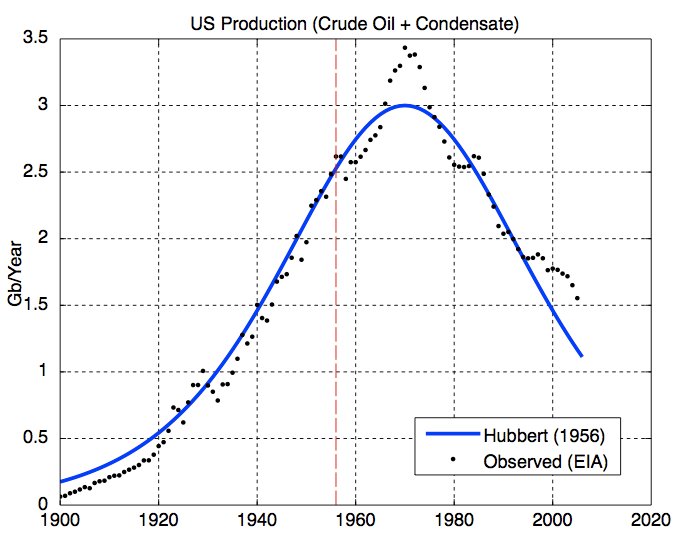

Since the "Hubbert Peak," USA oil production is down to less than 40% of the top years. We have not run out of oil, but the oil that is easy to find and cheap to produce is long gone. We mostly made up the shortfall in demand by importing oil from other parts of the world. But remaining domestic oil exploitation and production pushed into more remote, more difficult, more expensive, and more risky areas.
Few people realize that the Deepwater Horizon blow out occurred at one of over 3,800 wells drilled in the Gulf in the last 30 years. Collectively, these wells provide about one-third of USA domestic oil production.
In our addiction to oil, we tolerate enormous risks. As events sadly show on the Gulf Coast, we do not have technology to deal with massive oil spills after they happen. We recovered Only 8% of the oil spilled from the Exxon Valdez, in conditions much more favorable than the Gulf. We are dealing with the current disaster with essentially the same inadequate tools, and much more challenging conditions of geography, water temperature, and weather.
Mounting evidence shows that in its rush to get a well into production a little sooner, BP took too many short-cuts in prevention technology and procedure. They bypassed or curtailed standard inspections and tests on the blow out preventer (BOP), and possibly used one not sufficient for its challenging environment. This much we know even before formal investigation results.
Society's addiction to oil pushed BP into alien, dangerous territory. Perhaps it also pushed them into taking risks they knew, or should have known, to be fool-hardy. But that is the consequence and face of Peak Oil.
The USA is now almost 40 years past its Hubbert Peak. Unfortunately, the Hubbert Peak for the entire world just happened.
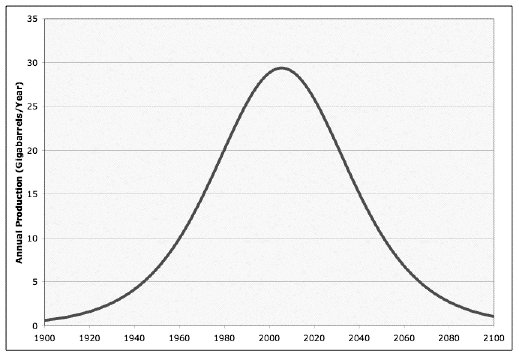
Soon the world will follow the USA in pushing oil exploration and production into areas of higher and higher risk. Without more care, Deepwater Horizon disasters will occur more frequently around the globe.
The USA can import oil from the rest of the world. But the world, as a practical matter, can't import oil from beyond Earth. Yes, it's out there, on Titan, in quantities that would make a BP CEO or a Saudi sheik ... well, pick your own metaphor. But only at a cost that, gram for gram, would exceed the price people pay for diamonds. By the way, diamonds, which consist of pure carbon, can burn.
There is a silver lining to the foul cloud of oil forming under the Gulf of Mexico and lapping at our beautiful, precious, and fragile shores. World Peak Oil means that oil prices are headed inevitably upward - even without delays and new restrictions on drilling in the Gulf that seem more likely as political fallout from the Deepwater Horizon blow out.
Alternate energy sources perform competitively against oil at $60 to $100 per barrel. We saw oil prices spike at over $140 per barrel in 2007, then sink as the world-wide mega-recession (mini-depression?) set in, moderating demand for energy. Economic recovery will drive more demand for energy, which will drive higher prices, which in turn will drive a massive shift in investment from black energy to green energy. It's a lot cheaper to invest in technologies like wind, solar, and biofuel that are proven on Earth than to pursue the sirens of Titan.
Building 100's of new nuclear power plants would improve the economy, reduce or eliminate dependence on foreign oil, create jobs, reduce pollution, and provide for future technological advancement.
I have been working with nuclear power for about 30 years. My family and I live in a home within 10 miles of a nuclear power plant. (where I work) I have a great understanding of the risks involved and am completely comfortable with a plant "in my backyard". I have confidence that our kids will be smart enough to treat the nuclear "waste" as a valuable resource or at least handle it safely. If the cavemen thought their children would be too stupid to use fire safely, where would we be now?
Using Chernobyl as a reason not to build is like saying because of the Hindenburg I will never fly in a commercial airliner.
Nuclear power has the smallest environmental impact of any current energy production method per unit of energy produced. One fuel pellet about the size of a pencil eraser produces the same energy as about 1 ton of coal, if reprocessed most of whatâs left can be reclaimed. Nuclear power is our best option for reliable, environmentally friendly base-load electrical power.
For these reasons, and others I describe in a prior post, I am pessimistic about the ability of new nuclear reactors to contribute very much or very soon to our clean energy picture. http://www.huffingtonpost.com/dr-philip-neches/back-to-school-on-nuclear_b_465234.html
Personally, I rather see government resources going to support research and development on some key points that would make nuclear power more attractive: thorium (more abundant, not a proliferation risk), standard designs that can be built in smaller increments, and basic material science for reactors. I think the public would get much more benefit form this kind of program than from subsidizing a handful of new plants with otherwise impossible business cases.
Nuclear is our best option, the fact that it takes time to build is only more reason to start building as soon as possible.
Press Release http://www.iea.org/Textbase/press/pressdetail.asp?PRESS_REL_ID=275
The prospect of accelerating declines in production at individual oilfields is adding to these uncertainties. The findings of an unprecedented field-by-field analysis of the historical production trends of 800 oilfields indicate that decline rates are likely to rise significantly in the long term, from an average of 6.7% today to 8.6% in 2030. "Despite all the attention that is given to demand growth, decline rates are actually a far more important determinant of investment needs. Even if oil demand was to remain flat to 2030, 45 mb/d of gross capacity - roughly four times the current capacity of Saudi Arabia - would need to be built by 2030 just to offset the effect of oilfield decline", Mr. Tanaka added
That means the equivalent of a new Saudi Arabia must come online every 5 years just to offset declines and stay at current capacity.
National Geographic
http://ngm.nationalgeographic.com/print/2009/03/energy-challenge/mckibben-text
"In NoÂvemÂber 2008 the International Energy Agency estimated that production from the world's mature oil fields was declining 6.7 percent a year, a rate that is expected to get even worse over time. Offsetting this decline will require finding a new Kuwait's worth of output every year, or somehow squeezing that much more from existing fields."
You have less than 20 years to prevent a collapse from happening (and I'm being generous with that many years) unless you can figure out a way to transport energy from plant to transport (i.e. autos, truck, farm tractors) through some other means ( I don't know quantum tunneling maybe) there is no stopping a collapse from happening.
And even if that new energy means were to happen you still need petroleum for all the other stuff that's made from oil, everything from asphalt, to plastics, to shampoo, to toothpaste, and even aspirin.
Partial list of products made from petroleum: http://www.ranken-energy.com/Products%20from%20Petroleum.htm
BTW we use petroleum to make white paint for our houses that would reflect sunlight back out to space.
http://www.fas.org/man/eprint/joe2010.pdf
âA severe energy crunch is inevitable without a massive expansion of production and refining capacity. While it is difficult to predict precisely what economic, political, and strategic effects such a shortfall might produce, it surely would reduce the prospects for growth in both the developing and developed worlds. Such an economic slowdown would exacerbate other unresolved tensions, push fragile and failing states further down the path toward collapse, and perhaps have serious economic impact on both China and India. At best, it would lead to periods of harsh economic adjustment. To what extent conservation measures, investments in alternative energy production, and efforts to expand petroleum production from tar sands and shale would mitigate such a period of adjustment is difficult to predict. One should not forget that the Great Depression spawned a number of totalitarian regimes that sought economic prosperity for their nations by ruthless conquest...By 2012, surplus oil production capacity could entirely disappear, and as early as 2015, the shortfall in output could reach nearly 10 million barrels per dayâ
Since the US auto fleet requires 10 m/bbl of oil per day to supply its gasoline needs, A shortfall of 10 million by 2015 would be like having every filling station in the US going dry. From the East to the West coasts no more traffic...anywhere.
At 85,000,000 42-gallon barrels you could fill enough 55-gallon steel drums laid on end to encircle the earth 1 1/2 times each day or 540 times each year. Here's the math:
* 42 gallons equals one oil barrel
* A 55 gallon steel drum is 3 feet tall by 22 inches wide
* A mile is 5,280 feet
* The circumference of the earth is 24,901 miles
* Speed of sound 768 mph
(85,000,000bbl x 42gal) / 55gal = 64,909,090 fifty-five gallon steel drums
(64,9090,090 x 3ft) / 5280ft = 36,880 miles long
36,880 / 24,901 = 1.48 or a pipeline stretching 1 1/2 times around the earth every day!
(36,880 x 365days) / 24,901miles = 540 times
(36,880 / 24hr) / 768mph = Mach 2 or twice the speed of sound the oil would need to flow - NYC to LA 1hr 35min at that pump speed.
What's going to replace this?
However, a hurricane releases 50 terawatts of energy. The sun gives our planet some 174,000 terawatts.
There is plenty of energy out there. It is just in other forms than oil.
Humanity learned to harness more energy than the 100 watts we develop in our bodies from the food we eat. First by domesticating animals. Then by burning wood. Then coal. Then oil. If we think we can't learn anything new, then we're doomed to a poorer life. I, for one, believe humanity is still learning. By necessity.
And here's the problem: all that energy is dispersed through entropy. Nature concentrated energy in the form of coal, petroleum, hydro and nuclear for us.
I haven't checked this math but this came from the CEO of Titan. You can listen to the interview here at around 23 minutes; the first part might interest you too, it's w/ Matt Simmons plan to use wind to make NH3 for auto fuel: http://www.netcastdaily.com/broadcast/fsn2009-1121-3a.ram. Anyway, the CEO of Titan said that 10 average sized gasoline stations sells enough energy in one year to equal an 800 sq/mile solar panel. That's how much nature concentrated energy into petroleum. Prof Rich Smalley had this to say: There isn't enough money in the world to build the solar panels he envisioned: http://video.google.com/videoplay?docid=-4626573768558163231#
As the cost of oil increases the cost to maintain those highways will also increase...which means cities, counties, and states will be under pressure to increase taxes just to maintain their roads.
How 'bout using concrete instead? In processing, cement is heated to 2800 degrees using fossil fuels. At 600 degrees less the lave flowing from Kilauea volcano is 2200 degrees...just to put that into perspective.
Making roads white (with concrete, instead of asphalt) and rooftops white (with paint) would reflect sunlight. The air above the road or the roof would not be heated as much. This is not a panacea for global warming, but is a simple step property owners and society could take to reduce their energy bills. Not very high tech, but effective. And your house would be more comfortable.
OTOH if the 50-200yrs is correct, assuming "burn rate" is constant for both fossil or bio fuel, then instead of depleting fossil reserves we would to be depleting the earth's biomass reserves, i.e. depleting the overall bio-carbon sinks....and that would mean "green" biofuels aren't truly green.
You can argue that the living thing that became the oil we drill today took CO2 out of the air when it was alive. But, that was more than the 50-200 years it takes for CO2 to re-balance. On the other hand, biofuels would be made and used within the same year. Thus, biofuel should not impact the carbon balance, where burning fossil fuel does.
And since CO2 is supposed to say in the atmosphere 50-200 years, and not get recycled annually, transitioning to biomass does NOT solve the CO2 issue. So its logical to conclude then that using biomass at the same burn rate would have to deplete the OVERALL global biomass.
Vegetables. Organic. Fresh. Local. No more steak, boys and girls.
Local. Local. Local. Local.
Local. The answer to the whole problem.
BZ.
http://www.youtube.com/watch?v=hHmXhgBhtWk
MrEnergyCzar
Technology has become a house of cards. Putting one more card on is not the answer.
Until we cut consumption, this kind of environmental risk will only go up.
And it doesn't matter if we pass laws against drilling on our land or shores, the oil will still be drilled somewhere on the planet, and the risks transferred to other lands/shores (see Nigeria).
The irony is we are going to have to drastically cut our consumption anyway, as cheap oil become a distant memory.
Jevons Paradox applies.