EDITION: U.S.
 
CONNECT    

Dr. Stefan Waydenfeld

GET UPDATES FROM Dr. Stefan Waydenfeld
 

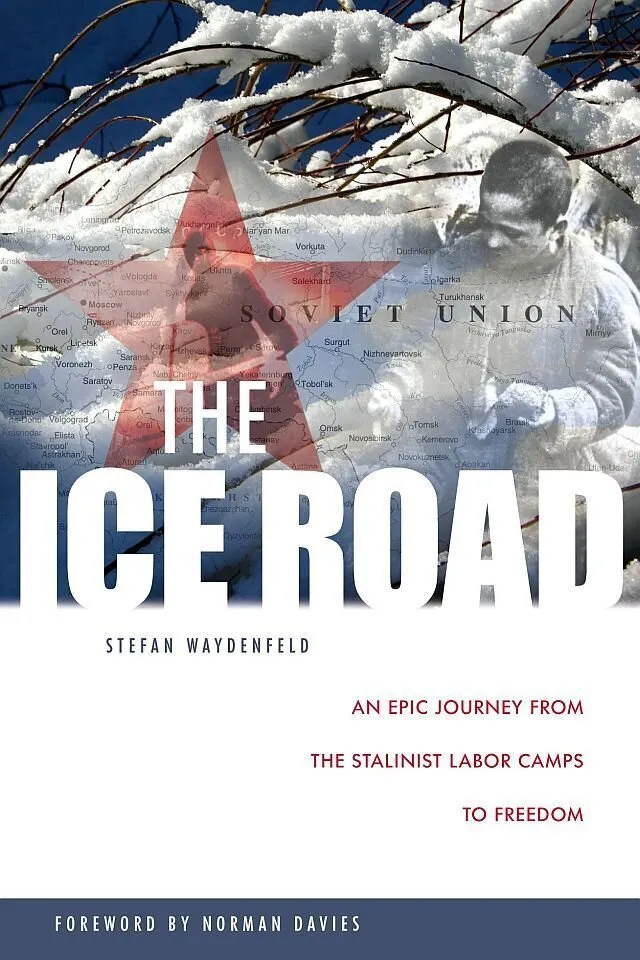
'The Ice Road': My Life In A Siberian Labor Camp

Posted: 3/15/10

"A thrilling adventure, all the more remarkable for being true."
--Norman Davies, foreword to "The Ice Road"

A few days after I turned fifteen, I found myself crammed into a cattle car with dozens of other people, lying on a long shelf. Luckily, I had a slit of a window. I kept thinking, soon I will be out of Soviet-controlled eastern Poland, on my way home near Warsaw -- though it might be a different home living under the Nazi occupation.

Dawn was coming, I couldn't sleep -- something was wrong. And then it hit me. The sun was rising on the wrong side. The train veered slightly to the left and I saw the reddish gold disk just over the horizon. I tried to think straight. On the map the railway line was perfectly straight. It went west to Warsaw and then Berlin, or east to Moscow. We were supposed to be going west.

Days later, the doors opened on Siberia, our worst fear.

We deportees, including old people and babies, were herded outside a log hut. A colonel raised his right arm, silence fell. He spoke calmly; the settlement was called Kvasha and we would spend the rest of our lives here. "You will live by the basic tenet of socialism: He who does not work, does not eat."

Later, Father told me: "Mother was assigned to a forest brigade. I could not allow it. I am sorry, but it means that you will have to go to work in her place. On this condition they agreed to leave Mother alone. Because of your age you will work only a six-hour day. I am sorry...I am sorry," Father kept repeating, visibly upset.

"Never mind," I said. "Honestly, Father, I am glad that you did it. I was wondering what I would do here all day. Really, I don't mind the slightest bit." Mother had tears in her eyes. She hugged me and I was embarrassed, but not too much. I felt grown up and, suddenly, it was all right to be hugged by my mother, even in public.

My life was hard labor in a Siberian logging camp, working all year round, maintaining an ice road for the transport of timber in subzero temperatures. Why? I had done no crime. I watched my father's health deteriorate and my mother quickly grow old. The Soviets told us we were "enemies of the people," here to be re-educated, but we were just individuals trapped by the vicissitudes of war. Nowadays refugee camps in Africa, Bosnia, Afghanistan, are full of people like us, hostages to history.

After the Nazi invasion of Poland, one and a half million Poles were arrested by Stalin who, having signed a pact with Hitler, annexed half of Poland in 1939. He kept it after the war ended, with the tacit approval of our allies Britain and the U.S. At the end of the war, though I eventually fought for a free Europe, I had no country to return to.

There are families who lose everything in the catastrophe we call history. I was sure I had lost my future. With no hope of school, my dream to become a doctor, like my father, was a memory -- just like my idyllic childhood in our villa near Warsaw. I was too tired to think of anything but a way to survive.

I became a bystander, a person who had lost one world and not yet found another. These stories have to be told, no matter how long it takes. I finally wrote "The Ice Road" for my American grandsons so they would know what happened.

I also wrote it because the history of WWII in Europe has become that of the West -- yet the role of Poland, the first of the Western Allies to fight Hitler, remains in the shadows. Most people, including even some Poles, have never heard this story. And it should be remembered, that this war was not just some glorious enterprise of good fighting evil. It was not as clean as the victors would like it remembered. Stories like mine are evidence of what really happened.

After the war ended, I could not envisage going back to Poland and spending more years under a communist rule. Instead, I found a new life in Britain. And though it seemed impossible, because of my lost years, to become a physician, I did become one. I also married my wartime sweetheart Danuta, whom I had met on the shore of the Caspian Sea after escaping from Stalin's paradise. We have now been married for 61 years.

In some ways, my life seems to have been an accident -- of fate or providence, whatever you call it. There were coincidences that kept our family together when others were separated and when so many -- more than half of the Poles deported by Stalin -- died. And the most absurd irony is that had that train returned to Nazi-occupied Poland, we would most likely have died in concentration camps.

Siberia made me grow up fast, and that wasn't all bad. Life was a great adventure! I was proud that at fifteen I was doing a man's work. I found a first love and enjoyed wild bareback rides in the forest. But the most important thing I gained from my travels -- escaping Siberia on a self-made raft, life in Soviet Central Asia, crossing Kazakhstan's mountains, the Caspian Sea, reaching a Persian beach -- was the knowledge that one could achieve anything with determination and an ounce of luck.

If you are suddenly caught in a whirlwind you need to mobilize all your skills. And, never knowing what crises might arise, I also learned the habit of lateral thinking, which helped me to solve problems quickly. But these are consolation prizes for the fortunate, for those who survived.

Individuals get caught in conflicts not of their making. Their stories must be told -- though it may be too much to hope that in the future nations will pause before repeating the errors of history...

 
"A thrilling adventure, all the more remarkable for being true." --Norman Davies, foreword to "The Ice Road" A few days after I turned fifteen, I found myself crammed into a cattle car with doze...
 
  • Comments
  • 14
  • Pending Comments
  • 0
  • View FAQ
Comments are closed for this entry
View All
Recency  | 
Popularity
01:50 AM on 03/16/2010
"Individua­ls get caught in conflicts not of their making. Their stories must be told -- though it may be too much to hope that in the future nations will pause before repeating the errors of history...­"

I fear the "errors of history" are not errors at all but simply the naturalnes­s of life at the top of the food chain. We have only to look at the fences around our own homes, the domestic violence, even the way we play - sports - pitting human against human - to see that conflict caused by territoria­l instinct, survival and the natural competitio­n stemming from the need to survive and protect that territory we are able to lay hands on by nook or by crook is natural to our species. Sadly, we are what we are. A war may be "not of our own making" as an individual­, however, we all share that genetic sameness that will fight rather than take flight for the sake of survival. Perhaps we will evolve to become less aggressive in the next million years or two.

Perhaps it will help to tell these stories. Who can say. But thank you for telling yours Dr. Weydenfeld­. I will purchase your book for my father.
12:31 AM on 03/16/2010
The great redistribu­tion of WWII rests in my own family history. My father spent five years of the war in Magnitogor­sk Siberia after being captured as a Hungarian foot soldier. He was not transporte­d there by rail but had to march there with his company, many did not make it but died of dehydratio­n and starvation on the way. They held each other up walking with arms interlinke­d so some could sleep as they marched, they took turns that way. If a soldier fell he was immediatel­y shot. When the war was over father was kept working for another year before released to walk home. When he got home with the remaining boys from his town they found their family farms had been occupied by others who had been distribute­d the land under the new communist system. No home to remain in father kept walking into Germany where he eventually found his surviving parents and brothers, reunited with my mother who had grown up in the same Hungarian town, married and began the task of emigrating to the USA. Why?
12:39 AM on 03/16/2010
Here is why.
USA rations had kept father alive in Siberia and to father that meant the USA must be rich and a strong healthy country with the right kind of government­. Eventually almost all the families of that small Hungarian farming community ended up in a Midwestern town. Because USA rations had kept father alive in Siberia and to father that meant the USA must be a rich and a strong healthy country with the right kind of government­. Eventually almost all the families of that small Hungarian farming community ended up in a Midwestern town. Mother's story was even more harrowing as she was smuggled across borders to escape. Father is 88 now and lives with me. I showed him his old family farm on Google Earth and we traced the march to Magnitogor­sk and back. Grandfathe­r's red tile roof house and barn is still standing but nothing else has changed in that small Hungarian farm town. The road, only one, is still unpaved. Father shook his head in unbelief.
04:36 PM on 04/07/2010
I am relaying Stefan Waydenfeld­'s reply.

Thank you for your warm response to my blog. You are right that THE ICE ROAD is only one of millions of unknown stories of Eastern Europe in WWII. Your father's tale of Hungary, including the ending, where his farm remains the same, is very interestin­g to me. Nothing has changed there but your father's world was very different. That he lived and made it to the United States is probably a small miracle. I hope you enjoy my book. I wrote it as an adult, but didn't forget what it was like for the boy I was.
06:01 PM on 03/15/2010
And don't forget the American Victor Herman who spent 10 years in the gulag and more in exile living in an ice chop out with his Russian wife and daughter Svetlana. Coming Out of the Ice is his book. It took him 45 years to get home. It only took Ulysses 20. Henry Ford sent his family over in the 30's to start an auto and truck plant. Victor was the only one who lived and returned. Ford never paid him what it had promised. Victor was trying to get The Grey People out when he died in Michigan having gotten his wife and two daughters out to be with him. The Grey People were Americans who had gone at Ford's instigatio­n and who were left there to perish or survive. The US never did anything to help them. They were captives in worse conditions than Jaycee Dugard.
04:35 PM on 04/07/2010
Again, I am replying for Stefan.

That is an amazing story, I knew nothing about Victor Herman and that Ford had a plant in Siberia. Perhaps that is a book I will read. I appreciate your response.
04:18 PM on 03/15/2010
you, sir, are an inspiratio­n. thank you for sharing your story.
04:35 PM on 04/07/2010
I am replying for Dr. Waydenfeld­.

Thanks for writing to me.
01:47 PM on 03/15/2010
Sound like a fantastic book.
04:35 PM on 04/07/2010
I am replying for Dr. Waydenfeld­.

I hope that you like it.
photo
HUFFPOST SUPER USER
CynicalDog
12:33 PM on 03/15/2010
I just finished reading, "The Long Walk", by Slavomir Rawicz, which was also about a Polish national who ended up in one of Stalin's Siberian labour camps. I enjoyed it very much (and learned a lot), so I'll be sure to read your book as well. Thank you for writing it!
06:35 PM on 03/15/2010
I too just finished "The Long Walk" a couple of weeks ago. Great read!
04:33 PM on 04/07/2010
I am commenting for Dr. Waydenfeld­.


I am not familiar with "The Long Walk," but perhaps should become acquainted with it. These stories are finally being read. It is about time.
04:35 PM on 04/07/2010
I am replying for Dr. Waydenfeld­.

That's great that you have interest in these stories. I am glad that you will also read my book.