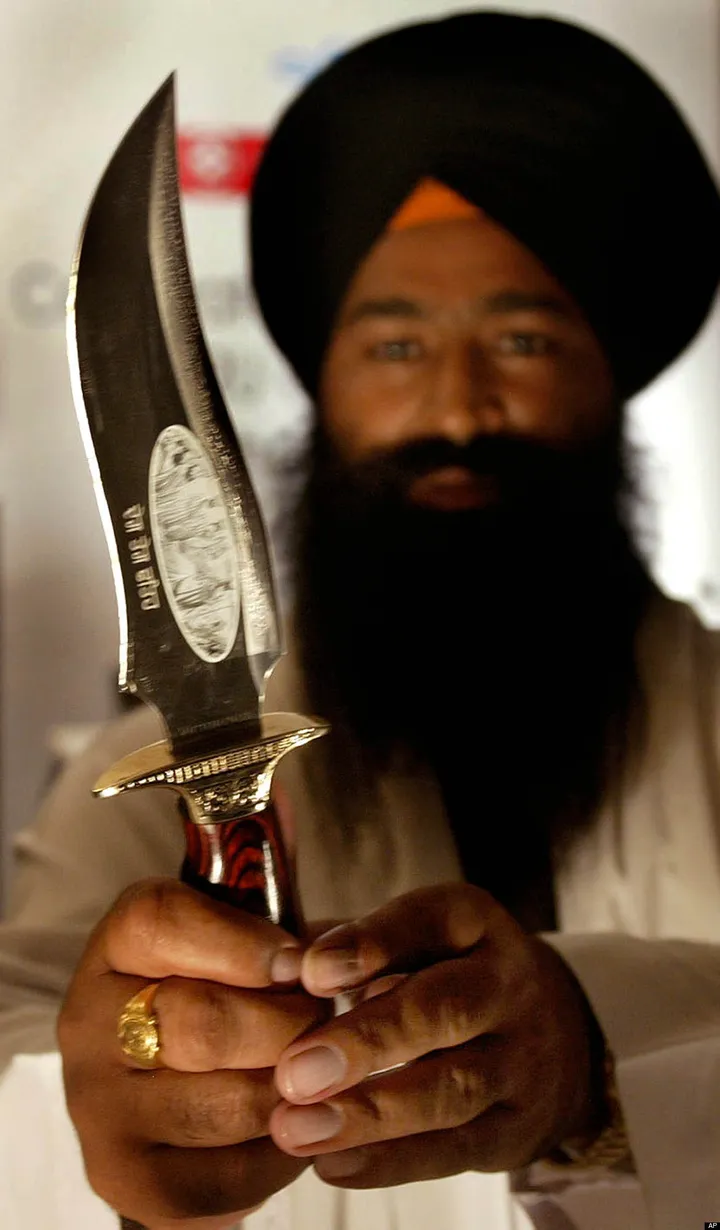
On Jan. 18, four representatives of the World Sikh Organization of Canada were refused entry into the Quebec National Assembly because they were wearing the kirpan -- a religious requirement of the Sikh Faith for those formally initiated. The Sikhs had gone there to testify before the Committee on Institutions in favor of religious accommodation for veiled Muslim women in Quebec, Canada.
Interestingly, the Sikh Faith prohibits the use of face-covering veils by Sikh women. The Canadian Sikhs had gone there to stand up for the right of Muslims to practice their faith, taking inspiration from the Ninth Sikh Guru, Siri Guru Tegh Bahaadar Sahib, who gave up his life in 1675 to protect the practices of the Hindu faith even though he disagreed with these practices of a faith different from his own. While working to promote inclusion in an interfaith spirit, these Canadian Sikhs were themselves excluded because of their faith.
This incident flooded me with several "sweet and sour" memories dealing with the kirpan issue in the U.S. I fondly recollect being invited to an interreligious consultation at the White House in early October 2010 along with approximately 50 other religious representatives, U.S. government officials and private sector representatives for "A Multi-Stakeholder Roundtable to Advance Multi-religious Cooperation for Peace, Development, and Shared Security." I was invited to the meeting in a religious capacity as a representative of the World Sikh Council -- America Region (WSC-AR) and as moderator of the U.S. chapter of Religions for Peace. Initially, White House officials informed me that my kirpan would need to be deposited at the security desk. WSC-AR in response re-affirmed that according to the Sikh Rehit Maryada (Principles of Sikh Living), the kirpan (worn in a Gaatra or sash across the chest) is a religious requirement for a formally initiated Sikh. It was further emphasized that this applied to, but is not limited to, presence at any event in a religious capacity. WSC-AR's insistence of its religious representative bearing the kirpan at the meeting was ultimately accommodated at the White House gathering after inspection by the Secret Service.
I later learned that this was the first time in recent history that a formally initiated Sikh was able to attend a meeting with U.S. government officials at the White House bearing the religious requirement of the kirpan. But my optimism was rather tempered because I was keenly aware of the "sour grapes" of the past including:
- A 2004 incident in which the then Chairperson of WSC-AR was forced to decline an invitation to the White House when he was asked by staffers to remove his kirpan and hence compromise the practice of his faith as a pre-condition to attend a religious gathering, which was, ironically, organized to honor the Sikh Faith!
- Representatives of the Sikh Federation (UK) refused to enter the European Union Parliament in Brussels, Belgium in 2006 when asked to first remove their kirpans.
- In 2008, WSC-AR representatives (including me) were unable to meet with Pope Benedict for an interreligious meeting when the U.S. Secret Service again refused to accommodate the Sikh requirement of the kirpan.
Just as we don't refer to the "menorah" as the Jewish "candle stand," I would urge that the kirpan not be called the Sikh "dagger" but instead what it is -- the kirpan. And that's the religious terminology I use here.
The word kirpan comes from Persian and literally means "bringer of mercy." It represents the Sikh commitment to resist oppression and injustice, but only in a defensive posture and never to initiate confrontation. The Sikh Rehit Maryada (Principles of Sikh Living) declares that "no limit can be placed on the length of a kirpan." Hence the length of Kirpaan varies from a few inches to a few feet (as in case of a dagger or sword). It is not a symbol but an article of the Sikh Faith.
In 1699, the Tenth Sikh Guru, Siri Guru Gobind Singh Sahib, introduced the formal initiation ceremony. Sikhs formally initiated are referred to as the Khalsa (Guru's own) and are required to bear the five K's irrespective of gender. These include Kes (uncut hair), Kachch (special type of shorts), Kara (an iron bangle), Kangha (a small wooden comb) and the kirpaan. Sikhs formally-initiated into the faith, who are committed to follow the guidance of Siri Guru Granth Sahib (the Sikh Scripture) and practice the way of life laid down in the Sikh Rehit Maryada, are collectively known as the Guru Panth. The Guru Panth was invested with guruship by the Tenth Guru (along with the Sikh scripture as Siri Guru Granth Sahib) and is the ultimate authority in all matters affecting the faith. Sikhs who choose not to undergo formal initiation are not required to keep the five K's and are not considered to be a part of the Guru Panth.
The Sikh Rehit Maryada prescribes that the kirpan must be worn in a Gaatra (sash across the chest). This personal kirpan (commonly varying with a blade length of a few inches to nine inches) is placed inside a metal/wooden sheath that hangs from the left waist at one end of the Gaatra while the other end of the Gaatra is slung over the right shoulder. Sikhs in western countries most commonly wear the kirpan in Gaatra under their shirt although some wear it over the shirt. The Sikh Rehit Maryada prescribes the ceremonial use of the kirpan during the formal initiation ceremony, marriage ceremony and for touching karah parshaad (sweet mixture/pudding) that is distributed towards the end of Sikh ceremonies and prayer meetings.
Some commonly asked questions (and my suggested responses) with regard to the Kirpan are below:
1. Is the kirpan a weapon? The kirpan is an article of the Sikh Faith required to be worn by formally initiated Sikhs. Like other non-religious items such as a pair of scissors, broken glass bottle, pointed pens and mechanical pencils, sharp dinner knives and forks, and even one's fist, it can also be used as weapon.
2. Sikhs take off the Kirpan during air travel so what's the harm in taking it off when Sikhs attend meetings where security is required? Many Sikhs prefer not to fly due to this reason. When a Sikh goes to the airport, it is not as a Sikh representative. Any gathering a formally initiated Sikh is attending in a religious capacity or as a Sikh representative requires wearing of the kirpan in Gaatra. Compliance with current air travel rules does not imply concurrence by the Sikh community.
3. What if someone misuses the Kirpaan when attending events with security? Most events and gatherings with public officials requiring security generally require attendees to undergo a security clearance in advance. If someone misuses the kirpan, they can be ordered to appear before Panj Piyaaras (any five formally initiated Sikhs in the presence of Siri Guru Granth Sahib, the Sikh scripture) for explanation and disciplinary action. Misuse of the kirpan by a Sikh provides grounds for criminal prosecution by civil authorities.
4. How about wearing the kirpan as a pendant in a necklace or a photo of it? The kirpan is an article of the Sikh Faith. It is not a symbol. Sikh Rehit Maryada requires that it be worn in a Gaatra (sash worn across the chest) and that no limit can be placed on the length of a kirpan.
5. Can't the blade be glued into or nailed through the sheath so it cannot be removed? This is not possible since the functionality of the kirpan will be compromised. It will then no more be an article of faith but become a symbol. Such an unauthorized adaptation is not permitted.
6. How about following the spirit of the law rather than the letter of the law? Only 10 percent to 15 percent of all Sikhs are formally initiated. Few formally initiated Sikhs will take off the kirpan for attending a meeting or gathering in a religious capacity. Those who remove the kirpan in Gaatra when attending a gathering in a religious capacity are compromising the articles of the Sikh Faith. They risk being called before the Panj Piyaaras to provide explanation and directed to correct the infringement with or without penance.
7. What if event security does not permit Sikhs with kirpan? Sikhs are not to attend events in a religious capacity at which the kirpan in Gaatra is not permitted. Sharing in advance with event security about the Kirpaan and making it available for inspection for security agents at the event is recommended.
8. Why don't formally initiated Sikhs refrain from attending religious gatherings with security and let those Sikhs not formally initiated attend? Where the Sikh articles of faith are not respected, it is advisable that a Sikh (whether formally initiated or not) refrain from attending.
With more than a century of Sikh presence in much of Europe and North America, the Sikh community is now being increasingly woven into the fabric of western nations. Sikhs are willing to be culturally assimilated into our new homelands but it seems will only religiously accommodate into our pluralistic societies we call home sweet home!