
Over 30 years have passed since the OPEC oil embargo of the 1970s led to a severe recession and warned Americans just how vulnerable our economic and national security are because of our dangerous dependence on foreign oil. Yet over three decades later, we still have no coherent energy policy -- and in fact, the United States has tripled its dependence on Middle Eastern oil in the interim.
Over two decades have passed since Americans began to hear that burning fossil fuels and pouring their byproducts into the air was producing changes in the earth's atmosphere and the face of the globe that, if allowed to continue, could have calamitous effects not just on some exotic species in Fiji but on the exotic species we call Homo sapiens. Yet in the meantime, Homo has not been so sapiens, at least in the United States. Scientists have just reported that the problem has accelerated past their worst-case predictions, particularly since China has become America's rival in carbon emissions from coal-powered plants. Yet in the intervening decades we have done nothing -- other than to spear the Kyoto Treaty we took the lead it writing -- while other countries have tried to move forward as best they could without American leadership (or at least participation).
So what explains a discrepancy of this magnitude over decades between the considered judgments of the reality-based community and public policy? Clearly many factors are involved, and we will not endeavor to list them all. One, of course, has been the campaign of disinformation by the energy industry, such as BP's superbly crafted "BP -- Beyond Petroleum" ads, replete with windmills and inspirational music, which don't quite advertise the fact that the company's actual diversification doesn't extend much beyond regular gas to premium unleaded. Then, of course, is the coal industry's multi-million dollar campaign to sell "Clean Coal -- America's Power." (If you believe that one, we have some clean pigs looking for a home -- preferably in your backyard, not ours.)
But there's another reason for the discrepancy between scientific knowledge and the level of public urgency it takes to make reform not only the right thing to do but the politically smart thing to do, especially for legislators from conservative or swing states and districts where skepticism runs as high as unemployment: We haven't been talking with the American people in their own language.
Instead, too often, as with so many issues about which progressives are passionate, we tend to speak to voters in our language -- the language of parts per million, carbon emissions, carbon sequestration, and the like -- and expect them to make the translation. We would do well to make that translation ourselves. If we can't convince the public to share our concern about what is, and our enthusiasm for what could be, perhaps it's our fault, not theirs.
The point is not to "dumb down" our messages. It's to increase their emotional intelligence.
As on so many progressive issues, we rely on science to develop the best public policy, but we too often then rely on intuition -- usually borne of what we find persuasive in talking with each other (i.e. with people who already agree with us) -- in trying to garner public support for that policy. We should be using science not only to develop our policies but to increase the likelihood that they will be enacted.
The best scientific evidence suggests that the best way to win public support for comprehensive energy and climate reform is not by presenting the public with the best scientific evidence. It is to talk with Americans in plain, emotionally compelling language that speaks to their values and concerns.
Over the last several months, we conducted an extensive research project with over 2000 voters designed to bring the language of energy and climate reform from the think tank to the kitchen table. Over the course of three phases of the research, we developed, tested, and refined messages so that they spoke to the American people about these issues in ways that address their values, concerns, and aspirations.
What we found is that when we talk in plain, values-oriented language, we solidly move people, motivate them to action, and beat the industry's well-crafted messages by 20-40 points. What resonates with people are not specific fuel standards or the mechanics of how a cap and trade system would work or the precise tonnage of carbon emissions per year. What moves them is a set of themes that bring the issue home to them: economic prosperity and jobs; energy independence and self-sufficiency; clean, safe, natural sources of energy that will never run out; getting pollution under control and making polluters pay for their own messes so we protect our health and the health of our children, preserve the majesty of our land, and reverse the deterioration of our atmosphere; harnessing American ingenuity and restoring American leadership; and protecting our legacy to our children the way our parents and grandparents protected their legacy to us.
And we learned that one striking fact that gets people to sit up and take notice -- for example, that the 10 hottest years on record have all occurred since 1990 -- is worth a thousand policy descriptions. In fact, more often than not, the second fact we offered in a message actually reduced the impact of the first.
The research is rooted in contemporary neuroscience and in both a scientific and clinical understanding of what psychologists and neuroscientists call networks of associations. Networks of association are interconnected sets of thoughts, feelings, images, metaphors, and emotions that are unconsciously active in people's minds and brains at any given moment (e.g., as they read, watch, or listen to messages on both sides about energy or climate change). Consider one very important example: Every time we used the term "global warming" in a message, we "lost" men and moderate Republican voters who were otherwise willing to hear us out. Why?
First, global warming is such an abstract concept that it's hard for most people to get worked up about it unless they're activists (like "universal health care," "reproductive health," and so many words in the progressive lexicon).
Second, "warming" accurately reflects a long-term trend observed by scientists, but it is the wrong word to include for nonscientists in a phrase intended to denote something destructive, because its connotations (the thoughts, images, metaphors, and emotions associated with it and hence unconsciously activated by it) are largely positive. "Warmth" is associatively linked to getting in from the cold, to hearth and home, to comfortable feelings, mom and apple pie -- and, for that matter, to stepping into the ocean on Memorial Day weekend and being pleasantly surprised rather than unpleasantly chilled.
Third, the term itself connotes linear increases in temperature that people expect should be observable to them. As a result, to many Americans, "global warming" is disconfirmed every time there's a cold spell. For example, a few weeks ago, during an unseasonably cool spell on the Gulf Coast of Florida, one of us overheard one man say to another, mockingly, "So I wonder what Al Gore would say about this, huh?"
We can, of course decry his ignorance. Alternatively, we can prevent this kind of misconception -- and its attendant emotion, which becomes hardened against any facts we try to throw at it -- by choosing our words wisely, taking into account the way our minds and brains naturally work. It's hard enough to beat an energy industry with billions to spend on advertising. There is no reason to add the brain to our list of political adversaries.
But it's not just individual words or phrases that matter. It's the narratives in which those phrases are embedded. We aren't talking about hypothetical ways of framing the discussion that should, theoretically, move voters. We're talking about narratives that empirically do move voters, particularly the "swing" voters who didn't start out quite sure whether they favored the industry's disingenuous message of "all of the above" or a new way forward to clean, safe forms of energy -- or who weren't quite sure they believed in climate change. In fact, those narratives made such a strong difference that by the end of a 20-minute online survey in which voters heard both our narratives and strong counter-narratives from the other side, voters shifted by 24 points on whether dealing with our changing climate and weather patterns should be a high or very high priority, from an initially small majority of 55% to a strong majority of 79%. That's change we can believe in. And it included Democrats, Republicans, and Independents.
As in other recent polls, we found that when we use resonant language and imagery, voters are confident that comprehensive energy reform can help create a new manufacturing base so we start building things in America again. The public sees innovation and the potential for renewed prosperity in the development of new clean energy technologies. They recognize that renovating and refitting our homes and businesses to conserve energy creates jobs that can't be outsourced. They think it's time we start exporting energy, not jobs, and sending American dollars to Middle America, not the Middle East. They resonate with the idea that people who show personal responsibility and take the initiative to conserve should be rewarded with tax credits, and they believe it's time we start imposing and enforcing strict pollution limits again on corporations that pour chemicals into the air and make polluters pay if they exceed those limits. They intuitively grasp the difference between sources of energy you have to burn to turn them into power and those that can be harnessed from sources like the sun or wind without damage to our air, land, and lungs.
We began by trying to understand the complex and often contradictory networks of association that constitute public opinion across dozens of existing polls (e.g., why most voters are concerned about climate change but then rank it a low priority when given a list of potential governmental priorities). We then listened to everyday voters' concerns in focus groups, watched how a representative national sample of 1000 voters responded to specific words, phrases, and narratives, and then polled another 1000 voters with a refined set of messages. And in so doing, we learned something at once complex and remarkably simple.
When Americans make a simple distinction, captured in the network of associations illustrated below, they prefer comprehensive energy reform that addresses climate change over well crafted conservative or industry messages by roughly a 2:1 margin. (In the illustration, solid black lines suggest that one concept implies another, dotted lines suggest that one contradicts the other, blue connotes positive associations, and red connotes negative associations.)
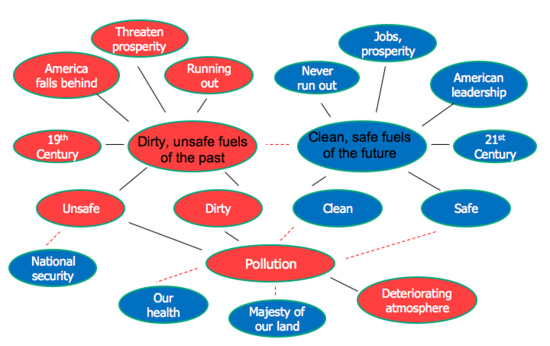
This network suggests a clear narrative: We have a choice. We can move toward the safe, clean fuels of the 21st century -- energy from the sun, the wind, and the ground (whether the geothermal energy at the core of the earth or the biofuels that actually gain us ground on energy) -- fuels that will never run out, don't have to be burned to produce energy, and will create new jobs and help us restore prosperity. Or we can continue to rely on the fossil fuels of the 19th century, which will run out, cost more and more over time to produce less and less, take jobs with them, threaten our economic and national security, and destroy the land and air as we extract and burn them -- pouring billions of tons of pollutants into the air, including those that are destroying our atmosphere and altering the delicate balance of nature. We can restore American leadership, or we can abdicate it. We can lead the first technological revolution of the 21st century the way we led the major technological revolutions of the 20th, or we can leave the task to Europe, Brazil, or China. We can confront the forms of pollution we face today, including those that are destroying our atmosphere, changing our weather patterns, and damaging our lungs -- just as our parents took on the pollution that confronted them in the 1960s and 1970s -- or we can ignore our sacred responsibilities to our children. That is our choice. It isn't a hard one.
Drew Westen, Ph.D., is Professor of Psychology and Psychiatry at Emory University, founder of Westen Strategies, and author of "The Political Brain: The Role of Emotion in Deciding the Fate of the Nation."
Celinda Lake is President and Founder of Lake Research Partners, and one of the most well-respected pollsters in the country.
This research was undertaken in collaboration and under the sponsorship and guidance of ecoAmerica and the Natural Resources Defense Council (NRDC). For a description of the complete study and results (entitled, Climate Truths: Making the Necessary Connections), contact meighen@ecoAmerica.org, or fkoe@nrdc.org.