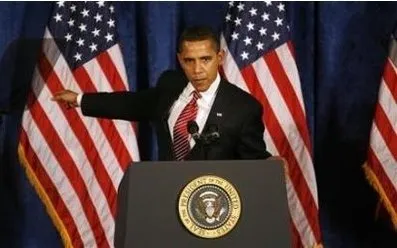
Last Tuesday afternoon, President Obama met with forty three of the forty nine Blue Dogs, an increasingly influential group of fiscally conservative Democrats, to discuss changes to the stimulus package. The big topics of discussion: fiscal responsibility, balancing the budget, and reducing government spending, an agenda with uncanny resemblance to the campaign literature distributed by Democrats in recently won -- and once thought unwinnable -- conservative Congressional districts.
The Blue Dog Coalition, formed in 1995, is primarily made up of pro-gun, pro-free trade, anti-spending Democrats from conservative districts in every region of the country. And they aren't the only game in town. The New Democrat Coalition, closely affiliated with the centrist Democratic Leadership Council, boasts almost sixty members, more than twenty percent of the entire Democratic caucus.
Thirty one Democrats became freshman Congressmen after the 2006 elections. Another twenty one did the same two years later. Winning so many seats meant competing in places where Democrats had not been seen as competitive in a generation or more. It required a confluence of events: a president without credibility, an opposing party with a mortally wounded brand, an unpopular war, a series of headline-grabbing corruption scandals, and, lest we forget, an economic collapse so serious that legitimate comparisons of Republicans to Hoover, and of the crisis to the Great Depression, are made daily in national media.
What was also required to win in such implausible districts was a centrist brand of Democrat, the kind for whom a Republican voter might give real consideration. All over the country, Democrats who railed against earmarks, who demanded a balanced budget and reduced government spending, those who had, as the central plank of their campaign, a call for fiscal conservatism, won by attracting business Republicans and Independent voters to their candidacies. In doing so, they established themselves as uniquely aligned to their constituency, but constrained by the narrow boundary on which they staked their campaign.
With such substantial congressional wins has come a swelling in the caucus on its moderate flank, an entire cast of characters who won their seats by opposing huge chunks of the party platform, by distancing themselves from rather than embracing all things Obama. Now, in light of a stimulus debate in which many Democrats worked with Republicans to cut major progressive spending, from education construction to energy efficiency and health care, they have left little doubt about their intent and potential influence.
Despite the resurgence of the progressive wing of the Democratic Party, and a modest liberalization of the voting public, the consequences of consecutive landslides might, for some, feel unintended, throwing up some of the very obstacles they were meant to break down. It is likely the case that Obama will be able to guide his agenda through Congress anyway; he has large enough margins and an impressive enough mandate to get the job done. But along the way, in committee and conference, during markup and debate, where critical funding is secured, the centrist wing of the Democratic party may well become the president's most frustrating opposition.