By Lisa Gosselin, Editorial Director, EatingWell Magazine
Do you have any idea how much of what you eat each day has been made from genetically modified organisms? Though I try to eat organic, like most Americans I’ve been consuming genetically engineered (GE) or genetically modified (GMO) foods for the past 15 years.
It’s hard not to: 70 percent of our corn farmland and 93 percent of soy farmland are planted with crops genetically engineered to resist pests and herbicides and increase crop yields. And in the next few years new science may provide genetically modified apples that don’t turn brown, rice that helps build up vitamin A, even an “Enviropig” which produces less phosphorus in its manure. Find out more about the latest news on these and more common genetically modified foods including tomatoes, canola and sugar beets.
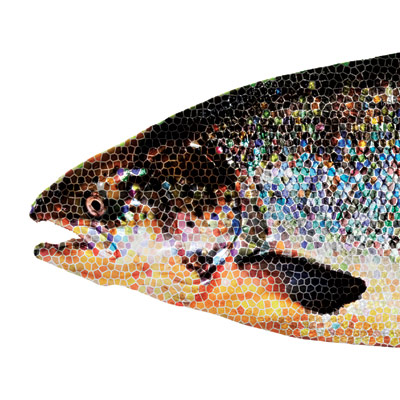
And as early as 2012, you may be able to buy a GE super salmon that grows to maturity in just two years. As John McQuaid writes in his special report, “The Future of Food,” in the March/April issue of EatingWell Magazine, “As science. this is pretty cool.”
The science geek in me is intrigued by these new foods and wants to believe they will improve the world. Theoretically, genetically modified crops will allow us to feed more people more nutritious food, using less land and fewer pesticides or herbicides.
The health freak in me is encouraged by the fact that to date there has been no widely accepted scientific link between genetically modified foods and human health problems.
And the nature lover in me is cautiously optimistic: I’d like to think that genetically modified salmon, farmed in inland pens, might alleviate pressure on depleted wild stocks from both overfishing and the diseases currently being spread by salmon farms.
But that’s assuming all goes right. And that the businesses that own the rights to these projects act responsibly, keeping the health of both humans and environment in mind, and that there’s no harm done to organic farms or traditional fishing practices. Unfortunately, that’s not always the case.
Last year a judge put a ban on planting genetically modified sugar beets, which a lawsuit brought by the Center for Food Safety and the Sierra Club claims can contaminate organic crops. That decision was reversed this past March. Now organic farmers are concerned that genetically engineered sugar beets as well as the new genetically modified alfalfa (approved, or ‘deregulated’) this past spring are going to contaminate non-genetically modified crops. And over the past few months rice farmers in five states have been reaching settlements with Bayer CropScience over an incident in 2006 when plots of Bayer’s experimental genetically modified rice contaminated their crops.
I am all for science and believe the mistakes or misconduct of some companies should not damn or disrupt all research, but they should make us pause and consider the potential long-term impacts. They should make us think more carefully about where our food comes from and how it is produced.
And consumers should have the right to know whether what they are eating has been genetically engineered or modified. At present, there are no laws requiring labeling, but there are three ways to know that your food is not genetically modified:
Buy Organic: The “USDA certified organic” label is a guarantee the food you buy was grown or made without any genetic modification to its ingredients.
Look for the Non-GMO Label: This relatively new label is gaining in popularity (it’s now on more than 900 products, including much of Whole Foods’s 365 Everyday Value brand) and comes with a certification that the product is GMO-free, but not necessarily organic.
Choose rBST- or rBGH-Free Milk: Though cows are not (yet) genetically engineered, many are being injected with a genetically engineered recombinant bovine growth hormone (rBGH) or recombinant bovine somatotropin (rBST) to boost milk production.
By Lisa Gosselin

Lisa Gosselin is the editorial director of EatingWell Media Group, publisher of the award-winning EatingWell Magazine, books such as EatingWell 500-Calorie Dinners and EatingWell in Season: The Farmers' Market Cookbook, EatingWell.com and EatingWell Custom Publishing. She lives in Vermont, near EatingWell's headquarters and Test Kitchen.
Related Links from EatingWell:
Follow EatingWell on Twitter: www.twitter.com/eatingwell
http://newhope360.com/non-gmo/10-products-ditch-genetically-modified-ingredients
play Smetana's "Moldeau" as I am eating it;
cause me to grow horns, temporarily;
moan in pleasure as I cut it and eat it;
enable me to breathe underwater;
enable me to use echolocation;
enable me to experience hibernation;
teach children how birds eat by making them gizzards;
being able to communicate with plants;
being able to experience the world as an ant does;
eat a mango that tastes like maple syrup and strawberries;
and much more :3
I don't understand the point of the slideshow, perhaps Ms. Gosselins brother is a struggling illustrator, a list would seem to have been fine.
Thanks for that.
As of spring 2011, momentum is building toward nationwide "Millions Against Monsanto" demonstrations on World Food Day, Oct. 16, 2011, demanding labeling of GMOs.
Monsanto (for example) says that to avoid GMOs, just eat organic. But crops like the new GE alfalfa threaten the integrity of the organic foodstream.
It is expedient for biotech to make promises about the future; solving world hunger is one such. It's always about tomorrow. But how about proving their case right now? My understanding is that there are not enough quality scientific studies to bolster the industry's claims of safety and so on.
Don't you think biotech ought to have to prove its case in the presence of labeling? Instead, it has sneakily seized status as the default setting* for U.S. agriculture.
* (my characterization, which I shared recently with a leading anti-GMO activist)
http://www.monsanto.no/index.php/en/environment/gmo/gmo-news/117-gmo-bt-cotton-linked-to-livestock-deaths-in-india
Do you think it is safer spraying on the "natural" bacteria that produces this toxin and many more or finding a single chemical that would safely kill the insects that were destroying all of the crops? This is why research into safety of any specific chemical or organism is required. To say that all GM is unsafe because of any incident is ridiculous. It is like saying get rid of all cars because one brand's computer malfunctioned killing people.
What do you think of organic farmers spraying Bt pesticides directly on crops which effect non-targeted insects such as butterflies? yes...organic farmers do use pesticides like Bt since it is a "natural" pesticide.. Please look it up. Oh wait....let me do it for you:
http://web.pppmb.cals.cornell.edu/resourceguide/mfs/02bacillus_thuringiensis.php
This is from Cornell Univ, that ivy league school run by Monsanto ya know....
If the silage cannot be used for food that presents yet another problem.
You are already voting against biotech with your wallet, which helps a lot, in the aggregate
But now we must gather in our numbers -- physically -- in order to help raise even broader consciousness nationwide, so that we can have the chance to make the impact that makes a difference.
The time has arrived for everyone, including moderates, to act immoderately around the issue of demanding labeling of GMOs. Momentum is building, thank goodness. It's up to each one of us to participate and recruit others.
Check out Millions Against Monsanto for date and location info. To participate, you don't have to ascribe to what other anti-GMO individuals and organizations say. Just join the protests for your own good reasons!
BTW - looked at a box of name brand crackers and they have partially hydrogenated cottonseed oil as the 6th ingredients. What?!? Seriously? Are manufacturers still taking the by-products that are not fit for human consumption and putting them in food? Isn't cotton a GMO crop? I thought that's why the FDA was started to begin with?
I too used to think I needed a PhD in molecular biology to know an "organic" apple is better for our kids than a GMO pop tart.
So, once the government agencies (FDA & USDA) combined with industry scientists and academia confirm that the world is round...I mean flat...what's the harm in labeling GMO food?
Do you know if academic scientists have to file a similar financial interest and/or ties to industry the same as MDs do when conducting clinical research?
I cannot eat soy or any msg derivative or hydrolyzed vegetable proteins. I discovered that auxigro, which contains msg, has been allowed to be sprayed on crops, even organic, as it is from a "naturally" occurring source. It does not wash off and makes the crop larger. I get sick ingesting this, and after 5 years have finally figured it out.
http://www.responsibletechnology.org/blog/1340
Here is what academia thinks of Jeffery Smith:
http://academicsreview.org/reviewed-individuals/jeffrey-smith/
BTW, have you even actually seen FOOD, Inc, which you love to vilify?
But surely there is a role for nonscientists in the debate about biotech. I am one such non-scientist. My title is "American citizen."
Bull calves from the very top-producing cows go to the large semen companies where they are in competition to become the superstars of breeding. The very few who make the grade are worth literally millions of dollars and their semen is among the most expensive liquids in the world. One dose, 0.25 ml, can sell for several hundred dollars. Those best-of-the-best cows are given hormones to cause them to release multiple eggs that are then harvested, fertilized in-vitro, and implanted into host cows in the hopes of producing more super bulls. If all this technology is not genetic modification, what is?
First, the genes being inserted into the plant or animal in question is not native to the species; in fact, in engineering herbicide resistance, it may express a protein that has never before been in the food chain.
Second, the method used is not the sort of deliberate, specific, Lego-block building that one tends to expect when the term"engineering" is used; the genes to be "inserted" in a crop are loaded into a "gene gun" and blasted into the seeds in question. These are then treated with the herbicide to be resisted, the seeds doused with that herbicide, and those few that survive are the new, resistant strain. Exactly where in the DNA the gene is located may or may not be known, I'm not sure, but it is not deliberately placed in a specific spot.
Third, the new gene is permanently "on"; constantly expressing the new protein. Signals naturally used to turn off gene expression are ignored; despite "hearing" that "there is enough of that protein; please stop", the expression continues unabated.
This is not Gregor Mendel's or Luther Burbank's hybridization; we need to be very, very careful.
Bravo!
"Theoretically, genetically modified crops will allow us to feed more people more nutritious food, using less land and fewer pesticides or herbicides." Practice is completely out of alignment with theory. In fact, the products are not more nutritious, have not reduced pesticide usage (it has increased), and crop yields have actually decreased. GM/GE foods have only one purpose: to increase profits for Biotechnology corporations. Farmers are forced to buy Monsanto seeds each year (they can't save any for the next season). Almost all of the corn and soy grown in the US is genetically engineered. This provides a large stream of revenue for Biotech firms.