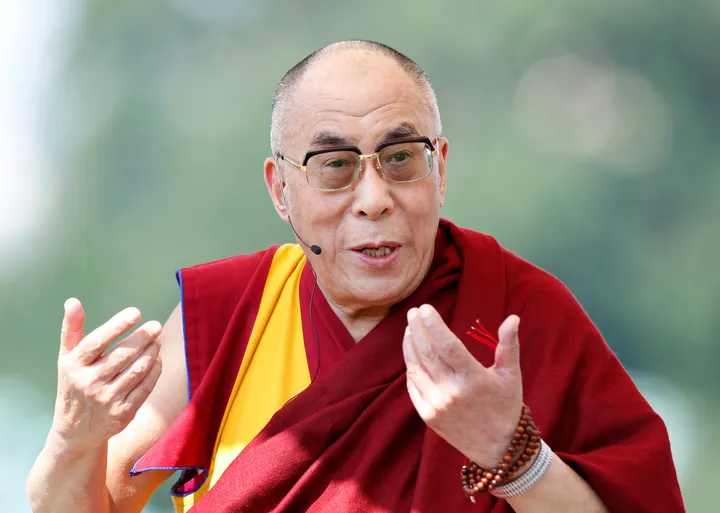
What's the Dalai Lama's secret? He's got over two million Twitter followers, people buy his books in droves, his speeches sell out stadiums. In a highly cynical age, he's held the public's attention for over two decades with some pretty elementary ideas: the essence of human nature is to be happy, human beings are happiest when they help others attain happiness, all major religions nurture the most basic ingredient of happiness, namely compassion, but you don't have to be religious to be compassionate, you just have to live up to the basic goodness of your human nature.
Like Socrates saying "I know that I know nothing", it's not just the simplicity of the message that attracts people, it's the remarkable journey of the man who is articulating it. The story of his escape from Tibet into India, his successful establishment of a government in exile, his continual advocacy for peaceful negotiations with his Chinese occupiers even while the culture and lives of his people are crushed day after day -- these things are well known, and more than enough to command admiration and attention.
But what is astounding about the Dalai Lama is how much more he is than the spiritual, symbolic and political (although he's stepping down from that role) leader of the Tibetan people. For those of us who believe religion is a source of inspiration and a bridge of cooperation, at a time when people presenting religion as a bomb of destruction are ruling the airwaves, the Dalai Lama is our single most powerful example. It is this part of his mission -- Dalai Lama as interfaith leader, which is also the subject of his most recent book, "Towards a True Kinship of Faiths: How the World's Religions Can Come Together" -- that has brought him to Chicago for a set of presentations sponsored by the Theosophical Society.
Like much of what the Dalai Lama does, the book and his presentations have been deceptively simple. He states clearly that inter-religious cooperation has to be one of the central priorities for our world, and says that it is one of his three core missions in life, along with promoting the basic human values of compassion and happiness, and finding a solution to the crisis of Tibet.
In the beginning of the book, the Dalai Lama tells stories of his personal encounters with different religious leaders and uses them to highlight the history of positive encounters between different religions. We find out about his conversation with the Trappist monk Thomas Merton, who came to visit him in Dharamsalla only a few weeks before he died. The two monks compared their robes, the times they each awoke for meditation (2:30 and 3:30 am, respectively, the Western tradition being the more severe on this particular count), the spiritual dimensions religious ritual was meant to awaken. It is the perfect personal story to lead into a brief history of the Christian presence in Tibet, which began as early as the 17th century, and included an Italian Jesuit priest who wrote a lengthy text in Tibetan that the Dalai Lama cites as an important document of early Tibetan Buddhist-Catholic interfaith dialogue.
The rest of the book includes chapters on major world religions, in which the Dalai Lama essentially explains what he admires about Christianity, Judaism, Islam, Hinduism and other faiths. He writes of the beauty of the Muslim call to prayer, the remarkable continuity of Judaism even in exile, Jesus as a symbol of service and love. There is a chapter on compassion, unsurprising as that is probably the term that His Holiness is most associated with, outside of perhaps 'Tibet' and 'Buddhism'. What is surprising is that the Dalai Lama writes about what he has learned from other religions about compassion. It reminded me of how King viewed Gandhi -- as someone from another religion who gave him a broader idea about values within his own.
Over the past decade or so, enough research has been done on religious diversity and interfaith cooperation to constitute the beginnings of a science of the field. Here's what we know from Robert Putnam and David Cambell's "American Grace": positive personal contact with people from different faiths significantly improves people's attitudes towards those religions and communities. Here's what we know from work done by Stephen Prothero and Pew and Gallup surveys: appreciative knowledge of other religions improves people's attitudes towards those communities and traditions. In other words there is a strong relationship between attitudes, behaviors, and knowledge -- a magic triangle, so to speak. And that is precisely how the Dalai Lama has shaped his book and his recent teachings. Get to know people from other religions personally, preferably by doing service work together. And get to know some things you admire about their traditions, especially those areas that have commonality with your own. A good place to start is on the shared value of compassion. In his simple and straightforward way, the Dalai Lama is telling stories that work the triangle.
To say there is a science to interfaith cooperation is not to deny that there is also an art. And it is his mastery of that art -- that infectious smile, his way of making stadiums feel like intimate environments during his teachings, the quality that makes millions of people think 'I believe him' when they hear the Dalai Lama speak -- that makes His Holiness the most important interfaith leader in the world.
I suppose one could say that he preached to the choir in Chicago. But if the choir learns the song of interfaith cooperation that the Dalai Lama is teaching, and dares to sing it out loud in the face of the haters and the extremists, and if a few of those choir members become preachers of this song themselves, then we join the Dalai Lama on his mission to make interfaith cooperation a 21st century reality, and we have a share in the secret of his success, perhaps even his happiness.
Follow Eboo Patel on Twitter: www.twitter.com/EbooPatel
Dalai Lama in Chicago this weekend to speak on interfaith cooperation
The Faith Divide: The Dalai Lama on interfaith cooperation - On ...
Dalai Lama In Chicago: Praises Illinois For Death Penalty Ban
Dalai Lama to Speak in Chicago This Weekend - Wheaton, IL Patch
(2) Appreciative knowledge of other religions improves people's attitudes towards those communities and traditions.
Let me introduce Judaism!
“Have we all not one father? Has not one God created us? (MalachI ii, 10”
“There are righteous individuals in all nations who will have a share in the world to come” (Tosefta Sanhedrin xiii,2)
“Who is mightiest of all? He who turns his enemy into a friend.” (Avoth d’R. Nathan xxiii)
Referring to someone as "his holiness" does not indicate that that person POSSESSES those qualities, nor does it PROJECT those qualities upon that person. It is simply that YOU recognize those qualities in the person. Of course you wouldn't call someone "his holiness" if you did not recognize those qualities. And, so, of course, your arguments against calling the Dalai Lama, "His Holiness" would be misplaced.
If you ever have the opportunity to meet His Holiness, you may be delighted and recognize "holy" qualities as happened in the documentary "10 Questions for the Dalai Lama" http://www.thedalailamamovie.com/.
There is also the additional benefit that by referring to someone as his/her holiness that you are creating the opportunity, encouragement, and support for them to pursue a path to cultivate, practice, and display qualities worthy of such an honor.
It is all about YOU, not belief systems or religions, or anything more.
You see, I don't want this to sound arrogant, but Christianity cannot really accept that "I'm okay, you're okay" type of teaching. We believe that you have to have Christ in your life to find acceptance from God. Now before you blast me over that comment, I'm just sharing the Christian belief. But there are certain issues we just feel cannot be compromised on in order to obtain salvation. So the problem comes that when so many people wish we would all just get along, sometimes it is more complicated than that. We as a society are all usually very passionate about our faith, and thus cannot compromise our beliefs.
The very idea that I need to be part of a particular religion/faith/denomination in order to receive salvation, regardless of how good a person I am, is probably one of the most significant reasons as to why I (and I think I speak for a significant part of my generation) has lost interest in religion entirely.
The idea that I could be the most generous, caring, loving, law-abiding person in the World, and yet not be rewarded with salvation/heaven/paradise/you-name-it because of some petty rule about having to either accept Jesus as my saviour, is pretty discouraging. And even if I did accept Jesus as my saviour, there will still be 1.5 Billion people that believe I'll go to hell because I didn't accept Allah as my only god and Mohammed as his last messenger. Meanwhile, the Jews are shaking their head because I'm not circumcised and had the audacity to work on a Sunday even though doing anything else is likely to get me fired.
Of course not everyone is as dogmatic about their beliefs as I just described, but I think you can see what I'm trying to say here.
But there is one thing I would like to point out...Some people don't like what the Bible says about the expectations God has for His people regarding Christ, or Hell, or grace. But their response is...well, I don't like that, so I'm not going to believe it. But let me ask you this; If I told you that you would burn yourself on the stove if you touched, and you answered, "That's not fair, so I don't believe you, so I'm going to touch it anyway." Who's fault would it be when you got burnt? Mine, Yours, or the Stove?
Speaking of the Dalai Lama, wouldn't it be nice if agitating muslims everywhere followed his non-violent ways? Here's what I think - were orthodox muslims & fundamentalist christians to follow the ways of the Dalai Lama, we would have no need whatsoever for "inter-faith dialogue". And we could all go home. How about Mr. Patel that you specifically call out the objectionable beliefs and practices within Islam and propose how these might be changed or abrogated. Indeed the Dalai Lama is the perfect emissary as a man of faith. But those who would match him in dialogue must first prove their own non-violent credentials rather than hope to be seen only for what their faiths might have in common with this great man.
"appreciative knowledge of other religions improves people's attitudes towards those communities and traditions. In other words there is a strong relationship between attitudes, behaviors, and knowledge -- a magic triangle, so to speak. And that is precisely how the Dalai Lama has shaped his book and his recent teachings. Get to know people from other religions personally, preferably by doing service work together. And get to know some things you admire about their traditions, especially those areas that have commonality with your own. "
However, the Pope has a much bigger, much better house.
The Pope has much more money.
The Pope has some of the best lawyers on earth, and the Dalai Lama may not even have a lawyer.
The Pope has a much more extravagant wardrobe than the Dalai Lama.
The Pope is so powerful, convinced his followers that 100,000+ child rapes by his own employees was ok.
Why doesn't the pope have as big of a following as the Dalai Lama?
The worst authority argument evah.
I find it interesting that HP is far more careful about how it references Mr. Lhamo Dondrub than it is about, say, the Pope.
Isn't favoritism wonderful...
To me holy and unholy are empty names.
I find lots of evidence that what the buddha taught is taken as perfection even when the buddha advised other wise.
humans tend almost always to take a spiritual teacher's words and make those teachings their cherished beliefs. it becomes a religion not a path and the followers no longer are sincere seekers but followers and true believers and often spend their time defending their cherished beliefs.
anger, hate, jealousy, envy and so on have one common origin: ignorance. all imperfections have one common origin; ignorance. a term the ego accepts much better than ignorance is its synonym unawareness.
find the meaning and purpose of that unawareness and a whole new world will evolve in one's consciousness. we are an evolving aspect of nature. in religious terms we as souls are gods in the making.
as our awareness evolves or unfolds we have less of what the world would call "imperfections".