One hundred years ago, the great African-American scholar W.E.B. DuBois famously wrote, "The problem of the 20th century will be the problem of the color line."
History proved DuBois correct. His century saw the struggles against, and ultimately the victory over, systems that separated and subjugated people based on race -- from colonialism in India to Jim Crow in the U.S. to apartheid in South Africa.
No American did more than Martin Luther King Jr. -- whom America pauses to honor today -- to address the problem of the color line. He spearheaded the marches that revealed the brutality of segregation, made speeches that reminded Americans that the promise of their nation applied to all citizens and expertly pressured the nation's leaders in Washington to pass landmark civil rights legislation.
But to confine King's role in history only to the color line -- as giant as that challenge is, and as dramatic as King's contribution was -- is to reduce his greatness. In one of his final books, Where Do We Go From Here: Chaos or Community, King showed that race was one part of his broader concern with human relations at large: "This is the great new problem of mankind. We have inherited ... a great 'world house' in which we have to live together -- black and white, Easterner and Westerner, Gentile and Jew, Catholic and Protestant, Muslim and Hindu ... Because we can never again live apart, we must learn somehow to live with each other in peace."
This ethos, as King's examples make clear, applies not only to the question of race, but to faith as well. In the same way as the headlines of the 20th century read of conflict between races, headlines in our times are full of violence between people of different religions. Indeed, what the color line was to the 20th century, the faith line might be to the 21st.
Faith as a bridge
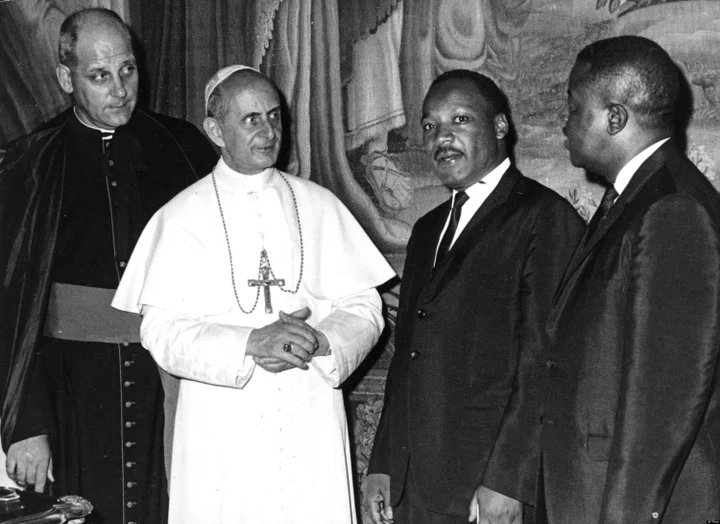
King's life has as much to say to us on the question of interfaith cooperation as it did on the matter of interracial harmony. A prince of the black church, deeply rooted in his own Baptist tradition, King viewed his faith as a bridge of cooperation rather than a barrier of division.
When, as a seminary student, King was introduced to the satyagraha ("love-force") philosophy of the Indian Hindu leader Mahatma Gandhi, King did not reject it because it came from a different religion. Instead, he sought to find resonances between Gandhi's Hinduism and his own interpretation of Christianity. Indeed, it was Gandhi's movement in India that provided King with a 20th century version of what Jesus would do. King patterned nearly all the strategy and tactics of the civil rights movement -- from boycotts to marches to readily accepting jail time -- after Gandhi's leadership in India. King called Gandhi "the first person in history to lift the love ethic of Jesus above mere interaction between individuals to a powerful and effective social force."
Following Gandhi was King's first step on a long journey of learning about the shared social justice values across the world's religions, and partnering with faith leaders of all backgrounds in the struggle for civil rights. In 1959, more than a decade after the Mahatma's death, King traveled to India to meet with people continuing the work Gandhi had started. He was surprised and inspired to meet Indians of all faith backgrounds working for equality and harmony, discovering in their own traditions the same inspiration for love and peace that King found in Christianity.
King's experience with religious diversity in India shaped the rest of his life. He readily formed a friendship with the Rabbi Abraham Joshua Heschel, finding a common bond in their love of the Hebrew prophets. The two walked arm-in-arm in the famous civil rights march from Selma to Montgomery.
Later, Heschel wrote, "Our march was worship. I felt my legs were praying."
King's friendship with the Buddhist monk Thich Nhat Hanh inspired one of his most controversial moves, the decision to publicly oppose the Vietnam War. In his letter nominating Nhat Hanh for the Nobel Peace Prize, King wrote, "He is a holy man. ... His ideas for peace, if applied, would build a monument to ecumenism, to a world brotherhood, to humanity."
In his famous sermon "A Time to Break Silence," King was unequivocal about his Christian commitment and at the same time summarized his view of the powerful commonality across all faiths: "This Hindu-Muslim-Christian-Jewish-Buddhist belief about ultimate reality" is that the force of love is "the supreme unifying principle of life."
We live at a time of religious conflict abroad and religious tension at home. This would no doubt have dismayed King, who viewed faith as an inspiration to serve and connect, not to destroy and divide. During King's time, groups ranging from white supremacists to black militants believed that the races were better apart. Today, the same is said of division along the lines of faith.
King insisted that we are always better together. Indeed, that pluralism is part of divine plan. To paraphrase one of his most enduring statements: The world is not divided between black and white or Christian and Muslim, but between those who would live together as brothers and those who would perish together as fools.
This piece originally appeared in USA Today.