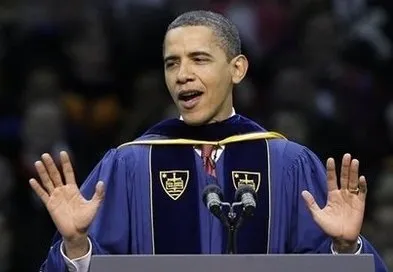
It's understandable that progressive listeners heard different things in President Obama's remarkable commencement address yesterday at Notre Dame. Martha Burk heard a disturbing mushiness and evasion on abortion rights. James Fallows heard an "eloquence of thought" that transcended the "prettiness" of more famous orators. E.J. Dionne heard Obama strengthen "moderate and liberal forces inside the [Catholic] church itself."
But as a Christian progressive, I heard Obama directly challenge religious fundamentalism of every sort by associating the fear of God with "doubt" and "humility," and offering that as a "common ground" for debates within and beyond the ranks of the faithful.
After decades of listening to conservative Christian politicians--echoed by some progressives as well--speak of their faith as an absolute assurance of absolute positions on public policies ranging from abortion to war, these lines at Notre Dame were incredibly refreshing:
[T]he ultimate irony of faith is that it necessarily admits doubt. It is the belief in things not seen. It is beyond our capacity as human beings to know with certainty what God has planned for us or what He asks of us, and those of us who believe must trust that His wisdom is greater than our own.
This doubt should not push us away from our faith. But it should humble us. It should temper our passions, and cause us to be wary of self-righteousness. It should compel us to remain open, and curious, and eager to continue the moral and spiritual debate that began for so many of you within the walls of Notre Dame.
Fundamentalism, particularly in its political application, is typically based on the redefinition of "humility" as a rejection of civility and mutual respect as an act of obedience to God, whose revelation of His will, through scripture, teaching or tradition, is so clear that only selfishness and rebellion could explain the persistence of doubt. This inversion of the "fear of God" as requiring aggressive and repressive self-righteousness has been responsible for endless scandals of faith over the centuries, quite often in conjunction with the divinization of culturally conservative causes from slavery to nationalism to patriarchy.
By insisting on the spiritual validity--indeed, necessity--of doubt, Obama is repudiating on religious grounds the very idea that appeals to Revelation should have presumptive value in political debates. As he forthrightly says, those who truly fear God have particular reason to confine their arguments to the "common ground" of reason where all believers, along with unbelievers, can speak:
[W]ithin our vast democracy, this doubt should remind us to persuade through reason, through an appeal whenever we can to universal rather than parochial principles, and most of all through an abiding example of good works, charity, kindness, and service that moves hearts and minds.
For if there is one law that we can be most certain of, it is the law that binds people of all faiths and no faith together. It is no coincidence that it exists in Christianity and Judaism; in Islam and Hinduism; in Buddhism and humanism. It is, of course, the Golden Rule - the call to treat one another as we wish to be treated. The call to love. To serve. To do what we can to make a difference in the lives of those with whom we share the same brief moment on this Earth.
It's safe to say that many progressives cringe whenever Barack Obama talks about "common ground" with anti-abortionists, theocrats, or in general, with Republicans, because they view it as an offer to compromise or even betray their rights and values. But in the religious context, what he was talking about at Notre Dame is a "common ground" that is inherently secular, empirically based, and respectful of individual rights in a way that is antithetical to the thinking of the Christian Right.
Viewed from this perspective, it's no contradiction at all that the President spoke of "common ground" on abortion even as he directly acknowleged that pro-choice and pro-life views can't be compromised:
I do not suggest that the debate surrounding abortion can or should go away. No matter how much we may want to fudge it - indeed, while we know that the views of most Americans on the subject are complex and even contradictory - the fact is that at some level, the views of the two camps are irreconcilable.
This strikes me as a pretty plain admonition to those of his own "religious advisers" who talk of achieving some sort of "compromise" on abortion rights that will make the issue--or indeed, the "cultural wars"--simply "go away."
Now it's true that Obama's pledge to respect and not vilify those who are on the other side of the barricades on abortion remains offensive to those abortion rights advocates who for good reason resent any "debate"--particularly among men--about what should be regarded as fundamental reproductive rights. And such "debate" really is phony (as has been brilliantly explained by Linda Hirshman) if it is conducted on the "common ground" that abortion is evil, and that women who seek them are either perpetrators or victims of a tragedy if not a crime.
But I don't hear Obama saying that, and moreover, abortion rights in this country will never be safe if they depend on the presumption that discussion of the subject is a priori illegitimate.
In the end, as Obama himself suggests, what unites secular liberalism with non-fundamentalist religious beliefs is the conviction that we live in a world governed by universal laws that cannot be reliably deduced in many particulars. That is why mutual respect, including respect for individual rights, and a commitment to pluralism and rational discourse, are so critical to both traditions, and why many of us subscribe to both. If religious fundamentalists or cultural conservatives generally choose to reject that "common ground," as many will, then they are willfully abandoning any path to the achievement of their own objectives that does not depend on raw power and repression. And large majorities of Americans -- including many God-fearing Americans -- will reject them in turn.