
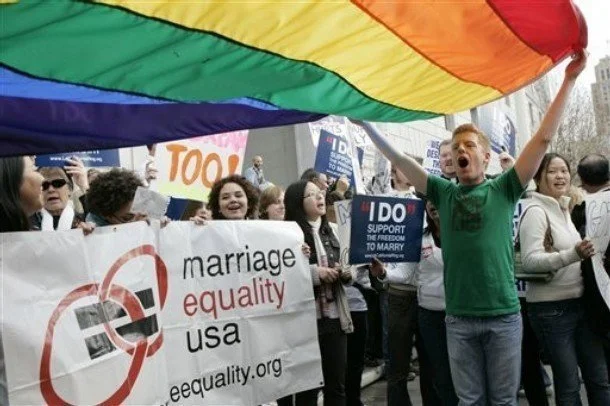
It has been an unprecedented week for the rights of lesbians, gay men, and bisexuals. Last Friday, the Iowa Supreme Court found that denying same-sex couples the opportunity to marry violated that state's constitution. Four days later, the Vermont legislature overrode the governor's veto of a law giving same-sex couples the right to marry. Vermont and Iowa now join Massachusetts and Connecticut in providing full marriage equality to same-sex couples. Also, the City Council in the District of Columbia just voted to recognize valid same-sex marriages from other jurisdictions even though same-sex couples cannot get married in D.C. Who would have thought that in the aftermath of Prop. 8 in California, one of the most liberal states in the union, so much would happen so quickly for gay marriage?
Iowa in context
What makes the Iowa decision remarkable is that the decision was unanimous (7-0) and that the decision comes in the middle of the country. Before Iowa, the eleven states that recognized same-sex relationship were coastal (or very close to the coast). Besides Massachusetts and Connecticut, Vermont, New Jersey and New Hampshire had civil unions, California and Oregon had robust domestic partnerships (which are basically the same thing as civil unions; California allowed same-sex marriages for several months in 2008), and Washington, Maryland, Hawaii, and Maine had limited domestic partnerships (which provide some small subset of the rights associated with marriage to registered same-sex couples). Iowa shows that the recognition of same-sex relationships -- and, more significantly, full marriage equality -- is possible even in the "heartland" of the United States.
While the Iowa decision did not break new ground, like the highest courts of Massachusetts, California, and Connecticut, the Iowa court found that denying same-sex couples the right to marry violated the principle of equality enshrined in the state constitution.
Sexual orientation gets heightened scrutiny
As did the Supreme Courts of California and Connecticut in the process of reaching their conclusion, the Iowa court held that laws that make use of sexual-orientation classifications warrant heightened judicial scrutiny. This means other laws in Iowa that make use of sexual-orientation classifications will be treated like laws that make use of sex classifications. When courts demand a very strong justification for laws that involve sexual-orientation classifications, they almost always find inadequate the proposed justification for laws that treat people differently in virtues of their sexual orientations.
Anti-gay marriage arguments about gay parents and procreation rejected
Further, with great clarity, the Iowa court rejected the two leading arguments made by opponents of same-sex marriage: (1) gay people are less good parents than heterosexuals and (2) prohibiting same-sex couples from marrying strengthens the incentives for different-sex couples to marry, thereby creating greater stability for the children of different-sex couples. These two arguments have been embraced by courts in New York, Maryland, Washington, Indiana, and Arizona, but the Iowa court, like California and Connecticut courts, firmly rejected such arguments against same-sex marriage.
Vermont in context
In Vermont, the path to marriage for same-sex couples was quite different than in Iowa. Vermont was a path-breaker with respect to the relationship recognition for same-sex couples. In 1999, the Vermont Supreme Court held that the state's constitution required that same-sex couples be able to obtain all the benefits that different-sex couples could obtain by marrying. After struggling with the options, the Vermont legislature created a new type of relationship for same-sex couples called civil union that is identical to marriage in terms of its effects under state law. Although Vermont preserved marriage for different-sex couples, with the passage of its civil union law, Vermont became the first state in the country to provide equal recognition to same-sex relationships.
Some LGB rights advocates criticized this law as creating a second-class status for same-sex couples. Others had a more pragmatic reaction, suggesting that some recognition is better than none at all. And others said civil unions might help clear a path to marriage. In ten years, it seems, Vermonters have come to realize hell has not frozen over and different-sex relationships have not been undermined simply because same-sex relationships are recognized.
Vermont is the first state where same-sex couples can marry as the result of a legislative process rather than as the result of a court order. Other states have enacted civil union or domestic partnership laws without being required to do so by courts (for example, Connecticut and New Hampshire passed civil unions laws without a court saying that the state's constitution demanded it). And California's state legislature twice passed a law that would have legalized same-sex marriage, but the state's governor twice vetoed it. So once again, Vermont is a trailblazer for civil rights.
Looking forward
Vermont, Iowa, and D.C. show that we have reason to be optimistic even after the voters of California took away full marriage equality only a few months after it was awarded. Although I suspect the California Supreme Court will uphold the constitutionality of Prop. 8 (while not invalidating the gay marriages legally performed during that brief period), in the coming months, the legislatures of Hawaii, Rhode Island, New York and New Hampshire may well enact same-sex marriage laws.
Regardless, there will continue to be a patchwork of recognition and non-recognition of same-sex relationships across the land. Further, no matter where in the U.S. you live, if you are in a same-sex relationship, because of DOMA, you won't get any of the federal benefits of marriage. And, even if DOMA is repealed, there will still be patchwork, because so many states have constitutional amendments that refuse recognition to same-sex marriages or other forms of legally-recognized same-sex relationships.
It has been an exciting week for same-sex marriage. I expect some more good news in the next several months, but I also expect some setbacks. For now, advocates of legal recognition for same-sex relationships should adopt a nuanced state-by-state strategy, pushing for full marriage equality in some states, civil unions in others, and limited recognition in the rest.