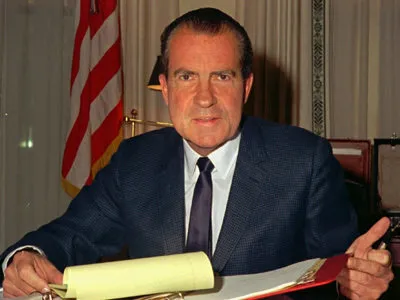
It's not surprising that the movie Frost/Nixon is receiving rave reviews. Like the eponymous smash play it's based on, it tells a dramatic story of a clash of two interesting figures (one of them absolutely riveting), with two richly talented actors, Frank Langella as Richard Nixon and Michael Sheen as David Frost. The film is even more powerful than the play because of the effects of motion-picture techniques - size, penetrating close-ups, film clips, variegated scenery, and simply more action. But mainly size: everyone and everything is bigger - even eyeballs. Moreover, the movie is set against the backdrop of one of the most dramatic, frightening, and significant episodes in American history -- "Watergate" is inadequate shorthand for the constitutional crisis this country went through (often misinterpreted as simply a series of crimes on the part of the president and his top aides), ending in Nixon's being the first (and as yet only) president to be forced to leave office.
But it's because of the enormously historical importance of that period that the film raises serious questions of its legitimacy. The film's plot is a contrivance; its telling is so riddled with departures from what actually happened as to be fundamentally dishonest; and its climactic moment is purely and simply a lie. Literary license in the name of drama or entertainment is one thing; the issue comes down to what one is taking license with, and the degree of license being taken.
The play/film is at least based on something that actually happened: three years after Nixon left office in 1974, the British talk-show host/entertainer Frost, his career on the skids, wangles the first set of television interviews with the disgraced former president, brooding and plotting in San Clemente, California over how to restore his own reputation and, by the by, to pay his substantial legal bills. (Typically, Nixon's effort to redeem himself in the public eye was a plotted project with a title, "The Wizard" -- a telling fact that the script omits.) The highly successful screenwriter Peter Morgan, using his familiar trope, turns the interviews into a mythic battle, David-and-Goliath style (note the order of the names in the title), pitting a callow Frost against the master conniver and debater Nixon, and, after hours and hours of frustrating questioning, "nails" him. Thus, Nixon is at last brought to justice, forced to admit his knavery to the American people, and truth wins out. The problem is, this isn't what happened.
First of all, the whole arrangement between Frost and Nixon was dubious from the outset. While the script is straightforward about the fact that under their agreement Nixon was to be paid for the interviews (a then-whopping $600,000), a highly unusual arrangement, it omits the even more questionable part of the deal in which Nixon was guaranteed twenty percent of the profits from the sales of the interviews to television stations. Thus, the two purported gladiators were in business together, with a mutual interest in making the interviews interesting enough to make a nice profit. The deal also guaranteed that only one-fourth of the time would be devoted to Watergate, leaving Nixon the rest to ramble on about his foreign policy achievements - which in his mind included the invasion of Cambodia. To further disguise the degree to which the interview project was essentially a fix, the script of both the play and the movie simply leaves out the episode in which, after Nixon returned to his dressing room during a sudden break in the taping of the Watergate segment - the break misrepresented in the script as having been called for by Nixon aides worried their boss was becoming uncomfortable, whereas it was actually called for by Frost because he misread a cue card held up by the Nixon aides saying "Let him talk" - Nixon aide Jack Brennan (Kevin Bacon) told Frost's frustrated aides, "He knows he has to go further. He's got more to volunteer." These lines appear in neither the play nor the movie.
Second, Frost did not in fact "nail" Nixon. The climactic moment of the movie (as in the play) has Nixon confessing to having participated in the cover-up of the famous break-in of the Watergate offices of the Democratic National Committee, in June, 1972 by operatives hired by White House aides. But this "confession" is produced through a blatant distortion of what Nixon actually said in the interviews. At that particular moment, Frost was pressing Nixon to admit that he had more than made "mistakes," that there had in fact been wrongdoing, that crime might have been involved (a rather mild way of putting it). Then, through a sleight of hand, the script simply changes what Nixon actually said: the script of the play has Nixon admitting that he "...was involved in a 'cover-up,' as you call it." The ellipsis is of course unknown to the audience, and is crucial: What Nixon actually said was, "You're wanting to me to say that I participated in an illegal cover-up. No!"
As he gives the faux confession in the movie, Langella's remarkably Nixon-like face (shown on a television screen in the play) is ravaged, distorted in agony, contorted in anger. On the disk of the actual interview, Nixon glowers and looks perturbed, but the scene lacks the drama of both the film and the play. Nixon, as promised, did give Frost some interesting material "I let down my country;" "I gave them a sword;" his mistakes "were mistakes of the heart rather than of the head," all very unusual things for an ex-President to say, but far short of an admission of attempts, carried out during Nixon's presidency, to undermine the inner workings of the opposition party, of his broad-scale and alarming assaults on the constitution. The Watergate break-in was small beans compared to, say, the break-in of the office of Dr. Lewis Fielding, the psychiatrist of Daniel Ellsberg, who had leaked the Pentagon Papers - Nixon was far more worried about the discovery of this break-in. In the movie, even the semi-admissions come across as dramatic; on the disks of the actual interviews, they seem bathetic.
There are other distortions in the movie. One of them makes a very big thing of the "discovery" by James Reston, Frost's chief researcher, of a taped conversation between Nixon and his political henchman Charles Colson, supposedly the first one about the cover-up. (Reston, is depicted as the moral conscience of the story, the one who is determined to hold Nixon to account, but he is made less of a noodge in the movie than in the play, where he became an irritating presence.) Much is made of the fact that this bit of conversation was theretofore unknown. But after I saw the play I checked with one of the Watergate prosecutors, who told me that that particular piece of tape was unknown because "we were awash in far more incriminating evidence" against Nixon, and the prosecutors didn't consider it worth using. (The play was based on an unpublished manuscript that Reston wrote about his role in the interviews; the book, The Conviction of Richard Nixon, was published after the play was a hit.)
Finally, though the main characters are acted well as they were written to be, they were not written to be what they were actually like. Langella, wreaks the magic of not just imitating Nixon but becoming him before our eyes, but this is not the true Nixon. The one we meet in the movie is too mellow, too jokey. There are only flashes of the bitterness that consumed and ultimately destroyed him. The main display of that bitterness comes in an invented scene in which Nixon phones Frost in his hotel room, and pours out his bitterness. No excessive liberty was taken in the invention of the scene as a device to display this critical aspect of Nixon's persona, but it goes further than that by also distorting the plot. In the imagined conversation, Nixon heightens the supposed collision between them ("I shall come at you with everything I got") and that only one of them can win. (But that wasn't the deal.) And this supposed conversation supposedly inspires Frost to try harder, which supposedly leads to Frost nailing Nixon, which never happened. Langella deftly shows that Nixon was a strange man, awkward with small talk, uneasy with people, but Langella's Nixon becomes an almost sympathetic figure, and also a jokey one, the one we most want to see, in order to have more laughs. But Nixon wasn't funny. And he certainly wasn't the likeable figure of Frost/Nixon. (Yes, of course, some people liked him, but not very many, and not even his dog.) He was a tragic Shakespearean figure, often out of control (and drunk), and, it seemed, more than a little mad (his aides never knew which orders were even intended, not least should be carried out), brought down by his flaws: he would have made for excellent drama, if not as much entertainment. Because Langella's figure is outsized, Sheen's remarkable talent is outshone. But Frost himself wasn't and isn't the dolt portrayed in the play/movie. Sheen has Frost's intonation down cold, and Frost certainly liked his booze and his women and his parties (he's settled down now, married to the daughter of a major Duke, and has three sons, on whom he dotes), but he's more intelligent and more serious-minded than the way he's portrayed.
Peter Morgan specializes in stories that pit two figures against each other -- David and Goliath-like -- with the good guy prevailing. The Queen, in which Sheen played Tony Blair convincing a frosty Queen Elizabeth to show her grieving subjects more empathy over the death of Princess Diana; The Last King of Scotland, in which a young Scottish doctor realizes the brutality of Idi Amin, and leaves him, the monstrous Amin desolated. So, in this story, Frost must win out over Nixon, even if it never happened. The interviews ended in a draw. Morgan himself told John Lahr of the New Yorker after the play came out, "I could just as easily written the piece -- and found substance to support it -- to substantiate it, that Frost didn't get Nixon, that Nixon threw it in, for these interviews to sell."
It doesn't matter whether the Queen actually cried and thought of Diana when she saw a beautiful stag about to be killed by hunters. We don't really know how mature, or even sane, Hamlet was. To try to ascertain to what degree the liberties taken in Frost/Nixon are in accord with dramatic tradition, and acceptable, I recently raised the subject of dramatic license with Michael Kahn, the esteemed Artistic Director of the Shakespeare Theater, in Washington. Kahn told me that "while Shakespeare took a lot of liberties to produce great drama, he based most of his stuff on historical sources; he didn't distort [ital] history." Kahn added, "There were court documents to work from, there were a lot of letters from Queen Elizabeth I; as far as I know what he never did was take any documentary dialog and change it into something else." (Kahn expressed shock when I told him about the distorted key line in Frost/Nixon.) There's also the matter of timing. Nixon remains a relatively recent figure, around whom there still swirls a lot of controversy. Shakespeare, Kahn said, never wrote about contemporary politics. If he wanted to write about Jacobean times he put it in the period of Pericles and Athens; the most recent figure he wrote about was Henry VIII, "and by the time he wrote it those figures were long dead."
It doesn't matter that Frost/Nixon moves some scenes around (though it's not always clear why), and engages in some invention. But such a gross misrepresentation of such important events -- roughly seventy percent of the population is too young to have been aware of Watergate -- about a figure over whom there is still serious debate, in the name of entertainment and profits, to my mind, crosses the line of dramatic integrity and is dishonorable.
Want to reply to a comment? Hint: Click "Reply" at the bottom of the comment; after being approved your comment will appear directly underneath the comment you replied to
But this film is not claiming to be an accurate representation of history. Anyone can go onto youtube and view the actual debate for themselves. Film's are primarily about entertainment, rather than education. I would agree with the article if Frost/Nixon was claiming 'this is what happened' but its not- it's simply dramatising the past for entertainment purposes.
There is a rapidly growing culture of preference for revisionist unreality in this country. It is a disease I have noticed becoming more prevalent and more accepted. People are not content with real life happenings and circumstances, more and more people need to shape the world in the way they want to see it instead of how it simply is. It blew my mind the other day when I was listening to KGO in San Francisco. The hosts, in their late 30's, were comparing this film with the actual Frost/Nixon interview. They concluded that we, the listeners, should watch the film first and then watch the actual interview. They were criticizing the actual interview as if it were a more boring film. They were in essence, denying reality and insisting on looking at post watergate Nixon from this contemporary Hollywood portrayal. It was absolutely stupefying. If this country continues on this course of reality denial and fantasy make believe, its frightening to think of the tragedies that could come to such a society. Its like a beaten wife that continually denies the beatings and then finally gets beaten into submission. We must as a society live in this life as it is and deal with simply what is. We need to revalidate reality for it is slipping into an ambiguity that could really lead us into an age of non-reason.
to wit:
ah yes, the disease of revisionism. definitely one to watch out for.
i myself am afflicted with sarcasm. it's tough to shake.
sorry to hear of your anger toward 'frost/nixon' and two deejays at kgo. here's hoping you don't find any more instances of people 'denying reality' in san francisco.
Sorry, but revisionism isn't new. It is the same old story of everybody putting the spin on "what happened" as he or she wishes it were. This is why, as Heny Ford said, "History is bunk," In my lifetime I have seen history about the European presence in America being described as the conquest of a vast, unpeopled land inhabited by some stone age savages morph to the conquest by Eurpoean disease and treachery of an American continent peopled with 800 to 900 million highly civilized Indians whose morals, mathematics, architecture, literature, art, medicine, and civil planning were far superior to anything Europe or Asia had ever seen. I have learned that our democratic principles were in fact already in use by Indians who instructed Benjamin Franklin in the elements of good government. In the first version the Europeans were the powerful, strong conquerors bringing civilization to bloodthirsty savages who like to rip beating hearts out of sacrifices to satisfy the sun (see Mel Gibson's movie "Apocalypto"); in the latter version the Indians are tall, uniformly healthy, morally straight, incorruptible, stylishly clothed and groomed and generally beautiful people while the Europeans are short, hairy, filtly, flea-ridden, ignorant, and misshapen. (Think Igor in the Film "Frankenstein.")
I doubt that either version is true. The only thing important is whose version is ascendant at any particular time. My conclusion, its all revisionism.-
I grew up in the South and learned 'revisionist' history all the time, particularly when it came to Virginia history - happy slaves, noble causes, savage Indians, rabble-rousing civil-rights advocates. I had to learn for myself what was really true. The mythification of history occurs in every culture. You have to be smart enough to look beyond what you read and see to discern the truth.
no matter, Bush makes Nixon look like a saint.
maybe someday will have an opportunity to have Bush
exposed for what he really is.
obviously you weren't around when Nixon was President or else you wouldn't be talking such nonsense.
HuffPost's Pick
Thank you! I know Bush is bad, but the times we lived in when Nixon ruled were just a convoluted mess.
We had lived through the upheaval of the Sixties... the murders of John Kennedy, Medger Evers, Bobby Kennedy, and Martin Luther King, Jr., the Kent State shootings, riots on college campuses and coming home EVERY DAY to watch the reporters announce that THOUSANDS had been killed in Viet Nam.
It seemed as if the bowels of hell were being poured out on us.
There was no joy in seeing Nixon fall, not even for those who did not vote for him. It was just more crap to deal with by the American people. When the people of the United States were finally allowed to know the depth of what went on in the NIxon White House we were so tired of all the madness and death of people and principles that we were more than betrayed. We were MAD AS HELL.
There was a little "lady" called Martha Mitchell . She was married to one of the lowest of the low in the Nixon White House... When she started telling us all what she knew it was something to hear, believe me!
People have to keep in mind that this film is NOT history, it is FICTION and was primarily created to entertain and MAKE MONEY.
TO MAKE MONEY ... TO MAKE MONEY ... TO MAKE MONEY ... and to the weak and uninformed mind, this is history.
I also thought the animal was meant to be the symbol of a bygone era, a time of old-school privacy, decency, honor, tradition, aristocracy, self-restraint (maybe self-repression), vs. the modern time media frenzy, celebrity culture, instant gratification. The Queen's mourning of the stag's killing is her recognition and mourning of the end of that era, the end of some values and beliefs that she held dear in life.
It is a bit curious that the author of this blog thought the Queen was crying for Dianna, although everyone is free to think of what they want of a film for sure. But maybe that also explains why she seems to be critiquing the docudrama as if it was a documentary - which is to say, she missed the whole point of the endeavor? One acquaintance of mine also made a missing-the-point comment on the stag killing scene, but then, he never finished 4-year college and doesn't make a living by writing.
(Typically, Nixon's effort to redeem himself in the public eye was a plotted project with a title, "The Wizard" -- a telling fact that the script omits.)
Ms Drew - if you are trying to defend Mr. Nixon then why use this information as a positive? - we all know that the Wizard was a complete fabrication and we are warned not to seek the truth behind the curtain - certainly we shouldn't pay any attention to the funny little man behind the curtain.
Plain and true is the fact that Richard Nixon plotted murder and treason and this is just a movie - outside of the lower 49 most people understand that doesn't mean gospel truth - none of that changes the fact that Richard Nixon was a bad man. Of course these are just my ill informed observations 30 years after the event.
What amazes me is how many Nixonites are still in power today.
That any of them had any future in politics will always remain a great shame to America's politics.
The reason they are in power is precisely BECAUSE they are Nixonites. They learned at the feet of the Master.
It's actually because they feed the conservative's addiction to hatred. Nixonites are masters of directing the rage of the enfranchized.
No matter how much negativity is said about Nixon, true or not, it is not enough in my opinion. I loathed him.
In deconstructing this film, your first quibble is the title: Frost/Nixon. It's my recollection (and, yes, I'm old enough to remember them too, so my memory might not be perfectly clear) that the "Frost-Nixon Interviews" are what they were called at the time. So how can you criticize Ron Howard for keeping the title historically accurate but ding him for taking liberties elsewhere? Don't like that slash between their names? What pettiness.
That's your snowball? You toss a snowball over a slash versus a dash, while she points out substantive falsehoods?
Keep your day job.
Historical drama is drama, not documentary, even when it draws on documentary sources, nor does it intend to be so. It is an attempt to use the past to either justify or challenge the present. It is, as Christopher Murray says about Irish historical drama, always about power, identity, and the national consciousness--which fits Frost/Nixon perfectly.
As for Shakespeare, his drama, in fact, is a good example of what Murray says. Most primary historical evidence indicates that Richard III was largely a good king and was certainly not responsible for the deaths of the princes in the Tower. But that would not have been politic to say during the Tudor regime; besides, Shakespeare had no reason to know it. He didn't have access to primary sources, and the sources he did use are clearly Tudor propaganda (yes, folks; historians are not necessarily objective). As for dialogue, Shakespeare never changed dialogue because he had no access to any to change; the historical sources he drew on were not primary sources, and, where they included dialogue, it was made up by the historian.
Ms. Drew's points are well taken; after seeing a film based on fact, we should learn something as well as be entertained; to find out that the filmmakers have messed with the facts makes everything we think we've learned questionable. However, Michael Kahn's assertion that Shakespeare did not distort the facts is ridiculous; his portrayals of Richard III and MacBeth are much worse than their historical counterparts, and Henry V and Henry VIII are handled with kid gloves. One supposes his reasoning for these liberties lie not so much in the need for artistic license, but to suck up to Elizabeth I.
IT'S A DOCU-DRAMA! ...NOT a documentary, and should be taken as such. Anyone who wants the unvarnished history can watch Frost/Nixon: The Original Watergate Interviews (1977) on DVD. Geez, I know some film goers thought Oliver Stone's JFK was historical, but these are the same kind of people who vote based on TV commercials.
Thanks for a wonderful review of this film. I really have little patience with films that portray historical events without telling the audience that the film is just a made-up story about an historical event. I'm afraid that way too many Americans think that actual history is told in films like this so they don't need to look up the actual facts. In a way, historical fiction tries to capture the emotional reality but in the end it does a greater disservice to factual reality by portraying historical events as if the portrayal happend that way. Let the viewer beware, Hollywood films do not tell historical truths, they tell the fantasy of history as the committee that makes the film sees it. And since the bottom line of the committee that makes a film is to generate a profit for the film corporation, history must necessarily take a back seat to the driving presence of dramatic conflict and resolution.
"I really have little patience with films that portray historical events without telling the audience that the film is just a made-up story about an historical event." If you can't figure that out without being told, you are seriously reality-challenged. On second thought, many people hearing The War of the Worlds thought Earth was being invaded. If people could believe some of the worst anti-Obama ads during the campaign, I guess there are a lot of people who are reality-challenged.
This is ridiculous. Were this a historical record, a scholarly work written to preserve
history, the author's comments would be valid. For a film, they are baseless and
without merit. This is a replay of the remarks made about Oliver Stone's JFK.
Movies are stories to entertain. That's why people pay to see them. If someone
in the audience thinks they're going to supplement or replace post graduate history
classes, they are mistaken.
Or does the author go to Madonna concerts in search of spirtual guidance?
A fictional biography makes no guarantee to constrain its liberty taking to the
author's, or the audience's, 'appropriate' boundaries.
This film is not being labeled a fictional bigraphy.
When something is "based on actual events" there are some liberties to be taken and others are to be left alone. It's called discretion. She asserts it went over the line in having Nixon "confess" - I agree.
I'm left thinking Ron Howard will never throw Opie or Ritchie under the bus; small consolation when he's dealing with such pertinent subject matter.
BASED ON actual events. Not GUARANTEED TO SHOW EVERY EVENT AS IT HAPPENED.
Those are different. I've been making moves for 30 years and have heard this endlessly. Everyone expects to see a movie that is as faithful to the subject matter as they, the audience member, deems 'required'.
The pertinentce of the subject matter, it's import, requirements for fidelity in retelling, are all left to the individual. That's the individual director and audience member. Rarely is there agreement in all cases.
I'm surprized more people don't know that Nixon was the protegé of Prescott Bush, grandfather of George W.
How does that make a difference?
just shows how deep and hidden the treason is
You must be logged in to comment. Log in or connect with