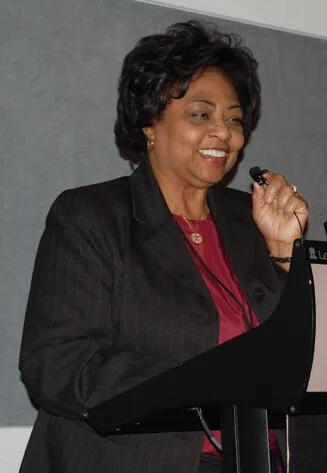
Shirley Sherrod's journey to self-awareness and an understanding of the hardships faced by both poor blacks and poor whites started in Baker County, a beautiful but dangerous place in rural southwest Georgia. In 1965, her father was murdered by a white man, who was never even indicted. Rather than becoming embittered, she resolved to work for change.
That any black person could emerge from Baker County at that time with a spirit of charity and good will toward whites is remarkable. I know because I found myself in Baker County in the summer of 1963, as a young law student working for a black civil rights lawyer, helping out in another case of racial shooting. To put Shirley Sherrod's life story -- including current events -- in context, it is crucial to understand clearly what life was like there, and what an extraordinary effort of spirit was needed to emerge as Ms. Sherrod did.
Baker County had a notorious history. In 1943, the local sheriff, Claude Screws tied a black man, Bobbie Hall, to the back of his car and dragged him through the courthouse square after beating him mercilessly. The US government prosecuted and a federal jury convicted Screws, but the Supreme Court overturned the conviction.
Screws' deputy, L. Warren Johnson, carried the tradition forward when he became sheriff. In 1961, Johnson, a huge, hulking, 300-pound man, came to the home of Charlie Ware, a small, slight black man, and arrested and handcuffed him for reasons that were unclear then, as now. Forcing Ware into his car, Johnson picked up the radio microphone and announced that Ware was coming at him with a knife and that he was going to shoot him. The sheriff thereupon shot the small, handcuffed man three times in the neck, but Ware miraculously survived. Although the sheriff should have been prosecuted, it was Ware who was charged with attempted murder, a charge that carried the death penalty.
The attorney for whom I was working was Ware's defense counsel. The case was so serious that a more senior attorney came from Atlanta to assist. The three of us drove every day for a week to the Baker County courthouse, the very same courthouse that Sheriff Screws dragged Bobby Hall around. The civil rights attorneys thought they would be shot for going into Baker County to defend Ware and sought help and protection from federal authorities. But in those days, which preceded the Mississippi murder of civil rights workers Schwerner, Goodman and Chaney, no federal help was forthcoming.
As we drove to Baker County, the beautiful lush green countryside took my breath away. The two lawyers gasped at something else -- mistakenly, as it turned out -- when the sunlight, reflecting off the dark glossy leaves, approximated sunlight glinting off the barrel of a gun. I traveled in the back seat -- in those days, a white woman could not safely sit next to a black man in a car -- and was let out at the edge of the tiny town to walk to the courthouse. Gripping my briefcase hard, I tried to look nonchalant. Every black person had to get off the sidewalk as I approached. In Baker County, black people couldn't even be on the same sidewalk as a white person. It was stifling, and there was menace in the air.
The courthouse itself was right out of To Kill a Mockingbird. Huge fans turned slowly overhead hanging from the high ceilings. There was a tiny balcony for black observers and witnesses. White farmers in overalls peered in through the open windows, chewing on stalks of grass. And on a platform, the judge in his black robes spat into a brass spittoon. There were no blacks on the jury that heard the charges against Charlie Ware, of course, and that was the ground on which Ware's inevitable conviction was ultimately overturned on appeal.
I didn't know Ms. Sherrod then, but I did know her husband Charles Sherrod, who was the leader of the Student Non-Violent Coordinating Committee in southwest Georgia that brought both blacks and whites there to work for civil rights. He was a courageous man and one of this country's heroes. It is now clear that his wife is one of its heroines.
It was cowardly and wrong for the U.S. government to force Ms. Sherrod to resign without hearing her side, without understanding the whole story, without showing the slightest interest in fairness or due process. Here was Baker County rearing its ugly history all over again, 70 years later. It was bad enough for high government officials show such weakness in the face of racist right wing charges against an innocent black woman. It was particularly unconscionable given what Ms. Sherrod lived through in her childhood. That this happened in the administration of the first black president is incomprehensible. Did we come this far for nothing?
The bad news is that the forces of racism and those who cower before it are alive and well. The good news is that both the Spooners, the poor white farmers that Ms. Sherrod helped, and Ms. Sherrod were able to reject that racism to find what connected them. The best news would be if the country would decisively cast off the legacy of Sheriff Screws, Sheriff Johnson, and all the racist evil they represent.